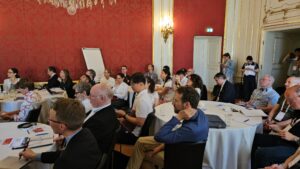
Ten workshops were organised around the 15th IEA Heat Pump Conference, most of them by the project managers of the international collaboration projects within the HPT TCP. This section summarises the workshops for which reports were submitted, covering circularity, multi-family buildings, positive energy districts, residential system design, the industrial deployment of high-temperature heat pumps, comfort cooling, and how to break barriers to accelerate heat pump deployment.
Circularity in Heat Pumps: Challenges, Chances, Change
Organiser: IEA HPT Project 65, report contributed by Virginia Natonek, Danish Technological Institute
This workshop explored how circular economy principles can be applied to heat pumps and their components. Participants assessed the technical and economic viability of different circular strategies for compressors, heat exchangers, pipes, fans, casings and insulation, inverters and power electronics, and for heat pumps as complete units. The full set of circular R-strategies was used as a framework, from Refuse and Rethink through to Recycle and Recover. In practice, the discussion focused on Reduce through Recycle, as these were seen as most relevant for heat pumps.
Across most components, reducing material use and recycling were viewed as the most promising strategies. Recycling was considered particularly economically viable for pipes, while repair and refurbishment showed strong potential for fans, heat exchangers and complete systems. Repurposing was generally judged the least feasible strategy. Significant differences between components emerged. Compressors were considered difficult to reuse and refurbish because of their hermetic design, precision manufacturing and testing requirements. Heat exchangers showed greater potential for repair, refurbishment and recycling, although the main barriers were identified as economic rather than technical. Power electronics presented a less clear-cut case, with opportunities for repair and remanufacturing but varied assessments because of technical uncertainty and concerns about economic viability. Casings and insulation were seen as particularly suitable for reduction, reuse and recycling, although wider reuse would require changes to product design and manufacturing. Fans stood out for repair and refurbishment potential.
The workshop highlighted heat pump refurbishment as a largely unexplored area. Open questions included the cost of refurbishing a unit, which components most often determine its end of life, the reliability of second-hand equipment, and whether manufacturers could develop viable refurbishment business models. Electronics may increasingly become the limiting factor for heat pump lifetime. Participants stressed the need for reverse logistics, transparent information on materials and substances, and design approaches that support dismantling and high-quality recycling. Digital product passports, producer responsibility, take-back systems and clearer allocation of collection and recycling costs were identified as possible enablers.
The main takeaway was that technology is often not the primary barrier to circularity in heat pumps. Progress will depend on viable business cases, economies of scale, supportive regulation and the integration of circular economy requirements from the earliest design stages.
More information about the slides shown at the workshop is available here.
From Theory to Practice: Heat Pump Solutions for Multi-Family Buildings
Organiser: IEA HPT Project 62, report contributed by Dr.-Ing. Marek Miara, Heat Pumps Watch
Nearly half of all Europeans live in multi-family buildings, yet heat pump adoption in new multi-family construction remains below 20 percent across most markets. This workshop set out to bridge that gap, drawing on the results of IEA HPT Project 62 and an interactive group exercise called The Solution Game.
Projects 50 and 62 established a classification framework of five solution families, running from fully centralised to room-based systems, and 13 system configurations. Project 62 tested this against nearly 80 real-world case studies from 14 countries. The statistics are telling: 76 percent of documented projects use centralised solutions, 50 percent are hybrid systems, 74 percent serve buildings with 21 or more apartments, and 73 percent are in well-insulated stock. The harder-to-retrofit existing building segment remains clearly underrepresented.
Nearly 60 participants were divided into five stakeholder groups: building owner or investor, tenant or resident, technical planner, installer or contractor, and policy or funding body. All groups worked on the same reference building, a 1968 urban apartment block with 32 units, end-of-life oil heating, condominium ownership, limited outdoor space, and a restricted noise zone. In the first step, each group selected three priority parameters from the seven defined in Project 62, covering building size suitability, insulation level, system complexity, fossil dependence, space requirements, heat source flexibility and investment cost, choosing from within their own stakeholder role. Investors focused on cost sensitivity, the policy group prioritised fossil energy dependence, and residents prioritised space requirements. In the second step, groups used their chosen parameters to recommend one of the five solution families. The centralised and combined central-decentral families came out on top, consistent with the actual distribution in the Project 62 database.
Three real case studies were revealed at the end. In Geneva, a 53-apartment building was retrofitted with a centralised water-to-water heat pump, made possible by access to Lake Leman as a heat source. In Innsbruck, a central rooftop heat pump feeding apartment-level 3 kW mini-units allowed installation to be phased across two separate ownership associations. In Flers, France, 112 individual exhaust-air heat pumps, one per flat, removed the need for outdoor units entirely.
The workshop made clear that choosing the right heat pump solution for a multi-family building is not a purely technical question. Stakeholder perspectives shape what is feasible, acceptable and prioritised, and they need to be considered in planning processes and in the broader development of technologies and deployment pathways.
Heat Pumps in Positive Energy Districts
Organiser: IEA HPT Project 61, report contributed by Carsten Wemhöner, OST – Eastern Switzerland University of Applied Sciences
The Project 61 workshop was divided into two parts. The first introduced the framework of Positive Energy Districts and presented two districts moving towards that status, meaning districts with high energy performance supplied by heat pumps but not entirely reaching a positive energy balance on the building footprint. In both the Austrian and Swiss districts, the optimisation potential identified was linked to heat pump integration. Both have centrally integrated heat pumps, which create greater system losses than more decentralised integration and also produce a higher temperature lift because of distribution losses. In the Austrian project, a performance increase of 1 to 1.5 points in seasonal performance factor was evaluated. In the Swiss project, the higher grid temperatures are driven by domestic hot water operation; temporary charging windows for decentralised hot water storage, with temperature reduction in the grid in between, led to an increase in seasonal performance factor of almost a factor of two. The first part concluded with a presentation on funding opportunities.
Discussion centred on the definition and implementation of positive energy districts in different countries and on heat pump integration. Participants debated whether the concept is too ambitious and whether a reduced ambition level would be more useful. The prevailing view was that even if a positive energy district is more a vision than a reality, it remains valuable as a planning guideline, since it forces designers towards maximum efficiency and on-site production even where the balance is not fully met. High, medium, and low temperature grids were all discussed as integration options.
The second part addressed heat pump integration options in districts and specific technology options. These included an asphalt collector as a heat source for a low-temperature grid, which also reduces the heat island effect in densely built areas, a mine water store used as integrated seasonal storage, and a dual-source heat pump using air and vertical ground probes. Measurements from the asphalt collector showed notably lower surface temperatures in the installation area. Mine water storage is restricted to sites with abandoned mines, though these exist in many places across Europe, and the results suggest that where waste heat and existing grids are available, it can be an economic option for seasonal storage. The dual-source solution can overcome the restrictions of single sources, increase overall performance, and allow the total ground probe length to be reduced disproportionately.
Subsequent discussion covered where asphalt collectors can be installed and which materials can support vehicle loads, as well as cost and installation time. For dual-source heat pumps, the discussion turned to control strategies and operating modes. On heat pump integration more generally, different opinions prevailed in the audience, and contrary recommendations for district supply were given.
Optimal Residential Heat Pump Design and Operation
Organiser: IEA HPT Project 66, report contributed by Riley Barta, Purdue University,
Colleagues from Purdue University and from RWTH Aachen, the university of the project deputy, hosted a workshop marking the mid-point of Project 66. Attendance was standing room only, with 60 chairs and well over 70 people present, most of them highly interactive. The session was facilitated by Professor Riley Barta, PhD student Ganesh Venkatesan, and RWTH Aachen researchers Sebastian Ostlender and Florian Will. Presentations came from Swiss project collaborators Leon Brendel and Silvan Bernal of OST on large-scale heat pump monitoring and quality assurance in Switzerland, and from Florian Will on building and heat pump modelling in Germany. Members from UPV in Spain and KTH in Sweden were also active and present.
The primary goals were to present initial findings and to collect feedback on project progress in three areas: a summary of best practices for design, selection and installation of residential heat pumps in both new build and retrofit; progress on control strategy collection and consolidation; and best practices for collecting and disseminating data and source code, in anticipation of the second half of the project, which will focus on experimental data and open-source heat pump models based on input from international stakeholders. Two breakout sessions led to active discussion and to concrete guidance from stakeholders for the remaining half of the project.
Decarbonising Industrial Process Heating with High-Temperature Heat Pumps: From Market to Application
Organiser: IEA HPT TCP Project 68, report contributed by Martin Stage Pihl Andersen, Danish Technological Institute
This workshop brought together more than 80 participants from manufacturers, end-users, research and technology organisations, consultants, universities and other parts of the value chain, to discuss how high-temperature heat pumps can move from emerging market availability to wider industrial deployment.
Three keynotes opened the session. Martin Pihl Andersen of the Danish Technological Institute presented on the developmental status of the technology, showing that the supplier landscape, the technology portfolio and the number of demonstration cases are all growing rapidly. Cordin Arpagaus of OST presented representative projects, highlighting realised and emerging industrial cases and the factors supporting successful implementation. Yannik Stark of GEA drew on experience from installing and operating the systems, particularly with mechanical vapour recompression. A key message was that MVR systems have built up extensive practical knowledge on integrating heat-upgrading technologies into industrial processes robustly and cost-effectively, and that the wider high-temperature heat pump community has a great deal to learn from that experience.
The interactive group session that followed was structured around four project phases: boundary conditions, conceptualisation, implementation and operation. Several recurring lessons emerged. Early stakeholder alignment is essential, including end-users, process owners, suppliers, integrators, grid operators, permitting authorities and management. Reliable process data is critical, covering temperatures, pressures, operating profiles, contamination risks and production variability. Existing heat distribution systems and industrial processes are often not ready for direct heat pump integration without adaptation.
Implementation was repeatedly described as more complex than expected. Integration represents a major share of project cost and requires flexible schedules, clear responsibilities, backup concepts, electrical infrastructure, safety assessments and careful commissioning. For operation, participants highlighted training, monitoring, maintenance planning, performance validation and dynamic control. Overall, though, the majority of challenges were judged similar to those of integrating any other new process equipment.
The workshop confirmed that the main question is changing from whether high-temperature heat pumps are available to how they are integrated and operated successfully in real industrial processes. That marks an important step towards wider market uptake, which is what matters most for decarbonising industry.
More information and slides from the workshop are available here.
Comfort Cooling Concepts for Different Types of Climates and Regions
Organiser: Heat Pump Centre, in collaboration with ZHAW School of Engineering, Institute of Energy Systems and Fluid-Engineering (IEFE), report contributed by Emilia Pisani, Heat Pump Centre
Space cooling is one of the fastest-growing sources of energy demand in buildings. Rising temperatures, more frequent heatwaves, growing incomes and changing expectations for indoor comfort are all driving it. If efficient technologies and smart system solutions are not deployed at scale, cooling-driven electricity peaks can strain affordability, reliability and grid capacity.
Axel Nordin Furdos of the IEA opened by pointing to untapped potential in both technologies and business models, including cooling-as-a-service. A key message was that air conditioners and heat pumps should increasingly be seen as closely related technologies. Reversible air conditioners provide both cooling and heating, so their widespread use could help accelerate heat pump deployment. Johan Carlsson of the European Commission’s Joint Research Centre presented rising cooling demand across Europe. He noted large differences between Member States and between income groups, since lower-income households are often more exposed to heat stress and less able to invest in efficient solutions.
A panel with Yunho Wang (University of Maryland), Johan Carlsson (JRC) and LV Han (China Heat Pump Alliance) compared regional perspectives:
- China: demand varies widely between regions. Challenges include installation quality, acoustics, knowledge gaps and the need for stronger policy support.
- Europe: demand is lower than in warmer regions but growing, as heatwaves expose buildings not designed for higher summer temperatures.
- United States: cooling adds to broader electricity demand growth, including growth from data centres. The shift from high-GWP to lower-GWP refrigerants remains a priority.
The second part explored a possible new HPT TCP collaboration project. Frank Tillenkamp of ZHAW presented the proposal CLImate-friendly COmfort units with focus on NATural refrigerants (CliCo-Nat). Working groups then discussed focus areas, tasks and barriers. Their priorities were:
- low-GWP refrigerants
- higher efficiency
- integration with photovoltaics and storage
- AI for forecasting and control
- business models that make efficient cooling affordable where high electricity prices are a barrier
The main takeaway was that comfort cooling is not a stand-alone issue. It is closely linked to building resilience, electricity system flexibility, refrigerant choices, affordability and the wider deployment of heat pumping technologies.
More information and slides from the workshop are available here.
Breaking Barriers: Accelerating Heat Pump Deployment
Organiser: Heat Pump Centre, report contributed by Emilia Pisani, Heat Pump Centre
This workshop brought together a full room of participants from policy, research, industry and the market. They discussed how to overcome policy, market and user-related barriers so that heat pumps become the default choice for clean, efficient and secure heating.
Axel Nordin Furdos of the IEA gave a global overview of heat pump roll-out, showing positive growth but significant differences between markets. He identified the lack of common terminology as one barrier to communication and comparison across countries.
Silvia Rezessy of DG ENER presented the European policy context, including REPowerEU. She covered measures such as renewable energy integration, the phase-out of fossil fuel boilers, energy efficiency requirements, ecodesign and energy labelling.
Richard Lowes of the Regulatory Assistance Project described a “policy temple” resting on three pillars: economic and market instruments, financial support, and regulation. Participants highlighted price signals as important, since lower electricity prices relative to fossil fuels strengthen the case for heat pumps. They also stressed clear communication, because misinformation and uncertainty can slow adoption even where policies and technologies are in place.
A panel with Hengyi Zhao (China Heat Pump Alliance), Sophie Hosatte (Natural Resources Canada), Martin Forsén (NIBE) and Silvia Rezessy (DG ENER) agreed there is no single deployment pathway. Climate, grids, policy frameworks, market maturity, installer capacity and consumer expectations all shape what is possible:
- China: growth has partly been driven by replacing coal heating with air-to-water heat pumps in rural areas to improve air quality.
- Europe: the focus is on replacing gas boilers and providing predictable policy signals.
Across all regions, affordability and customer confidence were decisive. The shared long-term goal is for heat pumps to become so natural a choice that fossil boilers are no longer the default.
The second part turned to users and implementation:
- Anja Floetenmeyer-Woltmann addressed how customers make decisions about heating and what information they need to feel confident.
- Christian Vering of RWTH Aachen discussed the processes, skills and tools needed for high-quality planning and installation.
- Christoph Reichl of AIT and Michael Wernhart of TU Graz presented work on acoustic barriers and on visualising sound to address user acceptance concerns.
Group discussions identified five key themes: affordability, installer capacity, stable policy frameworks, local grid constraints, and communication with end-users.
The main takeaway was that heat pump deployment is not only a technical challenge but also a question of markets, people, policies, and trust. It requires coordinated action across the value chain, supported by international knowledge exchange.
More information and slides from the workshop are available here.
Source: All papers from the 15th IEA Heat Pump Conference are available from the HPT TCP database: https://heatpumpingtechnologies.org/publications