

Advancing Circularity in Heat Pumps: Findings from the 15th IEA Heat Pump Conference
65On 26 May 2026, IEA HPT Project 65 hosted the interactive workshop “Circularity in Heat Pumps: Challenges, Chances, Change” at the 15th IEA Heat Pump Conference in Vienna taking place at the historic Vienna Hofburg. The workshop brought together Project 65 members, researchers, manufacturers and other stakeholders to explore how circular-economy principles can be applied to domestic heat pumps.

Heat pumps are a key technology for decarbonising heating, particularly when powered by low-carbon electricity. However, their growing deployment will also increase demand for materials such as copper, aluminium, nickel and rare earth elements. Potential supply risks and rising material demand make it increasingly important to consider circularity throughout the heat pump life cycle, from product design and manufacturing to maintenance, reuse and end-of-life treatment.
An interactive workshop built around the R-strategies
The workshop comprised two complementary parts: the first assessed the circular potential of heat pump components, while the second focused on the knowledge gaps and enabling conditions needed to turn this potential into practice.
From Components to Circular Strategies
During the first session, the participants used the R-strategy hierarchy as a common framework, ranging from Refuse (R0) and Rethink (R1) to Reduce (R2), Reuse (R3), Repair (R4), Refurbish (R5), Remanufacture (R6), Repurpose (R7), Recycle (R8) and finally Recover (R9). The practical exercises focused mainly on strategies R2 to R8, which were considered the most relevant for heat pump products and components.
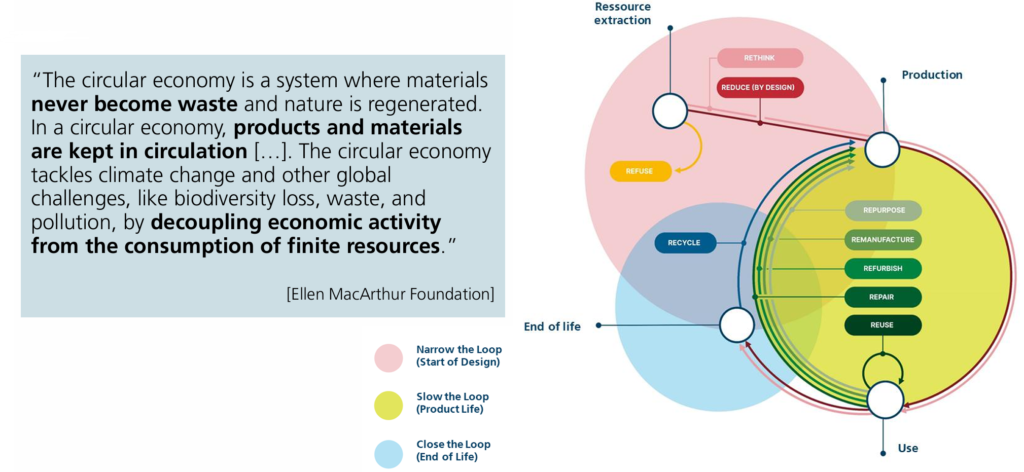
Below are summarized the main findings of the first part of the workshop:
| Component | Most promising R-strategies | Key considerations |
| Compressor | – (R2) Reduce – (R8) Recycle | Reuse, repair, refurbishment and remanufacturing are more difficult because of the design, are precision-built and costly to test |
| Heat Exchangers | – (R2) Reduce – (R4) Repair – (R5) Refurbish – (R8) Recycle | Main barriers are considered economic rather than technical |
| Pipes | – (R2) Reduce – (R8) Recycle | Reuse, repair, refurbishment and remanufacturing were also considered technically feasible by many participants. Material use could be reduced through shorter piping and thinner walls at lower pressures. |
| Casing and Insultation | – (R2) Reduce – (R3) Reuse – (R8) Recycle | Reuse is technicallly possible, but wider implementation would require major changes to product design and manufacturing processes |
| Inverters and Power Electronics | – (R4) Repair – (R6) Remanufacture – partly (R3) Reuse | Several strategies appear technically feasible, but their economic viability remains uncertain |
| Fans | – (R4) Repair – (R5) Refurbish | Reduction, reuse, remanufacturing, and recycling also showed potential. Reduction and reuse received relatively strong economing ratings |
| Heat Pump Unit | – (R2) Reduce – (R4) Repair – (R8) Recycle | Reduction and repair were considered the strongest options economically, followed by recycling, refurbishment and remanufacturing. |
Across most components, reducing material use and recycling were seen as the most promising approaches. Recycling was considered particularly viable for pipes, while repair and refurbishment showed strong potential for fans, heat exchangers and complete heat pump systems. Repurposing was generally viewed as the least feasible option.
Enabling Circular Solutions
The second session of the workshop explored the knowledge gaps and barriers that limit the viability of circular heat pumps. Refurbishment was identified as a largely unexplored area, with open questions around costs, component lifetimes, second-hand reliability and suitable business models. Participants also noted that electronics could become a key lifetime-limiting factor. For heat exchangers and pipes, the discussion highlighted the need to balance material reduction with efficiency, improve design for recycling and ensure that components can be collected at end of life. Reverse logistics, transparent material information, digital product passports, take-back schemes and clearer responsibility for collection and recycling costs were identified as important enablers.
Workshop Slides and Conclusion
The workshop’s central conclusion was that technology is often not the main obstacle to more circular heat pumps. Many solutions appear technically possible, but their implementation depends on viable business cases, economies of scale, suitable incentives and supportive regulation. The presentation analyzing the results in details can be found below:
Acknowledgements
We would like to thank Fraunhofer ISE for helping organising the workshop, preparing and presenting the results, and contributing to the collaboration within IEA HPT Project 65. Their contribution helped create an engaging discussion and provided important input for the project’s ongoing work on circularity in heat pumps.