By Thomas Fleckl, Chair of the National Organising Committee of the 15th IEA Heat Pump Conference and Head of Competence Unit “Sustainable Thermal Energy Systems” at AIT, Austrian Institute of Technology GmbH
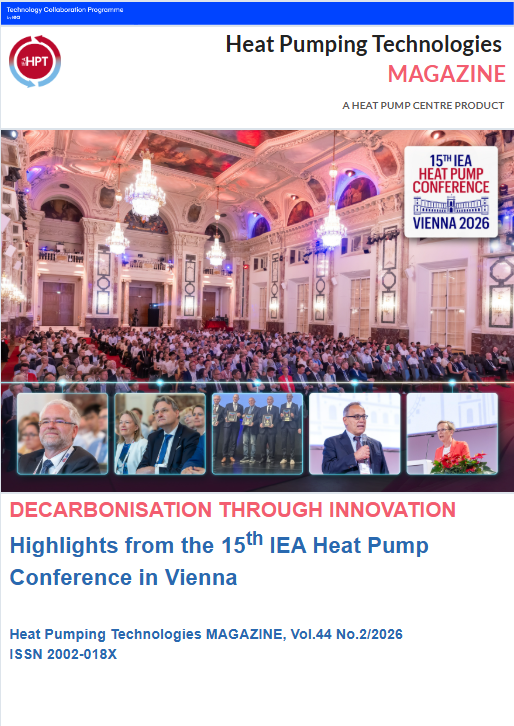
The 15th IEA Heat Pump Conference brought 812 participants to the Hofburg in Vienna at the end of May, for four days of presentations, workshops, policy forums and the kind of corridor conversation that no programme can schedule. It was the largest conference in the forty-odd year history of the series, with 367 scientific contributions selected from a review process in which 317 reviewers completed 2,943 reviews. The scale itself says something about where the field now sits.
Three years ago in Chicago, the message was that heat pumps had finally arrived in the policy conversation. Vienna showed what happens next. The questions that dominated the sessions were not whether heat pumps can decarbonise heating, but how they are integrated into processes and networks that were designed around something else, how they are operated once installed, how their performance is verified, and how markets and regulation can be arranged so that the technology is deployed at the pace the climate targets require.
That shift was clearest in industry. High-temperature heat pumps have moved out of the laboratory. Papers and workshop discussions in Vienna described multi-megawatt installations in pulp and paper, steel, chemicals, ceramics and food processing, producing steam at temperatures and pressures that were until recently the exclusive territory of fossil boilers. The recurring lesson from those projects was not thermodynamic. It was that integration is harder, slower and more expensive than expected, that reliable process data is often missing, and that existing distribution systems are rarely ready to accept a heat pump without adaptation. The question has changed from whether the equipment exists to how it is successfully installed and run.
A similar maturing was visible in buildings and networks. Large heat pumps in district heating are now the subject of measured commissioning experience rather than feasibility studies. Work on positive energy districts showed that how a heat pump is integrated, centrally or decentrally, can matter as much for seasonal performance as the unit itself. The existing building stock, and multi-family housing in particular, remains the hardest problem in the field, and the workshop devoted to it made clear that the obstacles are as much about ownership, cost sensitivity, noise and space as about technology.
Digitalisation cut across everything. Machine learning, virtual sensors and physics-informed models appeared in sessions on fault detection, commissioning, control and fleet monitoring. What was striking was the emphasis on the unglamorous foundations: data quality, standardised product information, labelled fault data, and test methods that reflect how equipment actually behaves rather than how it performs at a steady-state rating point.
The three policy forums, on global supply chains, on favourable energy policies and on innovation policy, added a dimension that a technical conference does not always capture. Their shared conclusion was that the barriers to deployment are mostly not technical. They lie in the price relationship between electricity and fossil fuels, in the stability of support schemes, in consumer trust, in access to finance and in the availability of skilled installers.
None of this diminishes the technology. It reflects a field that has won the argument about principle and is now doing the considerably harder work of delivery. That work is exactly what the international collaboration within the HPT TCP exists to support, and the number of project workshops in Vienna, several of them standing room only, suggests the appetite for it is strong.
My thanks go to the National and International Organising Committees, to the Scientific Committee, and the Scientific Advisors, to the partners and sponsors, to the reviewers, to the session chairs, and to everyone who travelled to Vienna to share their work. The 16th IEA Heat Pump Conference will be held in Copenhagen in 2029. We look forward to seeing you there.

Dr. Thomas Fleckl
Executive Committee Delegate & National Team Contact
AIT Austrian Institute of Technology GmbH
thomas.fleckl@ait.ac.at +43 50550-6616