

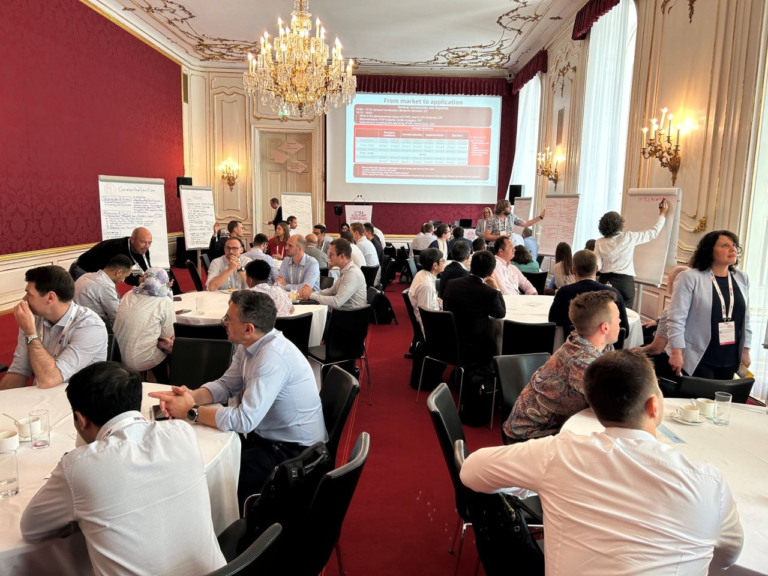
High-temperature heat pumps for process heating are emerging as a key technology for decarbonizing industrial heat. At the 15th IEA Heat Pump Conference in Vienna (26–29 May 2026), IEA HPT TCP Project 68 – Industrial High-Temperature Heat Pumps hosted an interactive workshop. The workshop explored how to move this technology from today’s market into full-scale industrial deployment.
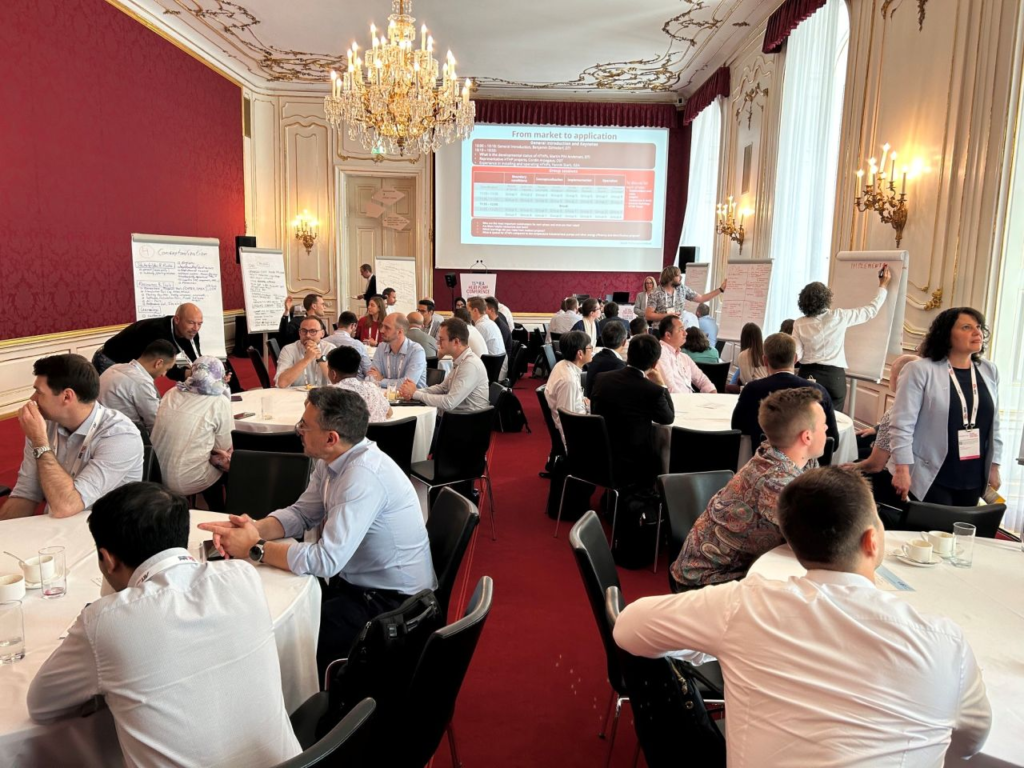
The event took place at the historic Vienna Hofburg. It brought together more than 80 participants — manufacturers, end-users, research and technology organisations, consultants, and universities. Together they discussed the practical barriers and success factors for high-temperature heat pumps for process heating.
The workshop combined keynote presentations with hands-on group sessions. The sessions followed the four project phases: Boundary Conditions, Conceptualization, Implementation, and Operation.

High-Temperature Heat Pump Technology Status and Projects
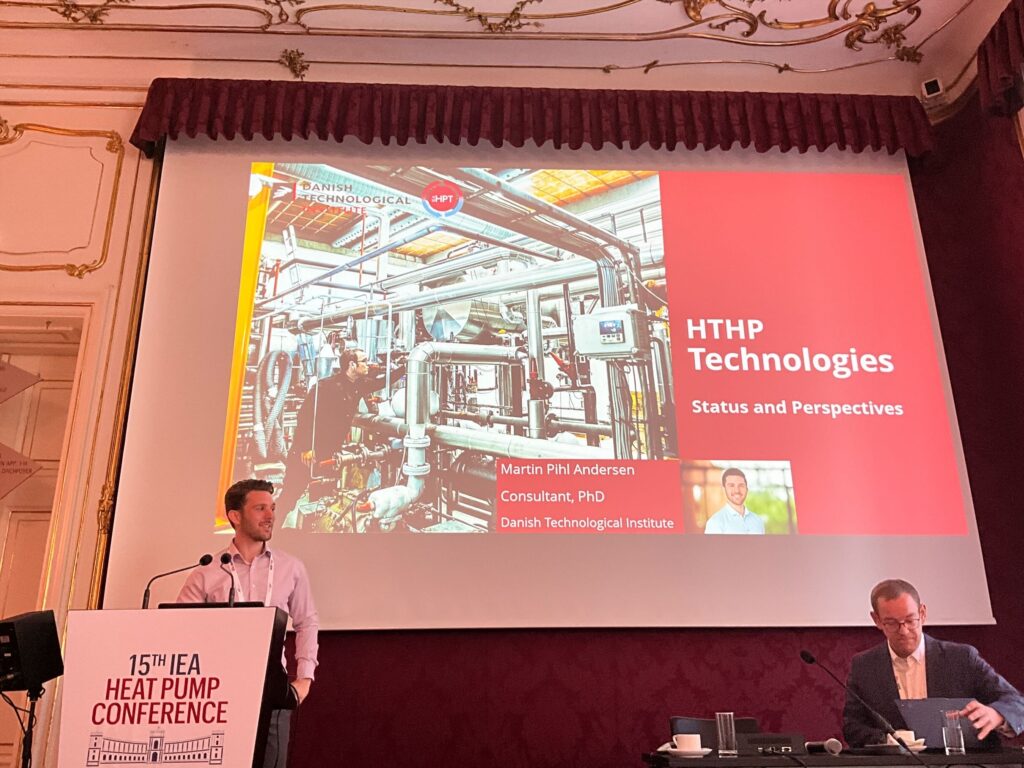
The morning opened with three keynote presentations on the status and application of high-temperature heat pumps:
- What is the developmental status of HTHPs? – Martin Pihl Andersen, Danish Technological Institute (DTI)
- Representative HTHP projects – Cordin Arpagaus, OST
- Experience in installing and operating HTHPs – Yannik Stark, GEA
These talks covered the current HTHP technology landscape. Project 68 has now mapped 55+ technology suppliers and 40+ demonstration cases. The speakers also addressed the shift toward natural refrigerants and showcased realized cases across industrial sectors. Finally, they shared practical lessons from mechanical vapor recompression and other installations..
Key Lessons Learned for High-Temperature Heat Pump Deployment
Early stakeholder alignment drives success: Successful HTHP projects depend on early engagement. Key stakeholders include end-users, plant operators, manufacturers, consultants, integrators, grid operators, funding agencies, and component suppliers. HTHP implementation is resource-intensive, cost-driven, and often unfamiliar. Therefore, teams should clarify roles, responsibilities, risks, and funding options early.
Reliable process data enables clear integration: HTHP projects need detailed process data. This includes temperatures, pressures, contamination risks, operating profiles, and boundary conditions. A balanced approach to system complexity and proper process integration are decisive for performance.
Implementation and operation prove complex: Realized projects show that complexity emerges during implementation. Projects often need more time, flexible schedules, and backup systems. They also require sufficient electrical infrastructure, dynamic control systems, and careful start-up planning. Integration alone can account for up to 80% of project costs. Standardized testing and operator training then support reliable long-term operation.
Process Heating with HTHPs: Stakeholders, Tools and Lessons
Across the four project phases, participants discussed several themes. They examined stakeholders and roles, helpful resources and tools, and key learnings from realized projects. They also explored what makes HTHPs different from low-temperature heat pumps and other electrification projects.
| Boundary Conditions | Conceptualization | Implementation | Operation | |
| What are the most imporant stakeholders and what are their roles? | •Policy makers/regulators influence, electricity/gas prices, CO₂ incentives •Grid operators are important for electricity availability, tariffs and security of supply •End-users define targets and ROI expectations •Industrial associations and can support market knowledge and sector-specific requirements | •Suppliers should be included to get reliable cost data. •Process owners, and process engineers are key for defining realistic heat demand profiles and integration options •Permit authorities may be relevant, especially for noise, refrigerants and safety aspects •Funding agencies and investors | •Plant operators and integrators should really communicate •Management should know that the implementation is ressource heavy •Subcontractors and safety experts are important for HAZOP, installation safety and start-up preparation | •Suppliers/OEMs may be needed for maintenance, performance data and service support •External certifiers/third parties may be relevant for validation of KPIs, guarantees •Heavily realies on proper training of plant/process operators |
| Are there helpfull resources and tools? | •Not a lot •Reference lists, site visits and demonstrator data help build confidence •Webinars •Maps for electricity grid connections | •Technoeconomic tool is missing, taking into consideration pinch, proper integration, using guide lines •Testing facilities for compressors/components can support validation •HAZOP analysis early on •Clear Maintenance plan | •Use the same documentation as any other complex process integration concepts •3D scans and brownfield site assessments can reduce installation risks •Clear list of priorities/actions is useful before implementation | •Data connections and dynamic controls systems are important •Digital Twin for predictive maintenance |
| Which learnings did you make from realised projects | •Life is much more complex than expected •Which funding schemes are available is important •Existing processes and heat distribution systems may not be ready for integration •Contractual liabilities should be considered early •Electricity should be available – also for start-up | •Spend more time identifying boundary conditions. Need a lot of process data (temperature, pressures, contamination) •It is important to balance complexity of system •Communication on concept is key •Safety concepts are very imporatnt to discuss up front •End-user trust requires references, warranties, technology validation and transparent performance | •Technology is new to many, so more time is needed to present the concept and how it works •Backup is essential •Fair conditions for all stakeholders, delays are rarely one stakeholders fault •A need of flexible time plans are needed especially with narrow windows of integration •Integration can be 80 % of project costs | •More standadised testing schemes Operation should be evaluated against KPIs, guarantees and contract conditions •More disciplined education is needed for operators, service staff and engineers |
| What is special for HTHPs compared to other energy efficiency/electrification projects? | •Boundary conditions like operation temperatures are even more important •Limited reference projects increase perceived risk •HTHP integration may require adaptation of the process or heat distribution system | •Know-how of technology and trust in process data is needed •Maintenance and dynamics become essential •Detailed HTHP concepts are often more case-specific and need customised solutions | •Extra safety concepts needed compared to other technologies •HTHP systems may have a larger footprint than alternative technologies •More detailed regulation, permitting and safety documentation may be required | •Flexibility for variable production and electricity price variations can add value •Continuous monitoring, optimisation are important for reliable HTHP operation |
Workshop Slides on Industrial Heat Pumps for Process Heating
The full set of presentations from the keynote speakers is available for download below.
Acknowledgements
This workshop was made possible by the entire Project 68 team. Special thanks to Cordin Arpagaus and Yannik Stark for their presentations, and to Florian Schlosser, Jonas Lundsted Poulsen, Ursula Wittstadt, Sabrina Dusek, Alessia Arteconi, Steven Lecompte, and José Luis Corrales Ciganda for leading the interactive group sessions. The session also featured insights on sector collaboration and common solutions from Project 68 – Task 2, presented by Florian Schlosser, Paderborn University.
Learn more about the project, its technology overview and ongoing sector collaborations at the IEA HPT Project 68 website.
Innovation Fund webinar: public consultation and stakeholder workshop for the upcoming IF26 Heat Auction