By Caroline Haglund Stignor, Heat Pump Centre
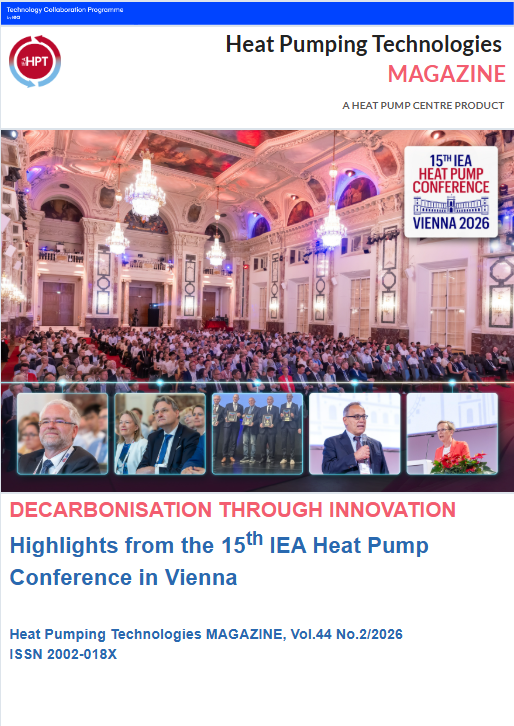
The 15th IEA Heat Pump Conference opened on 26 May in the historic surroundings of the Vienna Hofburg, welcoming more than 800 attendees from around the world. The plenary opening session set the scene for a programme of 367 scientific contributions with a series of keynote presentations on policy, technology and industrial transformation.

Thomas Fleckl of AIT, the Austrian Institute of Technology and Chair of the National Organising Committee, welcomed the audience together with the Scientific Director of AIT, Andreas Kugi. Welcoming remarks followed from Peter Hanke, Federal Minister of Innovation, Mobility and Infrastructure of Austria, and from Jürgen Czernohorszky, Executive Councillor for Climate, Environment, Democracy and Human Resources for the City of Vienna.
Heat pumps, energy security and affordability
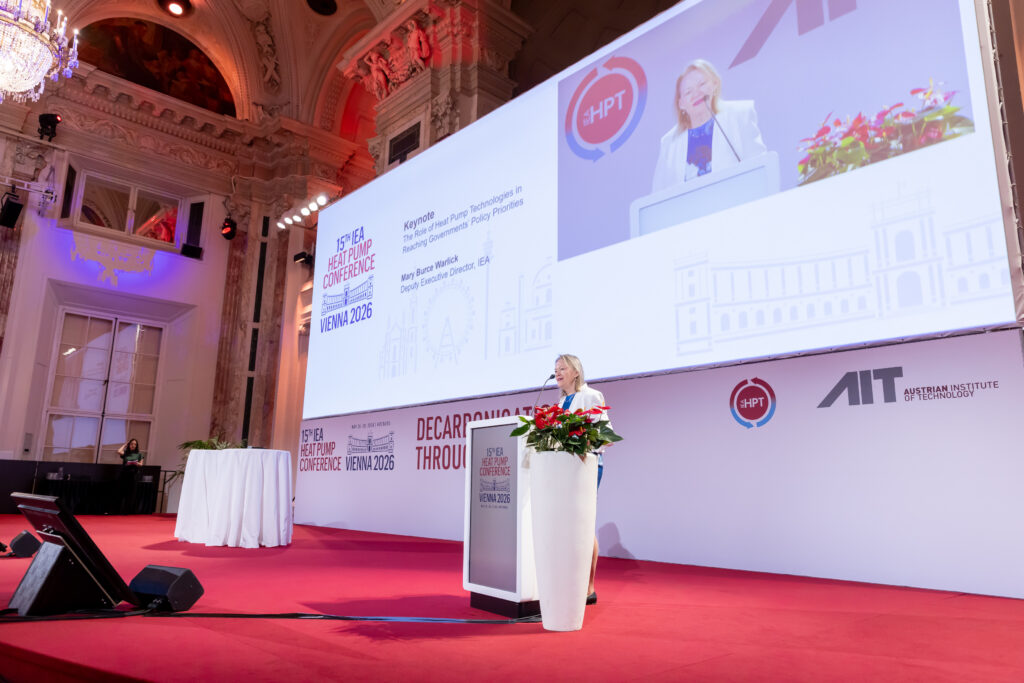
Mary Burce Warlick, Deputy Executive Director of the IEA, spoke on the role of heat pump technologies in reaching governments’ policy priorities. She pointed to how important heat pumping technologies have become for energy security and affordability, and for shielding consumers and industries from price shocks, particularly during periods of uncertainty. The installed heat pump stock already reduces gas demand in Europe by an amount comparable to the output of the largest LNG terminal in the European Union.
The technology is mature and has been in use for more than a century, she noted, but innovation must continue. The Kigali Amendment is driving the transition to new refrigerants; smart features need further development for optimisation and flexibility, industrial heat pumps are needed at still higher temperatures, and in district heating heat pumps are a key technology for the future, for example, large units recovering waste heat from data centres. She emphasised the role of the HPT TCP in ensuring competence and in generating and exchanging knowledge.
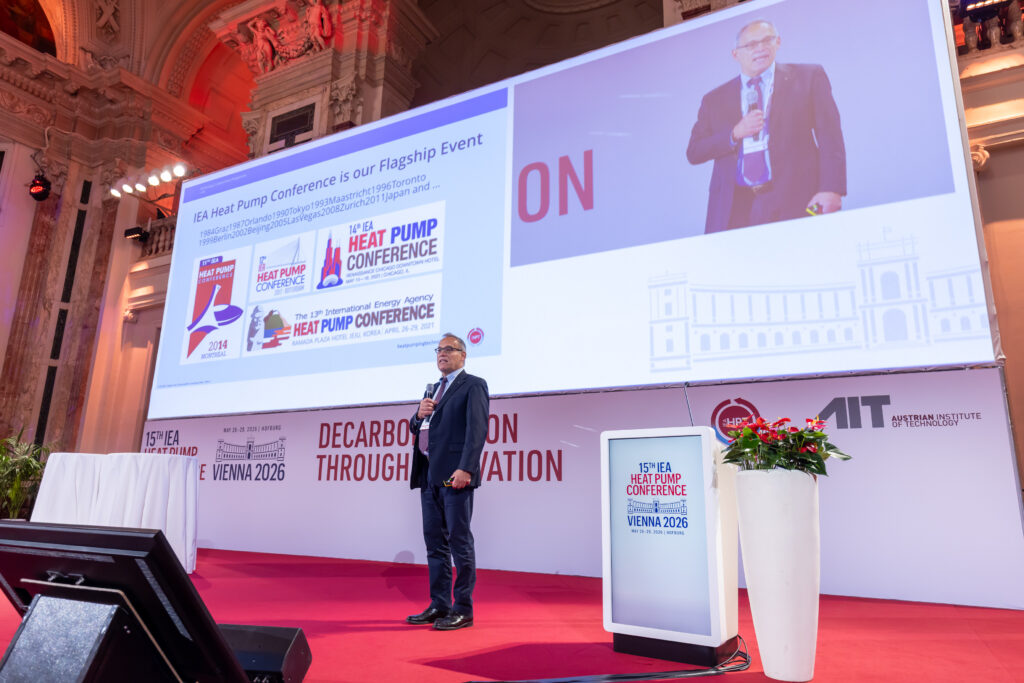
Stephan Renz, Chairman of the IEA Technology Collaboration Programme on Heat Pumping Technologies, gave his opening remarks on the theme Heat Pumping Technologies: Driving Transition Through Innovation, and described the activities under way within the collaboration programme. Sophie Hosatte-Ducassy, Chair of the International Organising Committee, closed the first part of the opening session, expressing her gratitude to the organising committees.
Energy and climate policy keynotes
Yosr Allouche, Director General of the International Institute of Refrigeration, spoke on the global cooling and heating transition, its challenges and its innovations. Among the points she raised were the possibilities offered by the properties of low-GWP refrigerants. Flammability, she argued, should not be confused with safety: what matters is proper application, installation, standards and qualified workers. In many parts of the world, a reduced use of R410A can be observed, while the use of R32 and R290 is increasing.

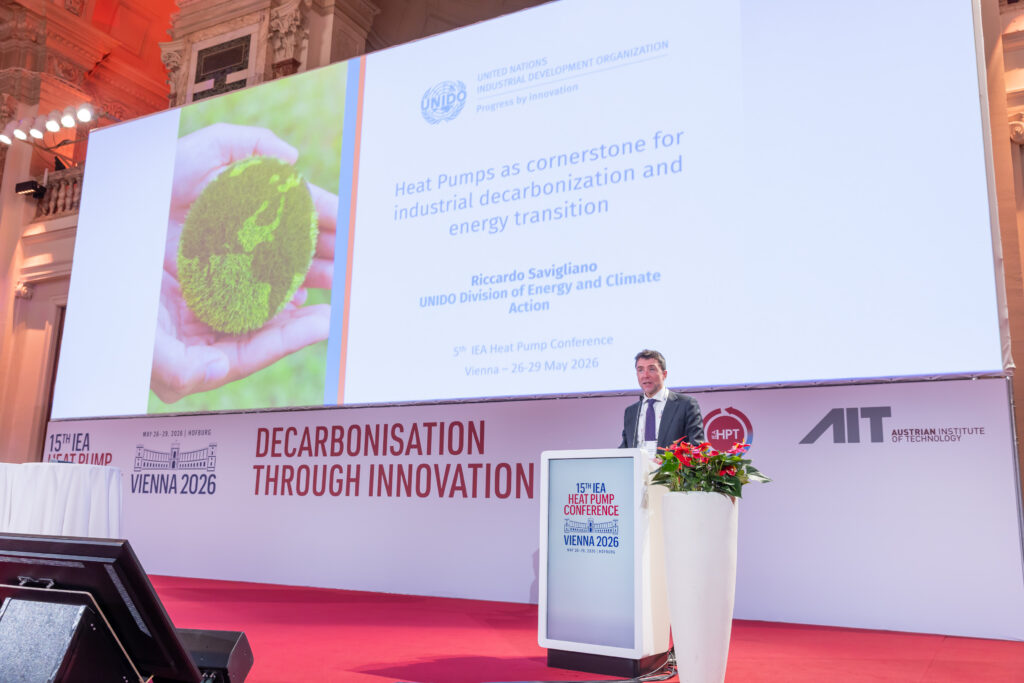
Riccardo Savigliano, Chief of the Energy Systems and Industrial Decarbonization Unit at the United Nations Industrial Development Organization, addressed why heat pumps matter for energy security, resilience, decarbonisation and electrification in developing countries and emerging markets. He concluded that heat pumps are key to decarbonising many thermal energy applications, in industry as well as in stand-alone and district heating and cooling systems. The priority, he said, is to create the enabling conditions for proper adoption and scale-up, including localisation of the heat pump supply chain. He also recommended that the heat pump community work alongside the solar thermal and wider renewable energy communities, since together they can reach markets that none can access as effectively alone.
Technology and industry transformation keynotes
Karl Gruber, Managing Director at Wien Energie, spoke on the role of heat pumps in the decarbonisation of Vienna. He described the vision of decarbonising the Vienna district heating grid by 2040 and the part heat pumps will play in it. Electrification of the heating sector is important, he argued, but so is changing how the electricity itself is produced. Vienna plans to expand wind generation and to phase out gas-fired combined heat and power. By 2040, the plan is for deep geothermal energy and heat pumps together to cover 55 percent of the heat supply, with the remainder from waste incineration and biomass, much of it already implemented.

Mitsunobu Nakajo, Director at the Heat Pump and Thermal Storage Technology Center of Japan, presented the potential of industrial heat pumps with case studies from Japan. He showed results mapping how much of the heating demand in different sectors, among them the food and automotive industries, could be covered by heat pumps, and described cases where separate boilers and liquid coolers had been replaced by combined heat pump and chiller systems, with significant energy savings as a result

In the final presentation, Rushad Nanavatty, Managing Director at the Rocky Mountain Institute, described heat pumps as the quiet engine of the energy transition. His closing points were that no technology is more important, that between 55 and 65 percent of useful energy is addressable by heat pumps, that heat pumps are the biggest efficiency multiplier available, returning three to six times the energy put in, and that heat pumps are a flexibility resource, with heat pump networks amounting to distributed power plants in the making. He concluded by calling heat pumps the silver bullet of the energy transition, setting the tone for the three days of knowledge sharing that followed.