By Caroline Haglund Stignor, Heat Pump Centre,
Three policy forums were organised during the conference, on global supply chains, on favourable energy policies and on innovation policy. Alongside a smaller number of market-oriented papers, they made the case that the principal obstacles to heat pump deployment now lie outside the technology itself.
Each section is based on a report contributed by the organiser or session chair and has been edited by the HPT Magazine editor for length and consistency.
Policy Forum 1: Global supply chains in a fragmented world
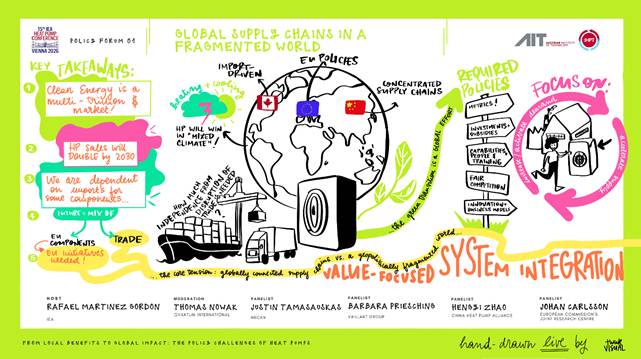
Hosted by Rafael Martinez Gordon, Renewable Energy Analyst at the IEA, with panellists Barbara Priesching of the Vaillant Group, Justin Tamasauskas of Natural Resources Canada, Cooper Zhao of the China Heat Pump Alliance and Johan Carlsson of the EC Joint Research Centre, this forum considered how supply chains can scale in a world shaped by rising demand, shifting trade dynamics and industrial-policy tension.
A central message was that heat pumps are comparatively more geographically diversified than many other clean energy technologies, with production and assembly spread across several regions. Supply-chain resilience nonetheless remains a concern where markets rely heavily on imported components or on a limited number of supplying countries. Significant investment has been made in European manufacturing capacity, and panellists argued that industry can deliver if stable demand is created. Views differed on how far Made in Europe criteria should go, with several speakers cautioning that protective measures should be avoided where they undermine affordability or international cooperation, while maintaining that fair competition is essential.
Contributions from China and Canada broadened the picture. China was presented not only as a manufacturing base but as a large domestic market whose demand drives innovation and scale. Canada illustrated a different challenge: heat pumps are a key strategy but the market remains relatively small, imports are significant, and products must be adapted to colder climates and local energy-system needs. Resilience, the forum concluded, is not only about where products are made but whether they suit local markets, grids, installation practices and service models. The suggested agenda was to stimulate stable end-user demand, support local value creation, maintain international trade on fair terms, and build resilience through diversification, scale, product adaptation and business models that ensure long-term service.
Policy Forum 2: Favourable energy policies for heat pumps
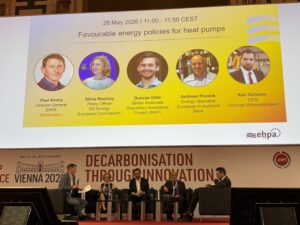
Hosted by Paul Kenny, Director General of EHPA, with Silvia Rezessy of DG Energy, Duncan Gibb of the Regulatory Assistance Project, Andreas Piontek of the European Investment Bank and Kari Ochsner of Ochsner Wärmepumpen, this forum focused on moving markets from stagnation to growth.
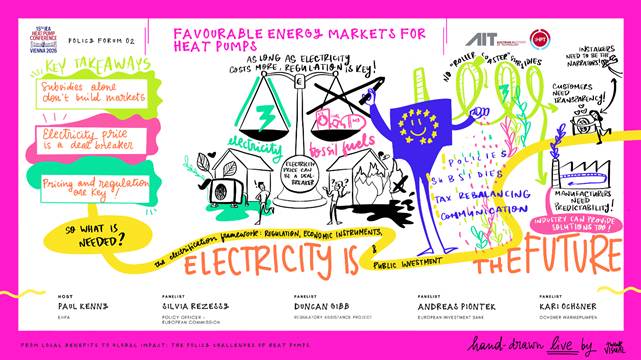
The central message was that subsidies alone are not enough. Deployment depends on a coherent policy environment, predictable long-term signals, and energy market design that makes electrified heating economically attractive. Several examples underlined the importance of correcting the price balance between electricity and fossil fuels, whether by reducing electricity levies, exempting electricity used for heating from certain taxes, or shifting levies from electricity to gas. Sweden was cited as a strong example where low electricity prices, carbon taxation, and clear communication have supported uptake.
Support schemes must also match market maturity and social conditions. In less mature markets, broad subsidy programmes may be needed to trigger demand, while advanced markets may require targeted support for households facing barriers. France was highlighted for placing equity at the centre of subsidy design, while the European Investment Bank emphasized one-stop-shop solutions, affordable finance and loan guarantees to reduce upfront barriers. Participants stressed that policy volatility raises costs and uncertainty for consumers and industry alike, and that a stable framework is essential for building supply chains and maintaining manufacturing capacity.
Beyond economics, the forum pointed to trust and communication. Consumers are not primarily interested in technical indicators such as coefficient of performance but in comfort, reliability and affordability. Installers, clear market information and trusted advisory structures were described as crucial to prevent poor-quality offers from damaging market confidence. European policy already contains many of the necessary elements, including electrification plans, renewable heating and cooling targets and restrictions on fossil boiler support; the remaining challenge is translating these into coordinated national action and credible consumer narratives.
Policy Forum 3: Innovation policy for a rapid and resilient transition
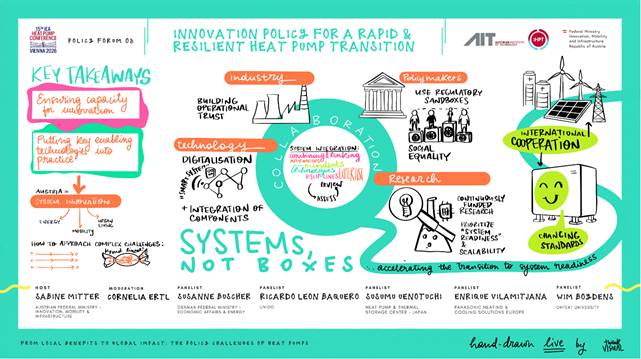
Hosted by Sabine Mitter of the Austrian Federal Ministry of Innovation, Mobility and Infrastructure, with Susanne Buscher of the German Federal Ministry for Economic Affairs and Energy, Ricardo Leon Baquero of UNIDO, Susumu Uenotsuchi of the Heat Pump and Thermal Storage Technology Center of Japan, Enrique Vilamitjana of Panasonic Heating and Cooling Solutions Europe and Wim Boydens of Ghent University, this forum addressed research and innovation policy.
The panel held that deployment remains too slow to meet political targets, and moved the discussion beyond conventional building applications to large-scale heat pumps for district heating, high-temperature machines for industry, and systems combined with storage and digitalisation to provide flexibility. A key message was that innovation policy cannot rely on linear models with simple objectives and indicators. Heat pump innovation is complex, circular and system-dependent, requiring approaches that address technology development, system integration, market formation, user acceptance and social impact simultaneously. Different applications need different support: industrial machines still need technology development, district heating requires stronger system integration, and building applications face new requirements linked to refrigerants, circularity and digital services.
Market and regulations in the technical programme
The panel called for more flexible and differentiated instruments, including programmes adapted to different technology readiness levels, living labs close to the market, and small low-administration projects accessible to SMEs. Cross-sector and value-chain collaboration, including installers and digital solution providers, was seen as essential. Participants also suggested that policy learning should include what does not work and how barriers are overcome, shared faster than traditional multi-year research projects allow.
A smaller group of papers addressed these questions directly. The European Heat Pump Association presented its strategy for accelerating deployment while safeguarding industrial competitiveness, building on its competitiveness analysis and recent market evidence. A second contribution reported insights from testing three innovative business models for the heat pump rollout, addressing the high upfront costs, limited consumer awareness and fragmented supply chains that hinder adoption. A third examined community-based events using behavioural design as a scalable strategy for adoption in Germany, explicitly targeting the gap between intention and action.
Regulation appeared in less obvious places. An Austrian survey on the frequency, location and detection of leaks in heat pump and cooling systems up to 50 kW addressed the safety and monitoring requirements arising from the F-gas Regulation and the proposed REACH restrictions, and a study on the common failure analysis of domestic heat pumps and air conditioners approached product lifetime from the perspective of circular economy requirements. A comparison of operating costs between heat pumps and condensing gas boilers for residential heating in Italy spoke directly to the price-ratio question that dominated the second policy forum.
The consistent thread across forums and papers is that the technology case has largely been accepted and the delivery case has not yet been resolved. Price signals, policy stability, finance, installer capacity and consumer trust were named repeatedly, and were treated by participants as the variables that will determine deployment rates over the next decade.
The panel discussions were live captured in graphic recordings
All conference papers are available from the searchable HPT TCP database: https://heatpumpingtechnologies.org/publications