
Monika Ignatowicz, Saman Nimali Gunasekara, Björn Palm, Rahmatollah Khodabandeh, KTH Royal Institute of Technology, Sweden
Only chemically stable refrigerants can ensure long lifetime and steady operation. The aim of this paper is to compare lab-controlled chemical stability tests of hydrofluoroolefins (HFOs) at temperatures up to 100ºC for 21days in combination with moisture and polyolester (POE) lubricants against the refrigerant samples from real installations. The results showed that HFOs undergo different polymerization processes in presence of POE lubricants; water; or a mixture of POE lubricants and water. Moreover, the control refrigerant samples showed highly elevated water levels confirming that water is one of the degradation by-products.
Introduction
Currently, mineral oils and semi-synthetic lubricants are not considered suitable for hydrofluoroolefins (HFOs) refrigerants such as R1234yf and R1234ze(E) having zero ozone depletion potential (ODP) and very low global warming potential (GWP). Synthetic lubricants such as polyol esters (POEs), polyalkylene glycols (PAGs), and polyvinyl ethers (PVEs) are increasingly used in the refrigeration and heat pump industry, as safer alternatives to mineral oils [1]. The commercially available POE lubricants are typically composed of linear, branched, or cyclic pentaerythritol esters (PECs) [2]. POE lubricants, due to their high polarity, can exhibit widely varying properties despite having the same viscosity index as mineral oils [3]. It is important to underline that the thermal stability and water absorptivity of different lubricants are of significance since water can accelerate degradation, and water content above 50 ppm should be strictly avoided [2]. Polar lubricants such as PAGs exhibit the highest water absorption among all synthetic oils, whereas mineral oils, due to their non-polar nature, have the lowest water absorption capability. Additionally, the viscosity index of POE lubricants plays a critical role in their water absorption behavior, and products with low viscosity index tend to have higher water absorptivity [4]. According to the Air-Conditioning, Heating, and Refrigeration Institute (AHRI) Standard 700-2024, the maximum allowable water content in HFO refrigerants is 20ppm [5].
Synthetic refrigerants can undergo ten different chemical degradation paths: molecular rearrangement, polymerization, hydrodehalogenation, hydrogenation, elimination, oxidation, nucleophilic substitution, electrophilic addition, disproportionation, and pyrolysis. Moreover, the reaction rates for stereoisomer rearrangement (Z to E isomerization) for HFOs were reported to be very low. Nevertheless, operating temperatures above 130°C can cause some isomerization, even in the more stable E-type isomers [6], suggesting a significant application limitation. As found, R1234yf exhibited a significant degradation in the presence of air and water due to hydrolysis of POE lubricant [7]. Studies showed that HFO refrigerants, such as R1234yf and R1234ze(E), in combination with POE lubricants, exhibited lower chemical reactivity than PVE lubricants over 14 days at 175°C [8]. Additionally, the isolated incidents of R1234yf polymerization during charging of mobile air conditioning systems, where “silicone-like” deposits caused irreversible system damage and indicated that probable causes included moisture and elevated temperatures during handling, leading to polymerization. To avoid polymerization, avoiding direct sunlight during transport and storage, slowly opening gas cylinders to prevent pressure changes, and avoiding rubber seals that contain peroxides (recommending PTFE, Teflon) were recommended [9].
Summing up, the literature review on the thermal and chemical stability of R1234yf and R1234ze(E) reported no significant degradation in different HVAC and laboratory experiments, nor signs of polymerization. However, no studies have examined the chemical stability of refrigerants in combination with different POE lubricants using the updated ASHRAE Guideline 38-2023 (Guideline for Using Metal Pressure Vessels to Test Materials Used in Refrigeration System) [10]. Therefore, the aim was to investigate the chemical stability and material compatibility of HFOs with POE lubricants having different chemistry under high-temperature and high-pressure conditions representative for applications, and comparison of obtained degradation results with refrigerant samples from real industrial installations.
Methodology
The compatibility and chemical stability of refrigerants and lubricants were evaluated using specially designed stainless-steel (SS) gas reactors. These tests followed the updated ASHRAE Guideline 38-2023 (Guideline for Using Metal Pressure Vessels to Test Materials Used in Refrigeration Systems). Each gas reactor consists of a cylindrical SS body, two SS ball valves with PTFE sealing and a four-screw closing mechanism (at the valve-cylinder connection edge), allowing for large sample volumes of approximately 99.98±0.1cm³. ASHRAE Standard 97-2007 (RA 2017) [11] was used for the calculation of refrigerant mass and calibration of the gas reactor volume and pressure sensors. To investigate the effects of lubricant presence and moisture, four sample categories were prepared for each refrigerant:
• Pristine refrigerant control sample (water content <20 ppm)
• Pristine refrigerant (water content <20 ppm) with additized POE lubricant – 1:1 mass ratio
• Pristine refrigerant (water content <20 ppm) with 5000 ppm added water
• Pristine refrigerant (water content <20 ppm) with additized POE lubricant and 5000 ppm added water.
This method enabled the evaluation of lubricant-driven and moisture-driven degradation mechanisms. Given that lubricant viscosity requirements can vary based on operating temperature, two different POE lubricants were tested. The aging and chemical stability experiments were carried out using a Termaks 4000 laboratory oven (temperature accuracy of ±1 °C). The refrigerant chemical composition was validated using a Thermo Scientific Trace 1310 Gas Chromatograph (GC) with Flame Ionization Detection (FID) and Thermal Conductivity Detector (TCD). Moreover, Liquid Chromatography-Tandem Mass Spectrometry (LC-MS/MS) was used to validate the lubricant composition. In addition, the control tests of pristine POE lubricants were conducted at 150°C for 21 days in the oven to assess any potential discoloration or physical degradation. Full details of the testing procedure can be found in [12]. Table 1 summarizes the testing conditions and lubricant Viscosity Index (VI).
| Refrigerant | Testing conditions | POE Lubricants |
| R1234yf | period: 21 days, temperature: 90ºC | POE VI32; POE VI55 |
| R1234ze(E) | period: 21 days, temperature: 100ºC | POE VI55; POE VI85 |
Table 1: Summary of the testing conditions.
After the 21-day chemical stability tests, the refrigerant samples were carefully separated from other components and transferred to smaller SS gas cylinders for GC analysis and to custom-built sealed glass tubes for visual inspection and expansion, as shown in Figure 1.
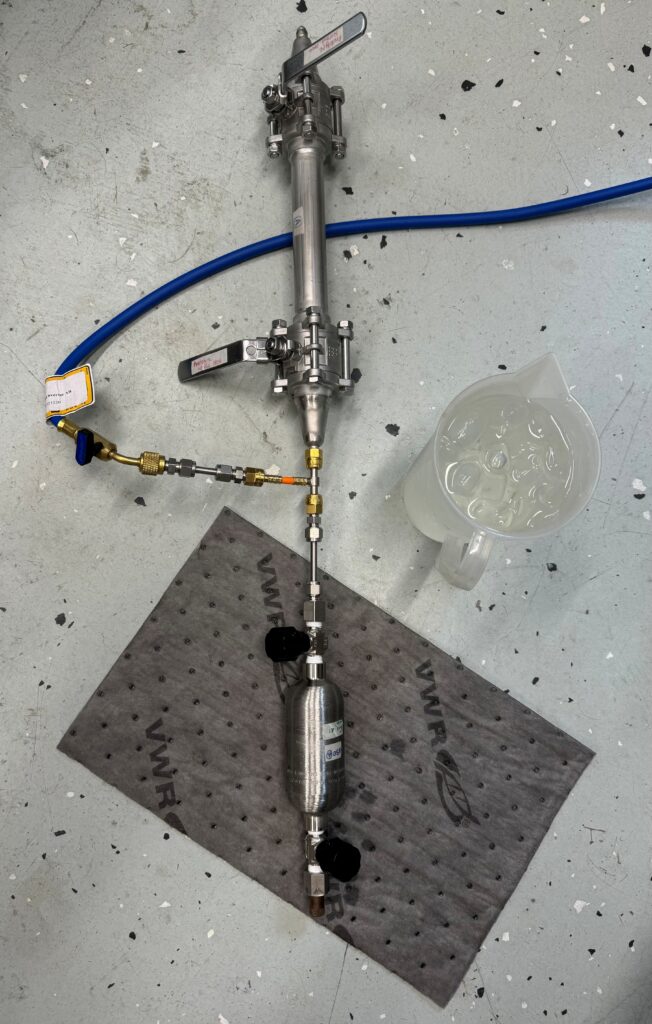
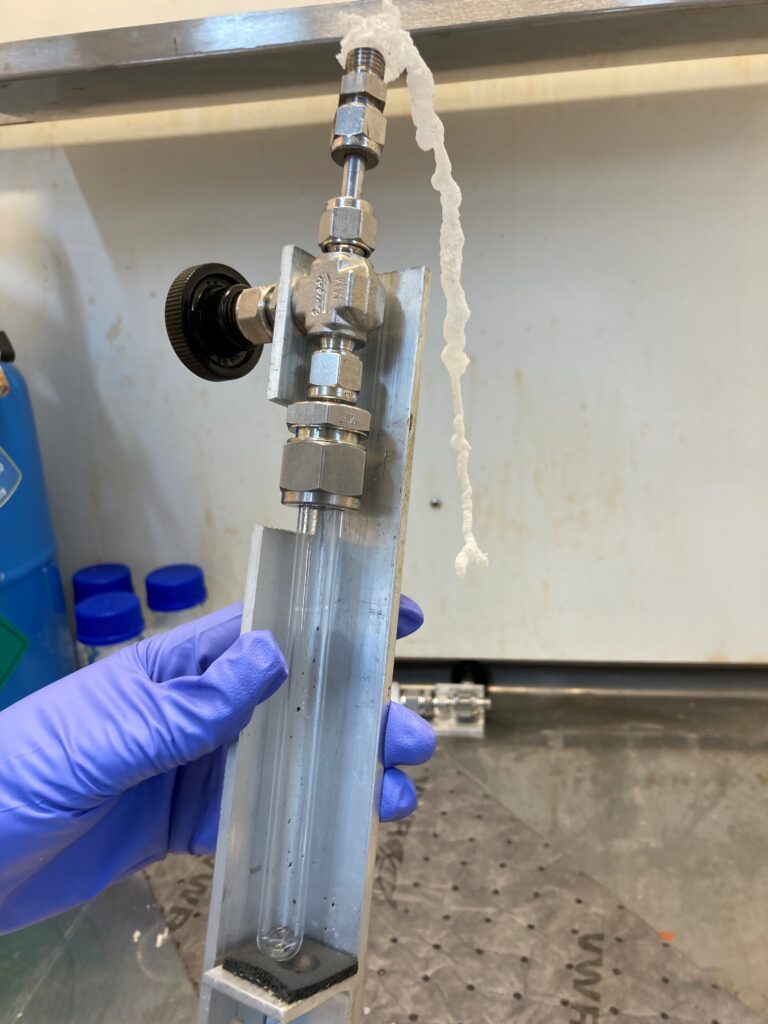
Figure 1: The transfer procedure of thermally treated refrigerant from the gas reactor to a smaller gas bottle for GC analysis (a), polymer-like formation during expansion test from the sealed glass tubes (b).
Results
Firstly, a pristine commercial POE lubricant composition was analyzed to quantify the relative fractions of linear and branched esters to understand the possible chemical interactions with the refrigerant. Table 2 presents the results of the analysis of the pristine lubricant composition.
| Sample | Penta-esters [%] | Dipenta-esters [%] | Additives / Stabilizers [%] |
| POE VI32 | 53 | 47 | – |
| POE VI55 | 4 | 95 | 1 |
| POE VI85 | 32 | 67 | 1 |
Notably, one lubricant exhibited absent levels of stabilizing organophosphorus additives, which may reduce resistance to thermal or chemical degradation under high-temperature conditions. Tables 3 summarize the chemical stability results for both refrigerants.
| Refrigerant | Pristine refrigerant | Refrigerant with POE lubricant | Refrigerant with water | Refrigerant with POE lubricant and water |
| R1234yf | No reaction | No reaction with POE VI32; White porous polymer (foam type) with POE VI55; | White porous polymer (foam type); | Transparent gel, smelly sample with both POE lubricants; |
| R1234ze(E) | No reaction | POE VI55: small white hard particle in gas reactor, whitish gel in glass tube, smelly sample; POE VI85: whitish gel in glass tube, smelly sample, no particle; | No reaction | Hard particles in whitish dense gel in both cases, smelly sample in both cases; |
As shown in Table 3, both HFO refrigerants appear to be highly thermally stable when pristine samples with water content below 20 ppm were analyzed. R1234yf was very stable with POE lubricant VI32, having less branched dipenta-esters. Instead, R1234yf with POE VI55 (recommended for higher temperatures) was very unstable and polymerized after the 21-day test. Moreover, R1234yf exhibited pronounced instability in the presence of both water and POE lubricants, resulting in a new liquid gel-type product. These findings are similar to results reported for R1234yf and three different POE lubricants [13], suggesting that the ratio between the branched dipenta-esters and penta-esters needs to be properly selected to reduce the risk of chemical degradation of R1234yf. A similar degradation path was observed for R1234ze(E) in contact with POE lubricant and water, whereas the control thermally treated refrigerant sample showed no signs of polymerization. Instead, tests conducted with two POE lubricants having a higher share of dipenta-esters showed very high chemical instability and a new gel-type product in the sealed glass tube expansion test. Furthermore, in the case of the test R1234ze(E) with POE VI55 lubricant, small, sharp white polymer-type particles were obtained (shown in Figure 2a).
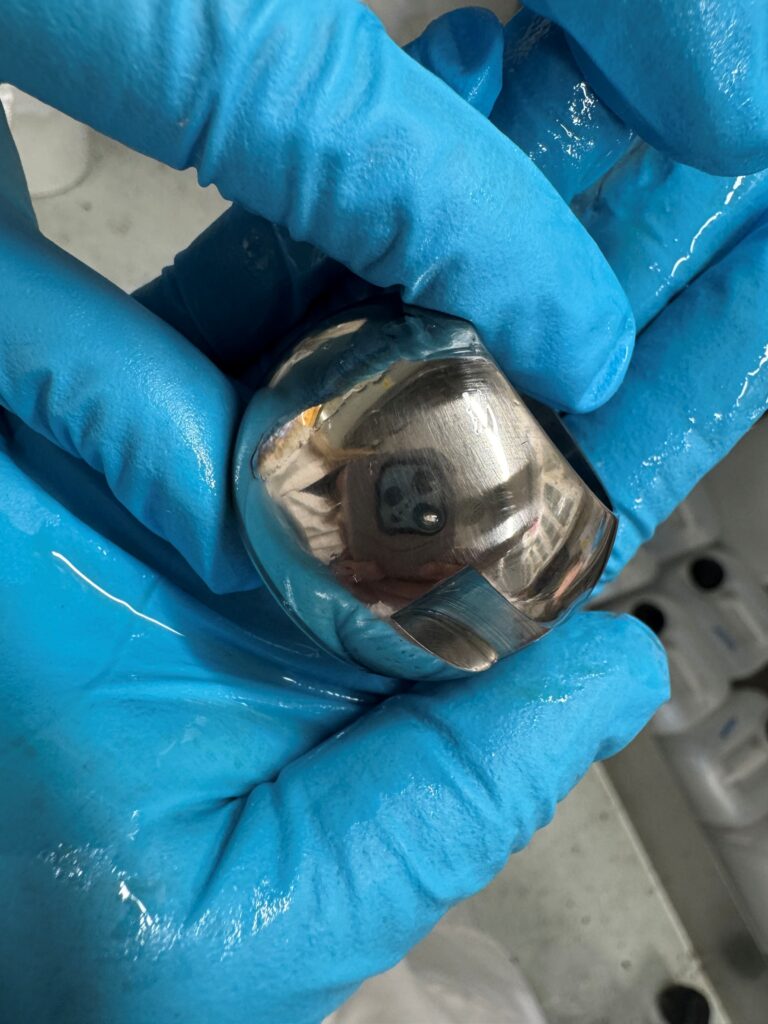
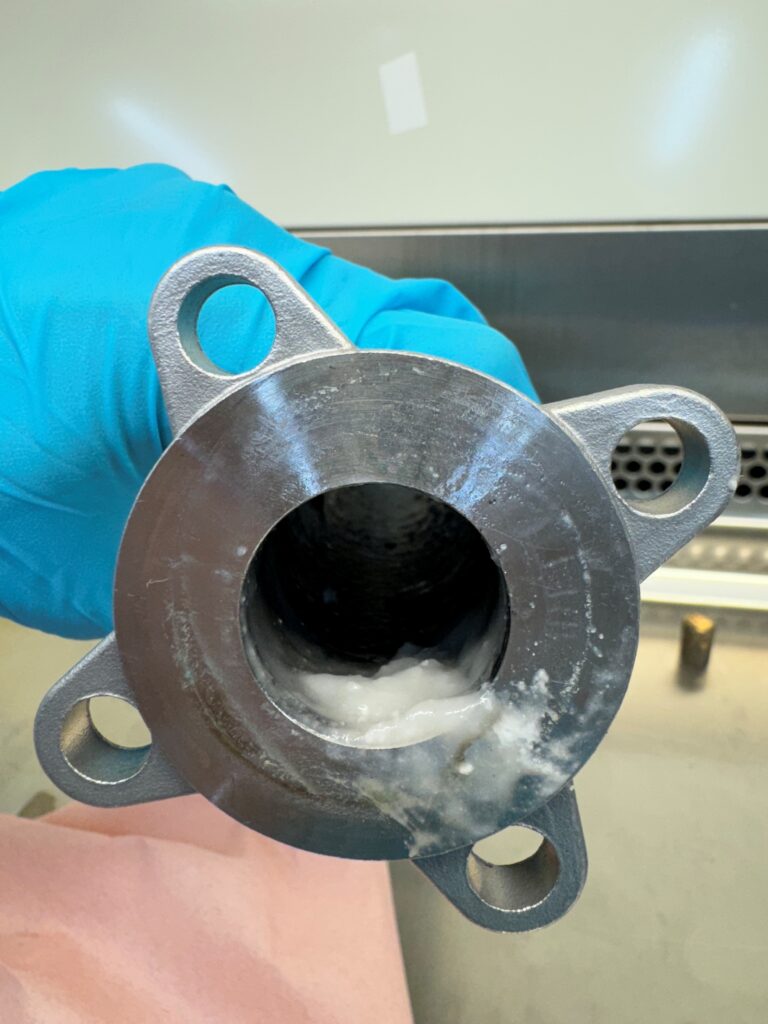
Figure 2: R1234ze(E) with POE VI55 lubricant (a), R1234ze(E) with POE lubricant and water polymerization product.
Moreover, similar hard particles in a white dense gel (shown in Figure 2.b) were obtained in the test with POE lubricants and excess water. In these cases, it was impossible to separate the lubricant or water from the gel formation. Finally, R1234ze(E) did not show any chemical instability when exposed to high water levels. As seen in Tab.3, both HFOs showed a specific chemical instability that was never reported before. The observed polymeric formations are most likely derived from fluorinated refrigerant species [6,13], as POE lubricants do not polymerize [14]. Since the polymerizing refrigerant can cause damage to the GC instrument, it was decided to only test the control refrigerant samples that were not showing any signs of polymerization. In the case of thermally treated R1234yf sample, neither chemical degradation nor new unidentified peaks were detected using the TCD. The GC analysis of R1234ze(E) revealed more unexpected results. The pristine R1234ze(E) tests confirmed lower purity refrigerant (about 96.64% pure) and some impurities such as R1234yf, water, 2 unknown substances, and two non-combustible gases (oxygen and carbon dioxide). Instead, the thermally treated R1234ze(E) sample exhibited a substantial increase in water content, reaching approximately 852ppm (roughly 26 times higher than in the pristine sample), suggesting that water can be one of the by-products from R1234ze(E) degradation (shown in Figure 3).
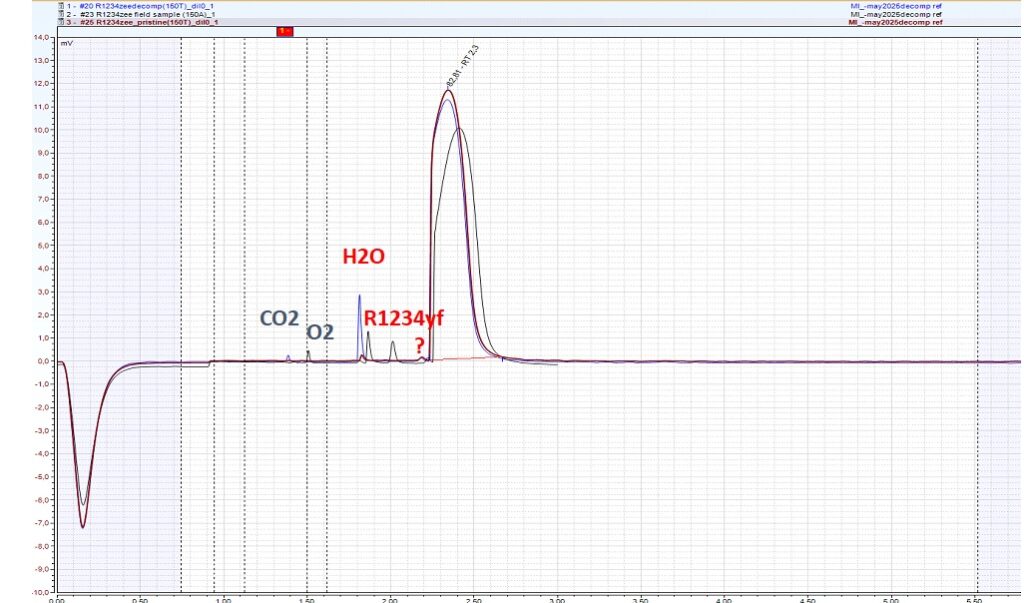
Moreover, R1234ze(E) sample from an industrial installation (the black chromatogram) showed similar tendency and alarming high water levels that confirms the chemical instability of R1234ze(E). Note that no degradation models for HFO refrigerants were found in open literature, except for one atmospheric degradation model for R1234ze(E) [15], which identifies water as one of the final products.
Conclusions
This study showed that some HFOs are very sensitive to POE lubricant composition with a higher share of dipenta-esters. The key novelty of this work lies in the direct comparison between laboratory-controlled chemical stability tests and refrigerant samples from a real industrial installation. As found, different parameters such as moisture content and lubricant can trigger polymerization processes that can lead to significant system failure. Each refrigerant seems to form different polymer structures. This study confirms that water is one of the final degradation products, which can cause further degradation of the lubricant and R1234ze(E) polymerization.
This work is a part of the Termo P51502-1 project “Environmentally friendly lubricants for high temperature heat pumps with low GWP refrigerants” and Termo P2022-00477 “Tank-to-Grave Management of Low-GWP Refrigerants” funded by the Swedish Energy Agency in collaboration with industrial partners.
Author contact information
| Name | Monika Ignatowicz |
| Title | |
| Affiliation | KTH Royal Institute of Technology |
| Postal address | Brinellvägen 68, 100 44 Stockholm, Sweden |
| E-mail address | monikai@kth.se |
References
These should be kept to a minimum and indicated numerically, e.g.:
[1] Karnaz J.A., 2024. “SWOT Type Considerations Of Lubricants And Low GWP Refrigerant Options”. 27th International Compressor Engineering Conference, Purdue, USA.
[2] Tangri H., Purohit N., Sethi A., Hulse R. 2023. “Solubility, miscibility and compatibility studies of low GWP non-flammable refrigerants and lubricants for refrigeration and air conditioning applications”. IJR 2025:148, pp.45-63.
[3] Cavestri R.C., 1996. “Potentially useful polyolester lubricant additives an overview of antioxidants, antiwear and antiseize compounds”. 1996 International Refrigerants Conference, Purdue, USA.
[4] Bock W., 2014. “Refrigeration oils”. Encyclopedia of Lubricants and Lubrication (pp. 1499-1514). Springer, Berlin.
[5] AHRI, 2024. AHRI 700 (SI): Standard for Specifications for Refrigerants, Air-Conditioning, Heating, and Refrigeration Institute.
[6] Kujak S., Leehey M., 2023 “Chemical stability investigation of haloolefin refrigerants and their blends with lubricants”. Science and Technology for the Built Environment, (2023) 29, 9: pp.936-953.
[7] Campo C., Solano C., Kent S., Seeton C., 2018. Compatibility of R1234yf and R134a and Lubricants used in Automotive Compressors. 17th International Refrigeration and Air Conditioning Conference, Purdue, USA.
[8] Kujak S., Sorenson E., Herried Leehy M., 2021. “Materials Compatibility and Lubricants Research for Low GWP Refrigerants: Chemical Stability of Low GWP Refrigerants with Lubricants”. AHRTI Report #09016. Air Conditioning, Heating and Refrigeration Technology Institute, INC. Arlington, VA.
[9] MAHLE Technical Messenger 05/2023. Polymerization of refrigerant R1234yf.
[10] ASHRAE Guideline 38-2023. Guideline for Using Metal Pressure Vessels to Test Materials Used in Refrigeration Systems.
[11] ANSI/ASHRAE 97-2007. Sealed Glass Tube Method to Test the Chemical Stability of Materials for Use within Refrigerant Systems.
[12] Ignatowicz M., Gunasekara S.N., Dong Y., Palm B., Khodabandeh R., Johansson M., Wang R., Arumugam A., Manca O., 2026 “Chemical stability of low-GWP refrigerants with polyol ester (POE) lubricants for high temperature heat pumps” 15th IEA Heat Pump Conference, Vienna, Austria.
[13] Sorenson E., Kujak S., Leehey M., Robaczewski C., Stellpflug T., 2021. “Material compatibility and lubricants research for low GWP refrigerants–Chemical stability of low GWP refrigerants with lubricants”. Report AHRI, 9016.
[14] Ngoc Dung (Rosine) Rohatgi, Robert W. Clark, David R. Hurst AHRTI Report No. 09004-01, “Material Compatibility & Lubricants Research for Low GWP Refrigerants – Phase I: Thermal and Chemical Stability of Low GWP Refrigerants with Lubricants”, 2012.
[15] Pérez-Peña M.P., Fisher J.A., Hansen C., Kable S.H., 2023. “Assessing the atmospheric fate of trifluoroacetaldehyde (CF3CHO) and its potential as a new source of fluoroform (HFC-23) using the AtChem2 box model”. Environmental Science: Atmospheres, 3(12), pp.1767-1777.