Welcome to Heat Pumping Technologies Magazine – Issue 1, 2026
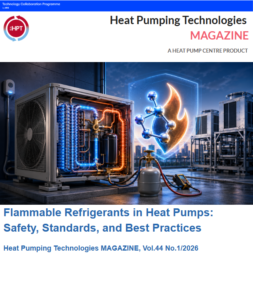
Welcome to the first issue of 2026 of Heat Pumping Technologies Magazine. This edition is dedicated to the theme of “Flammable Refrigerants in Heat Pumps: Safety, Standards, and Best Practices”, one of the most consequential topics shaping the near-term trajectory of the heat pump sector.
As the industry accelerates its transition toward low global warming potential (GWP) refrigerants, flammable working fluids, including hydrocarbons and mildly flammable HFOs, are playing an increasingly central role across residential, commercial, and industrial applications. Their strong thermodynamic performance and minimal environmental impact position them as key enablers of decarbonisation. At the same time, their flammability introduces safety considerations that must be rigorously addressed to support reliable and scalable deployment at every level of the value chain.
This issue places safety at the core, examining how system design, component selection, installation practice, monitoring strategies, and operational procedures can be aligned with existing and emerging standards to mitigate risk without compromising performance. It also addresses how regulatory frameworks, certification schemes, and best practice guidelines are evolving to enable broader market uptake.
In the Foreword, titled “Flammable Refrigerants in Heat Pumps: Managing Risk in a Rapidly Shifting Market”, we set the strategic context for this edition, examining the convergence of environmental regulation, refrigerant availability, and safety governance reshaping how the industry approaches flammable working fluids.
Our Column features “Heat Pumps at the Center of Korea’s Carbon-Free Transition”, offering a national-scale perspective on heat pump policy and deployment in one of Asia’s most dynamic energy markets.
Topical Articles
“Experimental Insights into Liquid and Vapor Leakage of R-290” (Esmaeelian et al., KTH Royal Institute of Technology, Sweden) investigates R-290 leakage dynamics under controlled liquid and vapor conditions, demonstrating transient pressure and phase-change effects that current steady-state safety models fail to capture. The findings have direct relevance for charge-limit calculations under IEC 60335-2-89.
“Techniques to Safely and Accurately Characterize the Performance of Flammable Refrigerants” (Barta and Ziviani, Purdue University, USA) documents experimental infrastructure for A3 refrigerant testing at system, component, and fluid level, covering psychrometric chambers, compressor test stands, thermophysical property rigs, and flammability facilities, drawing on experience across North America, Asia, and Europe.
“Chemical Stability Problems of Low-GWP HFO Refrigerants with Polyol Ester (POE) Lubricants” (Ignatowicz et al., KTH Royal Institute of Technology, Sweden) examines degradation mechanisms of R1234yf and R1234ze(E) in combination with POE lubricants under high-temperature aging conditions, identifying moisture-driven and lubricant-driven polymerization pathways validated against samples from real installations.
“Renewable District Heating from a Waste-to-Energy Plant through the Adoption of Large Commercial and Industrial Heat Pumps” (Gandini, Studio Gandini S.R.L., Italy) presents the Brescia WtE plant case study, where nine large heat pumps using R1234ze(E) delivered a 33% increase in thermal output and raised overall plant efficiency from 82% to 98%, without increasing combustion input, a compelling demonstration of HTHP technology and A2L refrigerant deployment at industrial scale.
National Market Section
In our National Market spotlight, we turn to Switzerland, presenting an exclusive Heat Pump Market Report examining deployment trends, policy drivers, and market dynamics in one of Europe’s most advanced heat pump markets.
We trust this issue provides a technically substantive and practically grounded perspective on the state of flammable refrigerants in heat pump technology, and that it serves as a useful reference for all those working to advance safe, efficient, and scalable decarbonisation of heating across all sectors.
Enjoy your reading!
Dr Metkel Yebiyo, Editor
Heat Pump Centre
The central communication activity of the Technology Collaboration Programme on Heat Pumping Technologies (HPT TCP)

Contact: metkel.yebiyo@ri.se