By Minsung KIM, Professor, Chung-Ang University, Republic of Korea, ExCo alternate delegate to the IEA HPT TCP
South Korea is entering a major turning point in its energy transition. Until now, national energy policy has largely been shaped by two priorities: expanding carbon-free electricity generation and maintaining a stable power supply. In Korea, carbon-free energy includes both renewable energy and nuclear power, reflecting the country’s broader approach to decarbonization. At the same time, Korea’s isolated power grid and limited external interconnection have made electricity security and peak demand management especially sensitive issues. Under these conditions, the national energy strategy has focused primarily on securing reliable carbon-free power generation, while taking a cautious approach toward large-scale thermal electrification.
This policy direction began to evolve following the launch of the Ministry of Climate, Energy, and Environment in October 2025, which marked an important step toward integrating climate, energy, and environmental policy under a unified governance structure. At the same time, a thermal industry division was established within the ministry, reflecting growing recognition that the thermal sector must become a central part of Korea’s decarbonization strategy. As heating and cooling account for a large share of final energy consumption, transforming thermal energy systems is increasingly seen as a key challenge for achieving carbon neutrality.
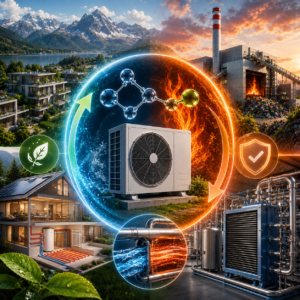
A symbolic milestone came on March 10, 2026, when the revised Enforcement Decree of the New and Renewable Energy Act was officially promulgated, formally recognizing air-source heat pump systems within Korea’s renewable energy framework. This was a significant policy shift. Until recently, only hydrothermal and geothermal heat pump systems were institutionally recognized, despite the expanding role of heat pumps in low-carbon energy systems. The inclusion of air-source heat pump systems, therefore, represents more than a technical revision. It signals that Korea is beginning to formally recognize thermal electrification as an important pathway within national carbon-free energy policy.
Attention is now shifting from policy direction to practical implementation. In particular, the large-scale transition from conventional residential boilers to heat pump systems is expected to create substantial impacts not only on the national power grid but also on local distribution networks in residential areas. Domestic hot water demand patterns, which are concentrated during specific hours of the day, could significantly increase localized peak electricity loads if electrification proceeds without careful planning. Even with demand forecasting and load management strategies, increases in electricity demand and additional grid reinforcement will likely be unavoidable. As a result, discussions are increasingly focusing on how thermal electrification can expand while maintaining grid stability and supply reliability.
Challenges still remain, including electricity market reform, grid flexibility, and public acceptance of electrified heating systems. Nevertheless, the overall direction is becoming increasingly clear. Korea is now moving beyond a power generation-centered strategy toward a broader transformation of the entire energy system. The expansion of heat pump-centered policies and the official recognition of air-source heat pump systems within Korea’s renewable energy framework together signal the beginning of a major transition toward a sustainable, carbon-free future.

Prof. Minsung Kim
Executive Committee Alternate Delegate
Chung-Ang University
minsungk@cau.ac.kr +82 2 820 5973