

Niclas Kalter, Cedric Kötting, Anna Halle, Matthias Mersch, Christian Vering, Dirk Müller
The paper industry is among the most energy-intensive sectors. High-temperature heat pumps are becoming increasingly viable at the required temperatures of about 130°C, offering the potential to decarbonise the process efficiently. However, the efficiency of heat pumps depends highly on both the cycle configuration and the refrigerant choice. Therefore, we present a screening of promising low-GWP refrigerants for subcritical and transcritical heat pump cycles, assessing both standard and enhanced vapour-injection cycle configurations. Our results show that most considered refrigerants outperform the commonly used conventional refrigerant R245fa in both Coefficient of Performance (COP) and volumetric heating capacity (VHC).
Introduction
Industrial manufacturing continues to be associated with significant CO₂ emissions, with the steel, chemical, and paper industries being among the most energy-intensive sectors [1]. Within the paper industry, many process steps require heat at temperatures attainable with high-temperature heat pumps (HTHPs), offering an opportunity to reduce fossil fuel dependence and emissions.
The paper production process consists of five main stages [2]:
- Dilution section: The diluted pulp is evenly distributed onto the wire to form a uniform sheet.
- Wire section: Water drains away while the fibers interlock, forming a continuous paper web.
- Press section: The paper web is mechanically pressed to remove water and increase density.
- Dryer section: Heated cylinders evaporate the remaining moisture from the paper.
- Calendering section: The surface of the paper is smoothed before being wound into large rolls.
The drying and calendering stages are the most energy-intensive steps [3], accounting for approximately 60 – 70 % of the total energy demand of the paper manufacturing process [3]. During drying, the paper web passes over 50 to 100 steam-heated cylinders, depending on machine size. The specific energy consumption of this process is approximately 1245 kWh per ton of paper [4]. In the subsequent calendering process, the paper passes over rolls heated to 80-400 °C, depending on product requirements and paper type. Hot water or pressurized steam at temperatures of up to 120 °C is commonly used, with an energy demand of around 220 kWh per ton of paper [4].
At present, both processes are predominantly supplied by gas-fired boilers. High-temperature heat pumps represent a promising alternative for these applications. They can deliver heat at the required temperature levels while significantly reducing fossil fuel use and carbon emissions. Integrating such systems into paper manufacturing processes could therefore play an important role in the industry’s transition towards climate-neutrality.
For the analysis presented here, we set the target heat sink temperature (TSink) for our HTHP to 130 °C, aiming to replace fossil-based steam generation at pressures below 5 bar, which is prevalent in European paper mills [5]. This selection is further motivated by the rapid advancements and existing market readiness of HTHPs, defined as systems providing heat sink temperatures above 100 °C [6], [7]:
- Commercial Availability: Several commercial products already operate in this space. Benchmarks demonstrate that specific HTHP units equipped with screw compressors are able to deliver temperatures up to 130 °C [6].
- Decarbonization Potential: By providing heat at 130 °C, the HTHP can directly substitute heat supplied by gas boilers for drying processes, which accounts for approximately 27 % of the total industrial process heat demand in the 100 °C to 200 °C range [7].
To operate HTHPs efficiently at this temperature, a sufficiently high-grade heat source ( is required. We propose utilising on-site low-temperature waste heat or District Heating (DH) at 70 °C as the heat source in our scenario. Higher source temperatures result in a lower temperature lift and thus higher COPs. In our case, the required temperature lift is relatively moderate at 60 K. This falls well within the high-efficiency operating window of modern HTHPs, whose COPs typically range from 2.4 to 5.8 for lifts between 95 K and 40 K [6]. However, reaching high efficiencies is key to the economic viability of industrial heat pumps. While achievable, it necessitates a sophisticated cycle design and refrigerant selection.
Cycle Configurations
The standard, single-stage vapor compression cycle is primarily used for low temperature lifts (around 30 K [7]). At higher temperature lifts, critical challenges arise:
- Efficiency Degradation: The COP decreases significantly as the temperature lift increases [8]. However, multi-stage cycles can increase the overall efficiency [9], [10].
- High Discharge Temperature: This yields a high lubricant temperature [8]. High temperatures threaten the thermal stability of the refrigerant-lubricant mixture [10]. This potentially leads to lubricant degradation, loss of lubrication, and material issues within the compressor [8], limiting its operating range and durability [11].
Although the maximum temperature lift for a standard cycle may reach up to 80 K [7], operation at a 60 K lift, as required for our application, places the system under substantial strain. Modifications to the simple heat pump flow sheet help overcome the performance and reliability limitations [10]. These modifications aim to reduce the compression work and mitigate the issue of high discharge temperatures, thereby extending the operating limits [12].
One of the most effective and widely adopted concepts for high-temperature lift applications is the quasi-two-stage cycle with vapor injection [10]. This technique fundamentally changes the compression process by injecting refrigerant vapor at an intermediate pressure to intercool the partially compressed vapour (see Figure 1) [11].
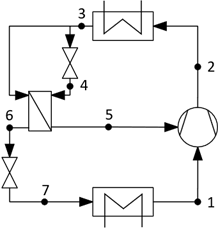
We therefore compare the performance of the simple, single-stage standard cycle, which serves as a baseline, with that of the vapour injection cycle. This comparison allows us to quantitatively demonstrate how modifications to the flow sheet address the core challenges of achieving high COPs and VHCs depending on the selected refrigerant.
Refrigerant Choice Matters for Efficiency and Volumetric Heating Capacity
The fluid screening is performed on refrigerants preselected from the REFPROP database to conform to the EU regulation on fluorinated greenhouse gases [13], which requires the fluids to have an Ozone depletion potential (ODP) of 0 and a Global Warming Potential (GWP) of less than 150 [14]. Flammability and toxicity are not restricted during the refrigerant selection, as we consider systems for industrial applications that will be tightly monitored and operated by professional staff.
Two screening processes are implemented: one for subcritical and one for transcritical processes. To avoid air leaking into the system, the minimum allowable evaporation pressure is set to 1.1 bar. For subcritical processes, the condensation pressure is limited to 90 % of the critical pressure, while for transcritical processes, the critical temperature must lie between the source and sink temperatures.
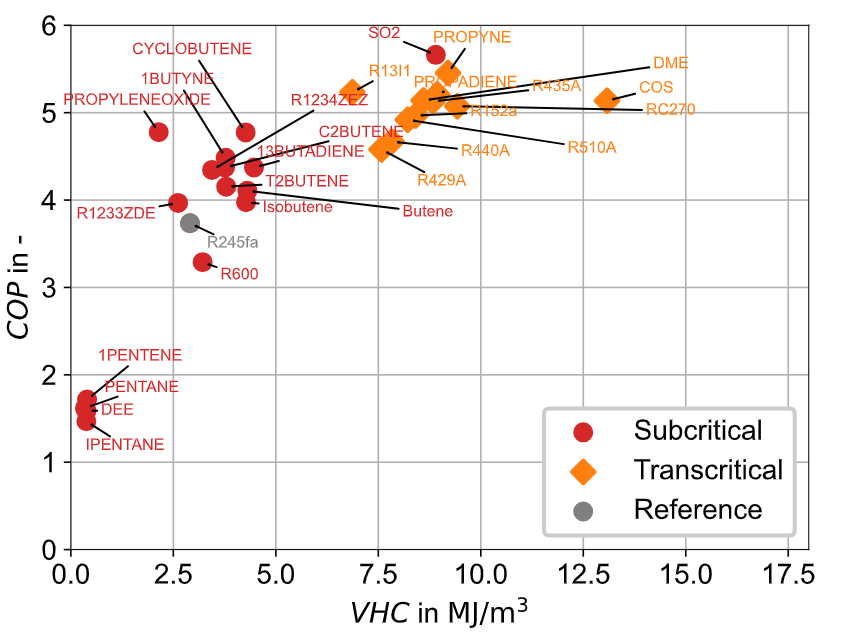
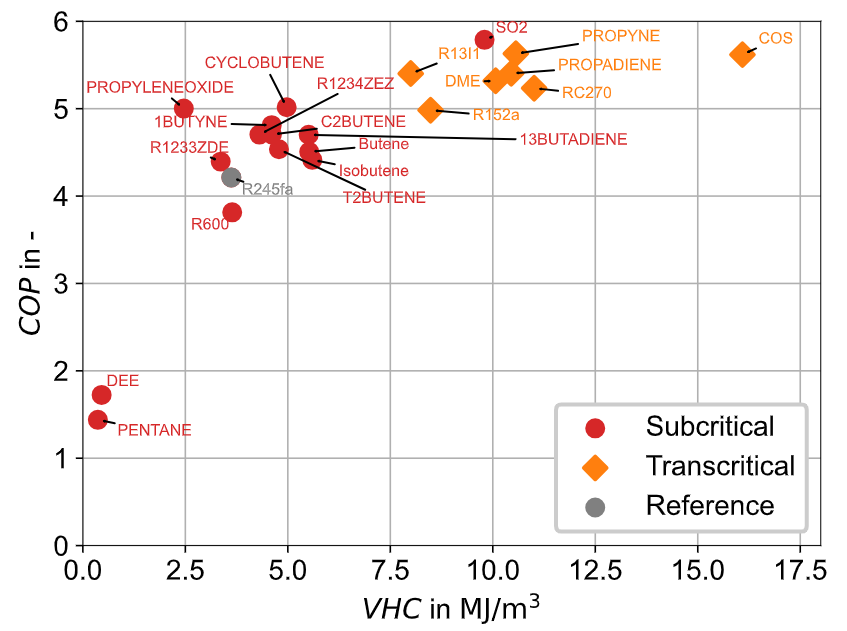
When applying these criteria, 20 suitable refrigerants remain. Among these, 13 refrigerants allow a subcritical process while 7 refrigerants result in transcritical operation. Figure 2 compares them in terms of their COP and VHC for the standard cycle and the vapor injection cycle.
The COP is a measure of cycle efficiency and, thus, of electricity usage and operating costs. The VHC, on the other hand, quantifies the useful heat output per unit volume. Thus, a higher VHC implies smaller components and lower investment costs [15]. For high-temperature heat pumps, operating costs typically dominate the levelised cost of heat [16], suggesting a higher importance of the COP for optimal refrigerant selection.
In both simulations, three clusters of refrigerants emerge:
- One cluster in the lower left-hand corner with COPs near 1.5 and VHCs lower than 1MJ/m3, which are not suitable for our application due to their low efficiency.
- A second cluster predominantly containing refrigerants in subcritical operation at COPs of 3.5 to 5 and VHCs of 2.4 MJ/m3 to 5.5 MJ/m3. Notably, natural refrigerants with four carbon atoms such as butane, butene and butyne offer a similar performance to HFOs like R1234ze(Z) in terms of both efficiency and volumetric heating capacity.
- A third cluster with COPs over 5. These refrigerants require transcritical operation under the investigated conditions. Transcritical cycles feature a gas cooler instead of a condenser and pose larger difficulties in designing control architectures, as pressure and temperature are no longer coupled by the phase change within the two-phase region and must thus be controlled independently from one another.
Almost all of the investigated refrigerants in the second and third cluster outperform the reference fluid, R245fa, a HFC with a GWP of 858 [18] commonly used in high-temperature heat pumps [6].
The majority of refrigerants in this third cluster contain a double (SO2) or triple bond (Propyne) or a carbon ring (RC270). These compounds have a high energy content but may be chemically unstable [18]. This is especially of concern at higher temperatures. Sulfur dioxide (SO2) is an outlier, as it performs well while remaining subcritical under the investigated operating conditions. However, it is corrosive to copper and therefore necessitates more expensive stainless steel piping.
Advanced Flowsheets Allow even Further Improvement
More complex cycle configurations can potentially offer efficiency improvements [18]. Figure 3 compares the results for the vapour injection cycle with the baseline standard cycle results.
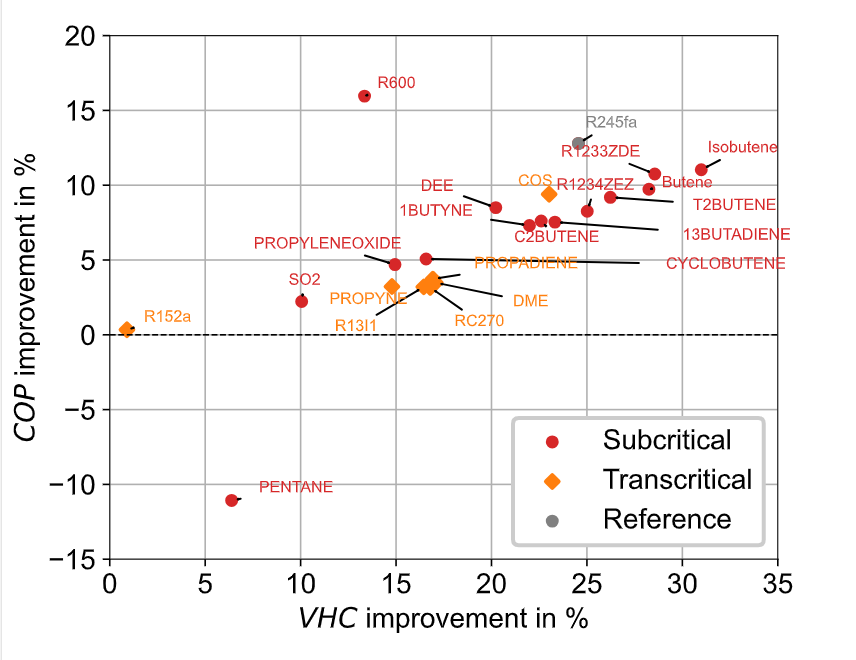
One of the largest VHC improvements is achieved for R1233zd(E), which was also identified as a promising refrigerant by Frate et al. [15], who screened refrigerants considering both COP and VHC under operating conditions similar to ours. The largest COP improvement is observed for R600, which is consistent with the findings of Höges et al. [14].
The results clearly indicate that vapour injection refrigerant cycles are superior in terms of efficiency and energy density for high-temperature heat pumps. The advanced cycle configuration enables improvements of over 10% in COP and over 25% in VHC. The large improvement in VHC is due to the injection of high-density fluid during the compression, limiting the maximum compressor temperature and increasing mass throughput.
Limitations
This study focuses on pure fluids. An alternative is the use of zeotropic mixtures to achieve temperature glide matching. The mixture composition is chosen so that the slope of the non-isothermal phase change matches that of the secondary fluid. This minimises the temperature difference in the heat exchanger and thus exergy losses. However, as Roskosch et al. [19] point out, the utilised compressor model must accurately reflect the fluid-dependent efficiencies of the zeotropic mixture to realize the theoretical COP improvements in practice. Widmaier et al. [20] have used Roskosch’s compressor model to explore the possibilities of using refrigerant mixtures to increase standardisation in the HTHP sector.
The methodology outlined in this study may be extended in similar ways in future work. Optimisation algorithms similar to those developed by Mersch et al. [21] may be used to include cost correlations rather than screening purely based on COP and VHC. Using group contribution theories such as PC-SAFT, the optimization can even go down to the molecular level in order to identify entirely novel refrigerants [22].
Conclusions
In this study, we investigated the decarbonisation of the drying and calendering processes in a paper mill using a high-temperature heat pump. We screened the REFPROP database for refrigerants that comply with current EU regulations. The analysis considers subcritical and transcritical processes and compares the results of a standard refrigerant cycle with those of a vapor-injection cycle using an economizer. The key findings are:
- The choice of refrigerant has a large impact on both efficiency and energy density, thus operating and investment costs.
- Low-GWP natural and synthetic refrigerants can outperform conventional refrigerants such as R245fa even using a standard cycle.
- Using a vapour-injection cycle improves the attainable COP by up to 15 % and the VHC by up to 32 %.
- The work can serve as a basis for future optimisation studies on optimal combinations of refrigerant and flow sheet with respect to economic and ecological aspects.
Author contact information
| Name | Niclas Kalter |
| Affiliation | Institute for Energy Efficient Buildings and Indoor Climate, RWTH Aachen University |
| Postal address | Mathieustrasse 10, 52074 Aachen |
| E-mail address | niclas.kalter@eonerc.rwth-aachen.de |
| Phone number | +49 241 80 49 793 |
References
[1] A. von Rebnitz, M. Hantke, and K. Brabender, “DIE PAPIERINDUSTRIE – Leistungsbericht PAPIER 2024,” DIE PAPIERINDUSTRIE e.V., Berlin, Leistungsbericht, Apr. 2024.
[2] F. Veitengruber, “Energetische Hybridisierung von energieintensiven Prozessen – Leitfaden für die Erschließung der Potenziale im Unternehmen.” Accessed: Oct. 30, 2025. [Online]. Available: https://www.ffe.de/wp-content/uploads/2020/02/Energetische-Hybridisierung.pdf
[3] J. Laurijssen, A. Faaij, and E. Worrell, “Benchmarking energy use in the paper industry: a benchmarking study on process unit level,” Energy Effic., vol. 6, no. 1, pp. 49–63, Feb. 2013, doi: 10.1007/s12053-012-9163-9.
[4] M. Bons, “Energiewende in der Industrie,” Executive Summary to the Bundesministerium für Wirtschaft und Energie Vorhaben: I C 4 – 80 14 38/42; Projekt-Nr. 42/17. Accessed: Oct. 30, 2025. [Online]. Available: https://www.bundeswirtschaftsministerium.de/Redaktion/DE/Downloads/E/energiewende-in-der-industrie-ap2b-executive-summary.pdf?__blob=publicationFile&v=4
[5] T. Nowak and A. Westenbroek, “Cepi-x-EHPA.” Feb. 2023. Accessed: Oct. 30, 2025. [Online]. Available: https://www.cepi.org/wp-content/uploads/2023/02/Cepi-x-EHPA.pdf
[6] C. Arpagaus, F. Bless, M. Uhlmann, J. Schiffmann, and S. S. Bertsch, “High temperature heat pumps: Market overview, state of the art, research status, refrigerants, and application potentials,” Energy, vol. 152, pp. 985–1010, Jun. 2018, doi: 10.1016/j.energy.2018.03.166.
[7] K.-M. Adamson et al., “High-temperature and transcritical heat pump cycles and advancements: A review,” Renew. Sustain. Energy Rev., vol. 167, p. 112798, Oct. 2022, doi: 10.1016/j.rser.2022.112798.
[8] A. Redón, E. Navarro-Peris, M. Pitarch, J. Gonzálvez-Macia, and J. M. Corberán, “Analysis and optimization of subcritical two-stage vapor injection heat pump systems,” Appl. Energy, vol. 124, pp. 231–240, Jul. 2014, doi: 10/f54xsz.
[9] M. E. Konrad and B. D. MacDonald, “Cold climate air source heat pumps: Industry progress and thermodynamic analysis of market-available residential units,” Renew. Sustain. Energy Rev., vol. 188, p. 113739, Dec. 2023, doi: 10.1016/j.rser.2023.113739.
[10] M. Zehnder, “Efficient air-water heat pumps for high temperature lift residential heating, including oil migration aspects,” Lausanne, EPFL, 2004. doi: 10.5075/EPFL-THESIS-2998.
[11] F. M. Tello Oquendo, “Study of scroll compressors with vapor-injection for heat pumps operating in cold climates or in high-temperature water heating applications,” Universitat Politècnica de València, Valencia (Spain), 2019. doi: 10.4995/Thesis/10251/120473.
[12] H. Ceylan, “Review on the two-stage vapor injection heat pump with a flash tank,” Eng. Sci. Technol. Int. J., vol. 48, p. 101583, Dec. 2023, doi: 10.1016/j.jestch.2023.101583.
[13] European Union, Regulation (EU) 2024/573 of the European Parliament and of the Council of 7 February 2024 on fluorinated greenhouse gases. 2024, p. 67. Accessed: Oct. 30, 2025. [Online]. Available: https://eur-lex.europa.eu/legal-content/EN/TXT/PDF/?uri=OJ:L_202400573
[14] C. Höges, D. Roskosch, J. Brach, C. Vering, V. Venzik, and D. Müller, “Investigation of the Interactions between Refrigerant, Flowsheet, and Compressor in Residential Heat Pumps,” Energy Technol., vol. 11, no. 2, Feb. 2023, doi: 10.1002/ente.202201295.
[15] G. F. Frate, L. Ferrari, and U. Desideri, “Analysis of suitability ranges of high temperature heat pump working fluids,” Appl. Therm. Eng., vol. 150, pp. 628–640, Mar. 2019, doi: 10.1016/j.applthermaleng.2019.01.034.
[16] F. Schlosser, S. Zysk, T. G. Walmsley, L. Kong, B. Zühlsdorf, and H. Meschede, “Break-even of high-temperature heat pump integration for milk spray drying,” Energy Convers. Manag., vol. 291, p. 117304, Sep. 2023, doi: 10.1016/j.enconman.2023.117304.
[17] A. Okasha, N. Müller, and K. Deb, “Bi-objective optimization of transcritical CO2 heat pump systems,” Energy, vol. 247, p. 123469, May 2022, doi: 10.1016/j.energy.2022.123469.
[18] C. Höges, V. Venzik, C. Vering, and D. Müller, “Decarbonizing Steam Generation with High Temperature Heat Pumps: Refrigerant Selection and Flowsheet Evaluation,” in Proceedings of the 14th IEA Heat Pump Conference 2023, Chicago, IL, USA, May 2023. [Online]. Available: https://www.researchgate.net/publication/371314235_Decarbonizing_Steam_Generation_with_High_Temperature_Heat_Pumps_Refrigerant_Selection_and_Flowsheet_Evaluation
[19] D. Roskosch, V. Venzik, J. Schilling, A. Bardow, and B. Atakan, “Beyond Temperature Glide: The Compressor is Key to Realizing Benefits of Zeotropic Mixtures in Heat Pumps,” Energy Technol., vol. 9, no. 4, p. 2000955, Apr. 2021, doi: 10.1002/ente.202000955.
[20] P. Widmaier, L. P. M. Brendel, S. S. Bertsch, A. Bardow, and D. Roskosch, “One Mixture to Rule Them All: Enhancing Efficiency and Standardization of Industrial High-Temperature Heat Pumps,” ACS Eng. Au, vol. 5, no. 4, pp. 359–369, Aug. 2025, doi: 10.1021/acsengineeringau.4c00060.
[21] M. Mersch, D. Tillmanns, P. Sapin, J. Schilling, A. Bardow, and C. N. Markides, “Integrated thermo-economic organic Rankine cycle and working fluid design – On the accuracy of molecular-based computer-aided methodologies,” Comput. Chem. Eng., vol. 199, p. 109151, Aug. 2025, doi: 10.1016/j.compchemeng.2025.109151.
[22] J. Schilling, D. Tillmanns, M. Lampe, M. Hopp, J. Gross, and A. Bardow, “From molecules to dollars: integrating molecular design into thermo-economic process design using consistent thermodynamic modeling,” Mol. Syst. Des. Eng., vol. 2, no. 3, pp. 301–320, 2017, doi: 10.1039/C7ME00026J.
