

Mostafa Babaei, Institute for Environmental Sciences, University of Geneva, Switzerland
High-temperature heat pumps are becoming a cornerstone of industrial decarbonization, offering a pathway to replace fossil-fuel-based heating with clean, efficient alternatives. Yet determining how and where to integrate them effectively remains a major challenge for engineers and planners. Traditionally, system design has relied on expert judgment and manual iteration, an approach that is too slow to keep pace with industrial transformation and the diversity of process conditions. This article examines how combining physics-based reasoning with data-driven algorithms can automate design and integration, enabling faster and more efficient electrification of industrial heat.
Introduction
Industry accounts for more than one-third of global final energy use, and nearly two-thirds of that energy is consumed to produce heat. Despite steady efficiency improvements, about 80 percent of industrial heat worldwide is still generated by burning fossil fuels. Replacing this heat with renewable or electricity-based alternatives is therefore one of the most direct and impactful steps toward reducing industrial emissions.
High-temperature heat pumps (HTHPs) offer a practical solution. They can recover low-grade waste heat from cooling streams or exhaust gases and upgrade it to provide process heat at the required temperature levels. For many applications, particularly those operating below approximately 200 °C, HTHPs can already achieve high efficiency and competitive operating costs. Their adoption, however, remains limited, not because of technology immaturity but because each industrial site presents a unique combination of heat sources, sinks, and process constraints.
Designing an effective heat-pump system requires selecting suitable temperature lifts, identifying integration points, and determining the number and size of units. Today, these decisions still rely heavily on expert judgment and manual assessment of process heat profiles. While this hands-on approach can yield robust solutions for single facilities, it becomes time-consuming and inconsistent when scaling up to many sites or exploring multiple design scenarios.
To enable large-scale deployment, heat-pump integration must evolve from manual, experience-driven design toward systematic and automated workflows. Such automation can use thermodynamic reasoning to identify technically sound operating conditions while algorithmic methods handle the complex task of configuration and sizing. By combining engineering knowledge with computational intelligence, designers can rapidly evaluate a wide range of options within a single framework. This transition does not replace human expertise; it amplifies it, allowing engineers to focus on strategic decisions while algorithms perform the heavy analytical work.
From Expert Design to Automated Integration
The integration of industrial heat pumps is a complex engineering task that requires balancing thermodynamic feasibility, process compatibility, and economic performance. Traditionally, this process has relied on expert-driven studies in which engineers manually analyze process data to identify suitable heat sources, sinks, and temperature levels for heat-pump operation. Such assessments typically make use of Grand Composite Curves (GCCs) to visualize process heating and cooling demands and to identify opportunities for heat recovery. While these methods provide valuable insights, they are highly dependent on engineering experience and can be time-consuming when applied across multiple sites or scenarios.
As industrial decarbonization progresses, there is a growing need for design approaches that can systematically evaluate a large number of integration opportunities. Applying conventional methods at scale would require considerable effort and may still overlook viable options due to the diversity of industrial processes and boundary conditions. Automated frameworks can help address this challenge by combining process data with thermodynamic reasoning and algorithmic tools to identify feasible and cost-effective heat-pump solutions. The key idea is to move from a sequential, human-led workflow to a structured system that can automatically evaluate many potential matches. In this context, each possible combination of waste-heat sources and process-heat demands is tested using simplified thermodynamic models. These models estimate whether the required temperature lift and expected performance fall within practical operating ranges. Configurations that are technically unrealistic or inefficient can be excluded early in the process, leaving only those that warrant detailed investigation.
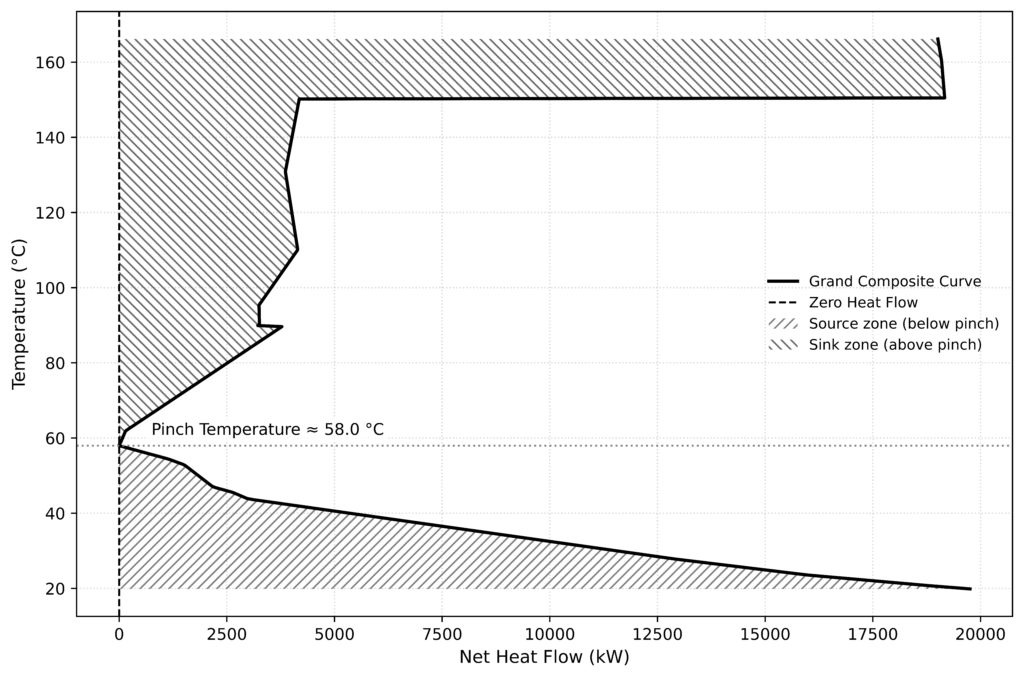
This thermodynamic screening serves as a transparent filter, reducing the design space and ensuring that subsequent optimization focuses on meaningful cases. Figure 1 illustrates an example of a Grand Composite Curve from a paper mill, where the regions below and above the pinch point represent potential heat-source and heat-sink zones for a high-temperature heat pump. Such profiles form the foundation for automated screening by clearly outlining feasible temperature intervals and helping identify the most promising integration levels.
Thermodynamic Feasibility and Process Matching
A central element of automated design is the assessment of thermodynamic feasibility. Instead of testing every possible configuration in detail, simplified models use temperature data from process streams to estimate whether a given source-sink pair is compatible with heat-pump operation. Using the concept of an ideal Carnot cycle as a reference, these models approximate the maximum theoretical performance and identify the range of temperature lifts that remain realistic within a given efficiency threshold.
By mapping this information across all process streams, the framework generates a systematic picture of which heat sources and sinks can potentially be connected. Pairs that would require excessive temperature lift or lead to poor performance can be filtered out automatically. The result is a reduced set of technically sound options that form the basis for further system-level evaluation. This approach accelerates the assessment and improves consistency, enabling fair comparison of multiple sites or process scenarios using a common set of thermodynamic criteria.
Superstructure and Integration Framework
Once the feasible temperature levels and source-sink combinations are known, the next challenge is to determine how one or several heat pumps can best be configured to meet the process requirements. Industrial facilities often include multiple heating and cooling streams with different temperature levels and loads, making manual evaluation of all possible arrangements difficult.
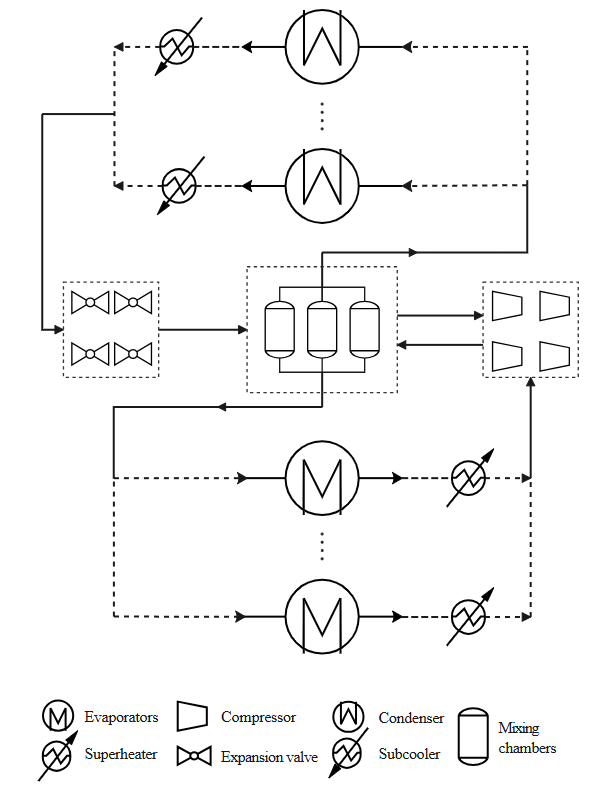
A superstructure-based framework addresses this challenge by representing all potential configurations within a single model. Each configuration describes a specific way of linking evaporators and condensers, possibly with intermediate heat exchangers or different working fluids. Optimization algorithms explore these configurations to find the combination that minimizes total annual cost while satisfying thermodynamic and operational constraints.
The concept is illustrated in Figure 2, in which multiple heat sources and sinks are evaluated under alternative heat-pump configurations. The algorithm then selects the most cost-effective configuration that meets process requirements. This approach enables consistent evaluation of both technical and economic performance, providing a unified view of feasibility, efficiency, and cost within the same analytical framework. By embedding thermodynamic screening and cost evaluation into a single structure, the superstructure framework bridges the gap between early-stage feasibility and detailed design. It enables engineers to rapidly and transparently explore multiple integration options through a reproducible process that complements, rather than replaces, engineering expertise.
Conclusions
Automating the design and integration of industrial heat pumps can significantly accelerate their deployment and improve decision-making consistency. By combining thermodynamic reasoning with algorithmic exploration, feasible temperature levels and optimal system configurations can be identified efficiently across diverse industrial processes. The superstructure framework provides a unified platform to compare alternatives, balancing technical feasibility and economic performance within a single tool.
Beyond individual projects, such approaches can support broader energy-transition strategies by identifying the most promising opportunities for electrifying industrial heat. As computational methods become more accessible, automation will increasingly complement engineering expertise, enabling faster, more transparent, and data-driven design of high-temperature heat-pump systems for industry.
Author contact information
| Name | Mostafa Babaei |
| Title | PhD Researcher |
| Affiliation | Group for Energy Efficiency, Institute for Environmental Sciences, University of Geneva |
| Postal address | University of Geneva, Institute for Environmental Sciences Boulevard Carl-Vogt 66, 1205 Geneva, Switzerland |
| E-mail address | Mostafa.babaei@unige.ch |
| Phone number | +41 76 645 41 30 |
References
[1] International Energy Agency (IEA). Energy System – Industry. Available at: https://www.iea.org/energy-system/industry (accessed October 2025).
[2] International Energy Agency (IEA). Energy System – Buildings. Available at: https://www.iea.org/energy-system/buildings (accessed October 2025).
[3] European Heat Pump Association (EHPA). Market and Policy Information on Heat Pumps. Available at: https://www.ehpa.org (accessed October 2025).
[4] Babaei, S., et al. (2025). Title of Your Paper. Journal of Cleaner Production. https://doi.org/10.1016/j.jclepro.2025.146109
[5] Wallerand, A. S., Kermani, M., Kantor, I., & Maréchal, F. (2018). Optimal heat pump integration in industrial processes. Applied Energy, 219, 68-92. https://doi.org/10.1016/j.apenergy.2018.02.114
