

3.3 Heat Pump for a Number of Apartments
50APARTMENTS GROUPED BY HEAT GENERATOR
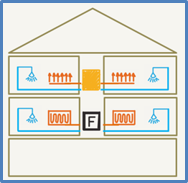

Main characteristic of the concept
The apartments are grouped by heat generators (usually grouped by levels or staircases).
Heat distribution and temperatures levels
The heat distribution occurs through the section of the building (usually a level or a staircase). The heat generators for each sector or group of sectors of the building differ. In sectors with heat pumps, each of them provides heat for space heating, as well as for DHW.
Size of building, number of apartments
This solution is more suitable for average and large buildings. In smaller buildings there is usually no need for grouping the apartments by heat generator.
DHW and storage characteristic
Depending on the sector of the building, the DHW is provided either by a heat pump or by other type of heat generator. Storage tanks for the DHW are needed.
Energy standard, insulation level
This solution is rather suitable in refurbishment cases with lower energy standard. Not a favourited solution for new buildings due to use of fossil energy sources.
Complexity of installation
The complexity of the whole hydronic system of the building is reduced through using several hydronic circuits. Complexity is related to the space needed for each heat pump (several technical rooms), as well as their connection to the heat source. In case of retrofitting, exchanging heat generation for only a group of apartments at a time may reduce the complexity of the planned construction work.
Heat Sources
All heat sources possible. Depending on the position of heat pumps, some heat sources may be very difficult to implement. For example, it may be difficult to connect ground collectors if the heat pump it is not located on the ground floor. In some cases, use of outside air may be difficult due to the sound emissions or heat source capacity.
Specific issues of the concept
The solution allows for retrofitting of the building section by section. May be convenient when retrofitting large buildings.
Positive aspects
- Interim solution for larger existing MFB’s in a phased approach or for partially renovated buildings.
Negative aspects
- Distribution of source energy through the building
- Decentral noise of outside-air units
- As final solution a substantial use of fossil fuel remains