

By Rainer M. Jakobs, Alternate Delegate of Germany, IEA HPT TCP, PhD, Information Centre on Heat Pumps and Refrigeration IZW e.V
What is the current status of Heat Pumps (HPs)? Is the HP technology at a limit? Which temperatures and what capacities could HPs achieve? What technological progress has been made in recent years? Are major steps forward in increasing efficiency still possible?
Which findings did the European Heat Pump Summit provide us with on such topics? The Summit took place on October 28-29, 2025, and returned for its ninth edition at a pivotal moment in the global energy transition. The HP industry stands at an unprecedented inflection point where political commitment, technological innovation, and market momentum converge to reshape how we heat our buildings and power our industries.
The European HP market has undergone a remarkable transformation. Building on 2022’s record-breaking 38 % sales increase to 3 million units, the market continues on a growth course. With over 25 million HPs (as of the end of 2024) installed across Europe, we’re witnessing a fundamental shift in heating and cooling approaches. The European HP market is now showing a slight yet uneven recovery this year. Sales across 13 European countries increased by an average of 9% in the first six months of 2025, compared with the same period in 2024. Despite this slight rebound, overall market confidence is still lower than in the record sales year of 2022. Progress is constrained by policy uncertainty and reduced incentives, according to national experts. (Source EHPA)
While residential applications have driven initial growth, industrial HPs represent the next critical frontier. With process heat accounting for over two-thirds of industrial energy consumption and still predominantly using fossil fuels, the transformation potential is immense. Simultaneously, 20-50 % of industrial input energy is lost as waste heat, presenting an untapped circular energy resource.
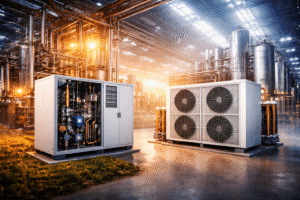
The Summit featured groundbreaking presentations on industrial applications that push technical and economic boundaries: transforming waste heat into high-pressure steam at 215 °C, or delivering solutions with 50 MWth, e.g., with the flagship BASF Ludwigshafen installation. It demonstrates real-world viability at scale.
The programme reflected increasing sophistication in HP applications. Denmark’s Esbjerg Mega HP showcases successful district heating integration, while presentations on chemical, petrochemical, food and beverage, and pulp and paper applications demonstrated sector-specific solutions. These real-world case studies offered practical insights for navigating complex industrial transformations.
The convergence of heat pump technology with digitalization and IoT capabilities opens new optimization frontiers. The comprehensive hardware-in-the-loop testing facility accelerates HP innovation from concept to deployment. Using versatile test benches with multiple cycle configurations, it optimizes refrigerant selection and system design for safety and performance across all operational ranges. The future of energy management with model predictive control (MPC) solutions will be thoroughly tested in holistic building energy systems. (Source RWTH Aachen)
The ongoing evolution of refrigerant regulations remains critical, demanding industry-wide collaboration and innovation. F-Gas Regulation amendments and PFAS discussions require thinking beyond traditional metrics. While Global Warming Potential remains important, comprehensive assessments using Total Equivalent Warming Impact (TEWI) and Life Cycle Climate Performance (LCCP) provide a more accurate picture of environmental impact.
The contents of the European Heat Pump Summit reflected the ongoing evolution of the HP sector and its growing relevance in various fields of application. Alongside market analyses and policy frameworks, the focus was on leading-edge topics, including digital simulation-based modelling methods, HP solutions for industry, and district heating at the megawatt scale. It is remarkable that even established companies in the engine manufacturing and machine construction sectors are increasingly engaging with HP technology, thereby contributing to the ongoing development of the sector.

Dr.-Ing. Rainer Jakobs
Executive Committee Alternate Delegate
Information Centre on Heat Pumps and Refrigeration
Jakobs@izw-online.de +49 6163 57 17