

By Benjamin Zühlsdorf, Innovation Director, PhD, Danish Technological Institute, Denmark
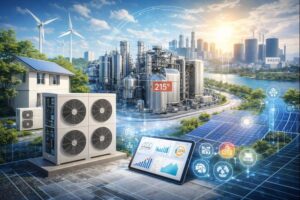
Industrial heat pumps have firmly established themselves as a game-changer for decarbonizing industrial process heating. By combining high energy efficiency with electrification, they are the optimal solution for a wide range of low- and medium-temperature applications, replacing fossil-fuel boilers while reducing emissions and operating costs.
Their relevance, however, extends far beyond climate policy. In an environment shaped by volatile fuel prices and geopolitical uncertainty, industrial heat pumps are increasingly seen as a strategic asset. They strengthen competitiveness through lower and more predictable energy costs and reduce dependence on imported fuels. These factors are rapidly becoming key decision drivers for companies and countries and are likely to further accelerate market uptake.
At the same time, the broader Electrotech-Revolution is accelerating deployment. The rapid build-out of renewable electricity, advances in power electronics and digitalization, and growing sector coupling all reinforce the business case for electrified process heat. Industrial heat pumps are at the heart of this development, converting increasingly green electricity and excess heat into reliable, high-value industrial heat.
Recent results from the IEA HPT Project 68 show that technologies are well underway. The technology portfolio is expanding, with more suppliers and solutions available, including systems delivering temperatures well above 200 °C. Commercialization and competition are intensifying, particularly in the range up to 140 °C, and market uptake is visible through a growing number of projects across diverse applications. Natural refrigerants are driving most new developments, while component supply chains are scaling as multiple suppliers build on proven compressors, heat exchangers, and other key components. Experience from real projects also underscores that integration is key: the roles of integrators and process equipment suppliers are crucial to ensuring optimal design, performance, and reliability.
To fully unlock this potential, a clear shift in mindset is needed. End-users must move from simple fuel substitution to rethinking their process heat supply around efficiency, electrification, and smart integration of heat pumps into the overall process. This transformation can only succeed through close collaboration along the entire value chain – from technology providers, integrators, and process equipment suppliers to industrial end-users, researchers, utilities, and policymakers.
An ideal place to catch up on the latest developments and connect with this community is the High-Temperature Heat Pump Symposium in Copenhagen on 21 & 22 January 2026 (https://hthp-symposium.org/). I hope this issue of Heat Pumping Technologies Magazine inspires you to explore the opportunities of industrial heat pumps, and I look forward to continuing the discussion with many of you at the HTHP Symposium.

