


In the first six months of 2026, sales of residential heat pumps rose by 11% in 12 European countries, according to new statistics presented by the European Heat Pump Association (EHPA). One important factor behind the increase was the closure of the Strait of Hormuz in February 2026, which sent oil and gas prices skyrocketing. According to the IEA, the 2022 energy crisis reshaped Europe’s heat pump market. In Q3 2026, Asian and European gas prices averaged their highest Q3 levels since 2022. As another heating season approaches in the Northern Hemisphere, ongoing disruptions in global energy markets have once again brought concerns about energy affordability, security of supply and resilience to the forefront. On 29 October, the IEA hosted two webinars to discuss this situation with several panellists from the heat pump sector.
During two webinars, one early in the day focusing on Asia and Europe and one later in the day focusing on the Americas and Europe, the IEA analysts presented their Heat Pump Monitor, published earlier this summer. Each presentation was followed by a panel discussion with selected representatives from the heat pump sector in America, Europe and Asia.
Against this backdrop, the discussions explored how energy shocks influence heat pump markets and what lessons can be drawn for future policy and market development. They also addressed the role of energy security in driving adoption and how the convergence of heating and cooling demand may shape future market development.
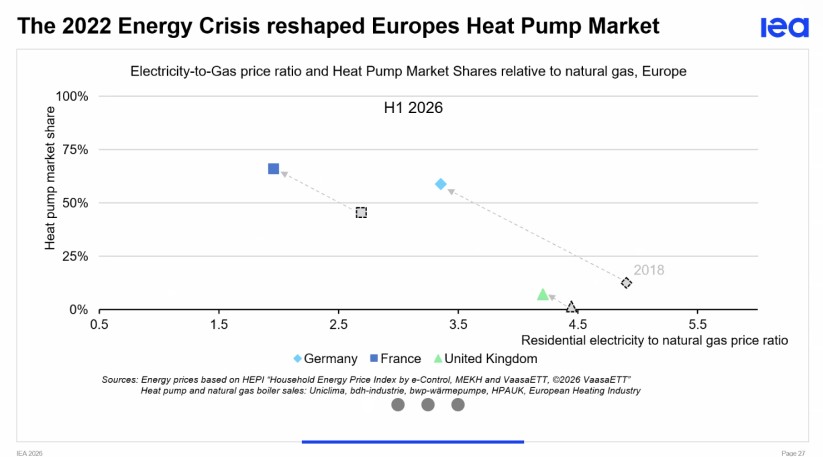
The electricity-to-gas price ratio has a large impact on heat pump penetration in different markets. Spiking gas prices have a considerable impact on this ratio. In addition, the European Commission encourages EU governments to lower electricity taxes to speed up the shift away from oil and gas. In its Electrification Action Plan, it specifically states that tax on electricity should be no higher than that on gas. The Commission is also proposing a revision of the network charges consumers pay on their power bills to reward flexible options like heat pumps.
Panel discussion
In the introduction to the panel discussion, the IEA analysts showed data illustrating how changes in electricity-to-gas price ratios have affected the market share of heat pumps in several countries from 2018 to the present. The trend is clear: a lower price ratio increases the market share of heat pumps.
The panel in the morning session consisted of Hengyi Zhao, CHPA in China; Duncan Gibb, RAP; Federica Sabbati, EHI; and Monica Axell, Heat Pump Centre, HPT TCP—the latter three based in Europe. In the later session, Justin Tamasaukas, CanmetENERGY in Canada; Martin Forsén, NIBE, Sweden; Paul Kenny, EHPA; and David Smedick, NEEP in the United States, shared their views. The questions and a summary of the answers are presented below.
Current crisis
Has there, in your opinion, been a noticeable “energy crisis effect” on heat pump markets so far, and in what ways? If not, do you think such effects could still emerge, or are other factors proving more important?
- Monica Axell from the Heat Pump Centre opened the panel discussion by stating that an energy crisis alone does not necessarily lead to growth in the heat pump market. Several factors need to work together: consumers need to be aware of and trust the technology, market actors and installers must be available, supply chains need to work properly, and policy support should be consistent and predictable.
- Many of the panellists agreed that even if there is an effect, especially in Europe, it is much more modest than the impact of the energy crisis in 2022, when the market boomed before declining sharply again in 2024. According to Duncan Gibb from RAP, such a ‘boom-and-bust’ cycle is not good for anyone—neither industry nor consumers – and the other panellists agreed. In China, sales have decreased after several years of market growth, mostly due to the slowdown in the construction sector, according to Hengyi Zhao. The United States has the highest penetration of heat pumps globally, primarily due to the combined need for heating and cooling there. David Smedick said that heat pump sales outpaced gas furnace sales in 2022. With fossil fuel prices now increasing, there is good potential for the further roll-out of heat pumps, especially in the north-east of the country.
- However, to further speed up the deployment of heat pumps and the shift away from oil and gas, long-term affordability needs to be considered. In several countries, the electricity-to-gas price ratio is still very high. Lowering taxes and fees on electricity, as recommended by the European Commission in its Electrification Action Plan, is therefore of vital importance.
Lessons from 2022
How does the current situation compare with the 2022 energy crisis? What similarities and differences do you see, and what lessons from 2022 should policymakers and industry keep in mind today?
- Martin Forsén from NIBE took us back to 2022 and made an analogy with an alarm clock. Back then the alarm went on and everyone reacted quickly and strongly – policy makers, consumers, industry. Just a few weeks after the invasion of Ukraine, the REPowerEU was published by the European Commission, and the demand for heat pumps surged. Shortly thereafter many manufacturers announced investment decisions to increase production capacity. However, after a year, when alternative gas supplies had been secured from other countries and continents, it appeared like many pushed the “snooze button”. However, everyone knows, that when you have “snoozed” the alarm will go on again. So even if the heat pump market response on the present energy crisis is more modest, consumers as well as policy makers are more aware that measures to shift away from oil and gas are needed to protect consumers from price shock and strengthen countries’ energy security. Many think twice before replacing an old fossil boiler with a new one. One of the most important drivers for heat pump roll-out is nowadays energy resilience – in addition to decarbonization, energy efficiency, affordability and clean air.
- According to several of the panellists, policymakers should keep in mind that consistency and predictability are important for a sustainable shift away from oil and gas towards electric heating using heat pumps – for consumers as well as for industry.
Structural drivers
What other factors beyond consecutive energy security crises can contribute to shaping markets moving forward? What factors will be decisive in driving sustained growth in the future?
- Many of the panellists mentioned that it is important to ensure the availability of skilled installers. Justin Tamasaukas from Canada emphasised that replacing a boiler is very rarely a planned activity. When an old fossil fuel boiler or furnace breaks down, building owners need to be able to contact skilled installers easily to arrange a heat pump installation.
- Paul Kenny, EHPA, summarized his recommendations as “tax and flex”. Shift taxation off electricity and match it with the tax on fossil energy. Make sure heat pumps run flexibly, in summer as well as in winter. Let them run when electricity price is lower and the renewable share in electricity production is high, avoid as far as possible the peak price hours and store the heat and cool between these periods. Sweden was mentioned as a market where flexible operation of heat pumps has started to be more and more common. Also, he recommended that subsidies to reduce the burden of high energy prices should focus on the people who need them and on electricity that maintains a price signal.
Heating and cooling synergies
Heat pumps and air conditioners overlap in technology and application. At the same time, AC sales have surged in important heating markets like Europe and Japan in 2026. Do you see rising air conditioner sales and growing demand for thermal comfort as a catalyst for wider heat pump adoption? How might the convergence of heating and cooling markets shape future technology development, consumer choices and policy design?
- David Smedick from the US confirmed that the high penetration of AC in the US is an important driver of heat pump roll-out. Homes that previously did not need comfort cooling but now require it because of rising outdoor temperatures and more frequent heatwaves offer great market potential for heat pumps that provide both heating and cooling. Homes that already have an AC unit combined with a gas furnace also offer potential. When these appliances need replacing, both could be replaced by a single heat pump for heating and cooling.
- A transformation is also taking place in Europe. According to Martin Forsén, in some countries where the use of electricity for comfort cooling in residential buildings was previously hardly permitted, only heat pumps with a reversible cooling function are now considered eligible for subsidies.
- Monica Axell from the Heat Pump Centre agreed that growing demand for comfort cooling and more frequent heatwaves are clear catalysts for heat pump growth. The opportunity is to address heating and cooling together. For new buildings, a heat pump that provides both is an attractive choice. But the largest market is in existing buildings, where the situation is more complex. Here, the need for cooling can create an opportunity to invest in a heat pump. To support this growth, policy, research and innovation need to address not only technology but also system integration, market formation, user acceptance and social impact. We need to create conditions that favour planned reinvestments focused on secure, affordable and sustainable thermal comfort for people.