

This publication is a new reference point for a technology under pressure to scale. A technology that offers great opportunities for heating and cooling of buildings, for industry, and for the overall energy security of society. Yet, the monitor shows that heat pumps still meet less than 15% of heating demand in buildings worldwide and remain niche in industry and district heating. The monitor includes a policy mapping that shows how heat pumps are being pushed forward across sectors in different parts of the world.
The International Energy Agency has released the Heat Pump Monitor 2026, a consolidated assessment of global and regional heat pump markets, their enabling conditions and their outlook to 2035. The framing is direct: heating and cooling account for a significant share of global energy demand and CO2 emissions, yet heat pumps still meet less than 15% of heating demand in buildings worldwide and remain niche in industry and district heating (p. 4). The IEA presents this gap as both the core challenge and the main commercial opportunity, with deployment expected to keep rising across most major economies on the back of improving cost-competitiveness, stricter building standards, rising cooling demand, wider electrification and growing interest in low-emissions district heating (p. 4). The Monitor is delivered as an online tool combining analytical text with 20 visual dashboards, organised around four pillars: cross-sectoral deployment, a deep dive on buildings, regional insights and policies (p. 5). Projections are built on three scenarios consistent with the World Energy Outlook 2025: the Current Policies Scenario (CPS), the Stated Policies Scenario (STEPS) and the Net Zero Emissions by 2050 Scenario (NZE) (p. 5, p. 6). Heat pumps are defined in line with the IEA Heat Pump Taxonomy, covering units serving as primary heating equipment and including reversible air conditioners in that role, while excluding cooling-only or minor supplementary units (p. 5, p. 43). For industry and district heating, the boundary explicitly includes mechanical vapour recompression (MVR) devices and, for district heating, thermally driven machines such as absorption heat pumps (p. 43).
The role of heat pumps across buildings: A large market waiting on policy
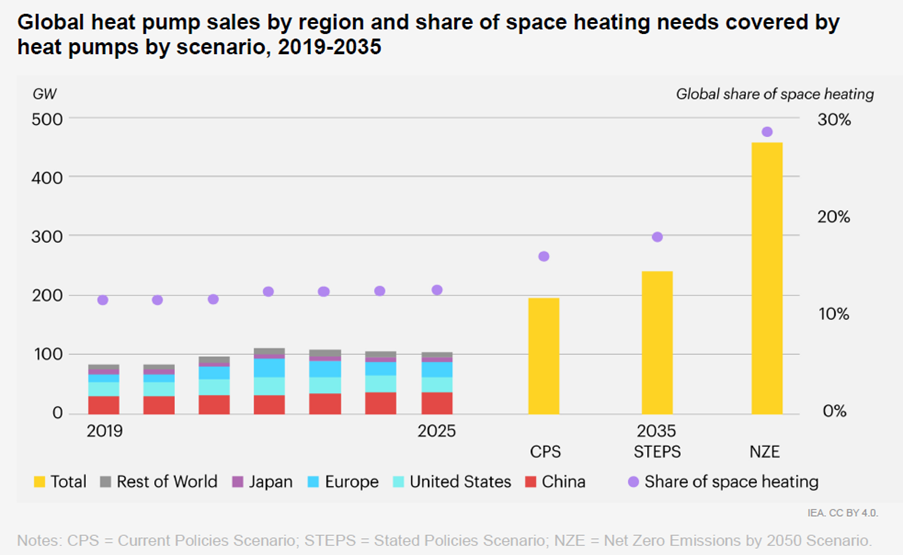
Deployment in buildings has been volatile, with record expansion in 2021 and 2022, particularly in Europe, followed by a slowdown in 2023 and broadly stable global sales since, with wide regional variation according to the publication (p. 8). The United States remains the largest market by installed stock, followed by China, Europe and Japan, while China leads on sales (p. 8). Persistent barriers are high upfront costs, high electricity prices in some regions and a shortage of skilled installers (p. 8). All three scenarios show a rebound: sales increase by over 80% by 2035 in the CPS, more than double in the STEPS to supply around 20% of global heating demand, and in the NZE Scenario grow twice as fast as over the past decade (p. 8). (See Figure 1.) Technology choice remains strongly regional. Air-to-air systems dominate in China, the United States, the Nordic countries and Japan, while Germany, the United Kingdom and northern Italy rely mainly on air-to-water hydronic systems with radiators or underfloor heating (p. 9). The IEA notes that divergent reporting standards and classifications hinder like-for-like comparison, and points to its proposed taxonomy as the route to harmonised global monitoring (p. 9).
Heat Pump Monitor 2026, IEA, Paris https://www.iea.org/reports/heat-pump-monitor-2026, Licence: CC BY 4.0)
The role of heat pumps in district heating: Small share today, large opportunity
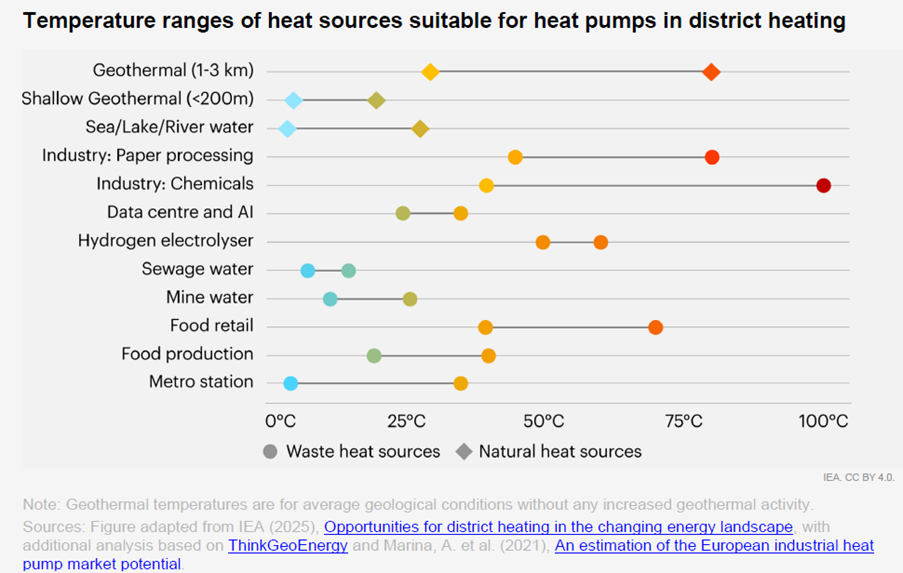
District heating supplies around 10% of global heat demand in buildings and still relies on fossil fuels for 90% of its supply globally (p. 10). In Europe, large heat pumps and electric boilers supplied about 3% of district heating in 2023, but recorded the highest growth rate of all heat sources (p. 10). Germany alone has around 900 MW of district heating heat pump capacity under construction or in planning (p. 10). Chinese district heating floorspace tripled between 2002 and 2022, while floorspace connected to district energy networks in North America grew by an average of 6% per year over the same period (p. 10). The Monitor makes a strong technical case for heat pumps in this segment, citing higher efficiency than other electric heating options and the ability to use low-temperature sources including industrial waste heat, sewage treatment plants, data centres, lakes, rivers and geothermal, together with flexible operation and thermal storage that can absorb excess solar and wind output (p. 11). Three deployments are highlighted: Stockholm, with a combined 500 MW of heat pumps supplying about 10-20% of network heat demand and among the largest such deployments globally; a 200 MW absorption heat pump in Qianxi, China, recovering waste heat from a nearby steel mill; and Amazon’s Seattle headquarters, heated since 2017 by waste heat from a neighbouring data centre via heat pumps and district heating (p. 11). A dedicated figure maps the temperature ranges of suitable sources, from sewage, mine water and metro stations at the low end through data centre and AI loads, food production and hydrogen electrolysers, up to paper processing and chemicals above 75°C (p. 11). (See Figure 2.)
IEA, Paris https://www.iea.org/reports/heat-pump-monitor-2026, Licence: CC BY 4.0)
The role of heat pumps in industry: High-temperature machines approaching commercial roll-out
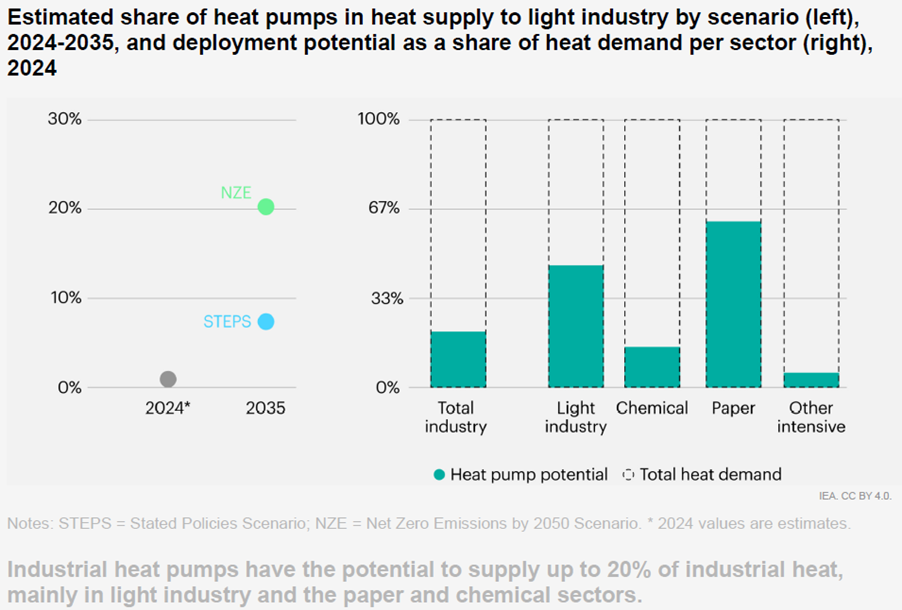
Industrial uptake remained very low until a recent acceleration, constrained by high capital cost, technological complexity, grid connection delays and limited awareness (p. 12). In Japan, industrial heat pump capacity reached almost 650 MW in 2024 according to the JEHC, up from 290 MW a decade earlier (p. 12). Drying, pasteurisation and steam supply are the best-suited applications, with light industry, paper and chemicals showing the highest deployment potential (p. 12). On technology, machines reaching 120°C were first demonstrated around 2022, and commercial roll-out of units above 160°C is expected by 2027 (p. 12). In the STEPS, heat pumps supply 8% of light industry heat demand in 2035, rising to 20% in the NZE Scenario (p. 12). (See Figure 3.) Economics remain the gating factor. Industrial heat pump capital cost is about ten times that of a gas boiler and three times that of a coal boiler, so lifecycle competitiveness depends on the coefficient of performance (COP) and the electricity-to-gas price ratio (p. 13). In China, a COP below 2 would not compete against a gas boiler at current prices, while a COP above 3 shifts the balance in favour of the heat pump (p. 13). The COP is driven mainly by temperature lift, which is why higher-temperature waste heat sources act as a stepping stone to competitive high-temperature output (p. 13).
(IEA (2026), Heat Pump Monitor 2026, IEA, Paris https://www.iea.org/reports/heat-pump-monitor-2026, Licence: CC BY 4.0)
Affordability, energy security and industrial competitiveness
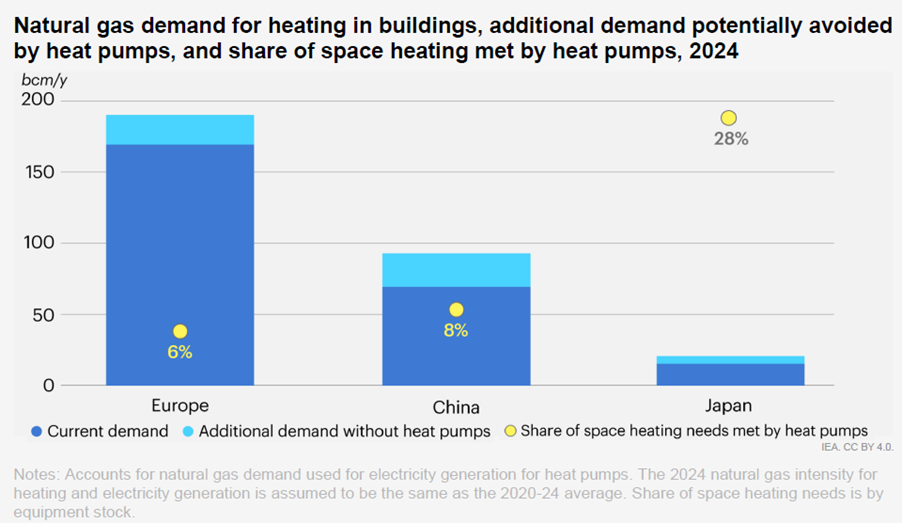
Heat pumps are 3-5 times more efficient than natural gas boilers but carry higher upfront costs, and prices differ by as much as 60% between lower and higher-cost products within comparable regions and segments (p. 16, p. 17). The Heat Pump Monitor shows that China is the most cost-competitive region across all product categories (p. 16). Policy options flagged for lifetime cost include adjusting energy taxes, levies and electricity tariffs, time-of-use pricing, direct subsidies, low-interest loans, leasing and Heating as a Service models, with Denmark and Finland cited as examples of reduced tax on electricity used for heating (p. 17, p. 18). On energy security, the numbers are notable. Peak heat pump electricity demand today ranges from around 2% to 16% of overall peak, amounting to about 10 GW in Japan and 130 GW in the United States (p. 20). In 2024, replacing all installed heat pumps with gas boilers would have raised annual gas demand for building heating by an estimated 12% in Europe (20 bcm) and by around 35% in Japan and China (6 bcm and 25 bcm respectively), with 2025 savings reaching a combined 53 bcm across the three regions (p. 21). (See Figure 4.) In Europe, gas demand in buildings fell 12% between 2019 and 2024, a decline that would have been only 3% without heat pumps, and full alignment with European targets including REPowerEU and the UK target could lift avoided consumption to 39 bcm per year by 2035, about 16% of today’s net imports (p. 34). The industrial picture is one of localised production and thin trade. Only around 15% of heat pumps installed in buildings worldwide were traded across borders in 2024, and over 70% of sales in China, the United States, Europe and Japan were sourced locally (p. 24). Global manufacturing capacity stood at around 145 GW/yr, led by China at 35%, the United States at 25% and the European Union at 20% (p. 24). About 90% of rotary compressor manufacturing capacity sits in China, which the IEA describes as an acute supply chain vulnerability, while scroll compressors and fluorspar are more diversified (p. 32). Components and materials account for 60-85% of production costs; air-to-air units cost about 40% less to produce in China than in Japan, and air-to-water units are around 60% more expensive to produce in Europe than in China (p. 25). Nearly 800 000 people work principally on heat pumps globally, about 1% of the total energy workforce, a figure that has grown 50% since 2015 and is projected to rise 30% by 2035 in the CPS, 60% in the STEPS and up to 140% in the NZE Scenario (p. 23).
(IEA (2026), Heat Pump Monitor 2026, IEA, Paris https://www.iea.org/reports/heat-pump-monitor-2026, Licence: CC BY 4.0)
Innovation: advanced cycles, refrigerants and digital integration
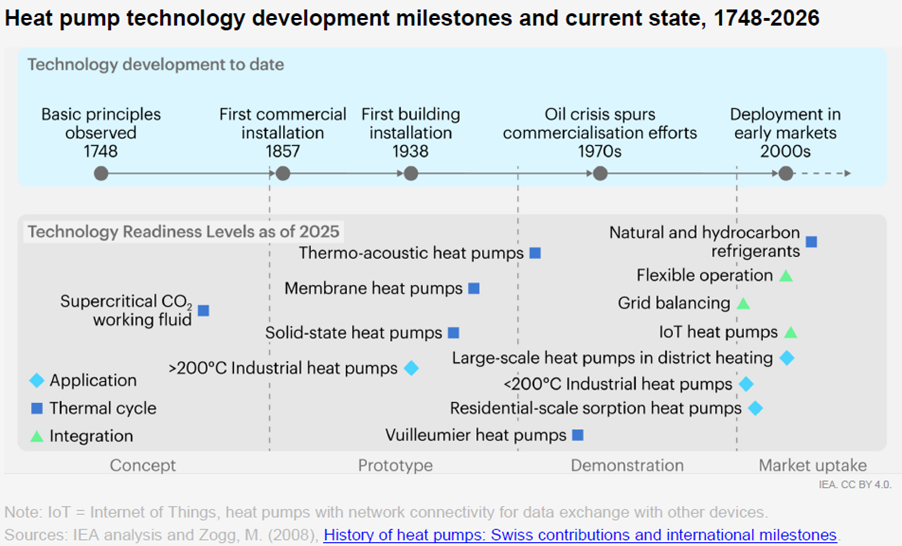
Heat pumps are treated as a mature technology, in commercial use for more than 100 years and overwhelmingly based on the vapour-compression cycle with hydrofluorocarbon refrigerants (p. 27). Absorption and adsorption designs remain limited to niche markets, while thermo-acoustic and membrane heat pumps are still under development and have not reached commercialisation (p. 27). The technology readiness figure places supercritical CO2 working fluids, thermo-acoustic, membrane, solid-state and Vuilleumier heat pumps, and industrial machines above 200°C, at concept or prototype stage, with industrial heat pumps below 200°C, large-scale district heating heat pumps and residential-scale sorption units at demonstration, and natural and hydrocarbon refrigerants, flexible operation, grid balancing and Internet of Things heat pumps moving into market uptake (p. 27). (See Figure 5.) R&D is led by multinationals including Daikin, Midea, Nibe and Carrier, alongside international collaborations, with the IEA Technology Collaboration Programme on Heat Pumping Technologies named explicitly (p. 27). Digitalisation appears mainly through integration and flexibility. The Monitor notes that intelligent operation combined with hot water storage tanks and time-of-use pricing can cut operational costs by shifting consumption to cheaper hours (p. 17), and that thermal inertia, water storage, hybrid configurations and manufacturer advances in controllability allow heat pumps to respond to grid or price signals, easing grid pressure and supporting renewables integration (p. 20). Patenting reflects the same direction of travel: activity has risen nearly fivefold since the 2000s, twice the average increase seen in other technologies, with China holding about one-third of all heat pump patents in 2022, and growth in software, system integration and low-GWP refrigerants alongside component-level innovation (p. 28). Refrigerants are the sharpest near-term regulatory pressure. Many legacy HFCs have global warming potentials more than 2 000 times that of CO2, R32 at a GWP of 675 is the widely deployed mid-transition option, and lower-GWP alternatives include HFO/HFC blends such as R-454B in the United States, CO2 in Japan and propane in Europe (p. 29). The Kigali Amendment, in force since 2019 and ratified by 172 countries as of June 2026, targets a cut in HFC use of over 80% globally by 2050, and heat pumps account for as much as 15% of HFC use in high-uptake countries (p. 29). Refrigerants below 150 GWP are expected in Europe and Japan by the end of the 2020s and in China and the United States by the early 2030s, forcing equipment redesign around higher pressures and flammability while preserving efficiency and unit size (p. 29).
Paris https://www.iea.org/reports/heat-pump-monitor-2026, Licence: CC BY 4.0)
Regional and policy signals
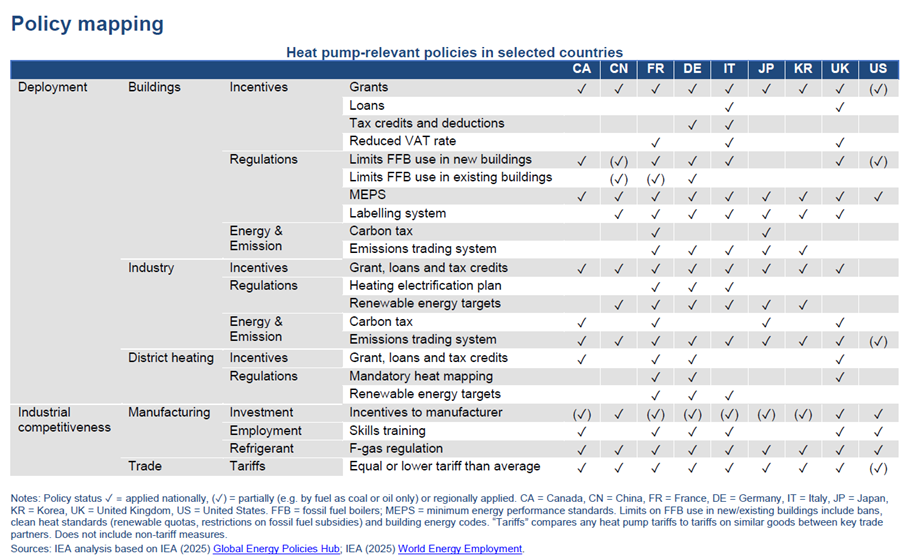
Europe accounts for more than 20% of global sales by capacity, with France, Italy and Germany leading total units sold in 2025 and Norway, Finland and Sweden showing the highest installation share per household (p. 33). After double-digit growth in 2022 and more than USD 2 billion in announced manufacturing investment, conditions weakened in 2023 and sales declined in 2024 outside the United Kingdom and Ireland, before 2025 data showed a return to growth led by countries including Germany and Sweden (p. 33). The European Commission’s Electrification Action Plan targets 32% of final energy use electrified by 2030, rising to 46% by 2040, and European heat pump stock is projected to nearly double by 2035 in the CPS and reach two-and-a-half times today’s level in the STEPS (p. 33). Elsewhere, Japan holds around 7% of global sales, with 2.8 air conditioning units per household, the highest in the world, and the CO2-based Eco-cute water heater capturing around 10% of the water heating market within a decade of its 2001 introduction (p. 35, p. 36). In the United States, 2025 heat pump sales were around 12% higher than those of fossil fuel heating systems, over 20% of households use a heat pump as primary heating, and upgrading a central air conditioner to a reversible system typically costs only USD 200-500 more, a route that could put heat pump heating in roughly 60% of US households by 2035 (p. 37, p. 38). The policy mapping shows financial incentives dominating in buildings, while long-term frameworks, regulatory reform and pricing reform remain less common, and dedicated targets in district heating and industry are limited (p. 40, p. 41). (See Figure 6.) Selected examples include China’s Heat Pump Action Plan, Korea’s target of 3.5 million heat pumps by 2035, New Zealand’s ban on new industrial coal boilers with phase-out of existing units by 2037, Moldova’s plan to integrate about 7 MW of heat pump capacity into two district heat utilities, France’s Fonds Chaleur, the Netherlands’ SDE++, the UK’s Green Heat Network Fund, the EU Net-Zero Industry Act listing heat pumps as a strategic net zero technology, and the US Industrial Heat Shot Initiative targeting an 85% cut in industrial heat emissions by 2035 (p. 41, p. 42).
IEA, Paris https://www.iea.org/reports/heat-pump-monitor-2026, Licence: CC BY 4.0)
International collaboration and the HPT TCP
International collaboration runs through the Monitor both as a data source and as an innovation channel. The IEA Technology Collaboration Programme on Heat Pumping Technologies (HPT TCP) is cited as one of the international collaborations driving heat pump R&D worldwide (p. 27), and its work feeds the analysis directly: 2024 industrial heat pump values were estimated using data from the JEHC, IEA HPT TCP Annex 48 and Project 68, and ACEEE (p. 45). The IEA District Heating and Cooling TCP and the HPT TCP are also represented among the report’s peer reviewers (p. 47, p. 48). Readers tracking the collaborative work behind these figures, including current project on high-temperature and industrial heat pumps, system integration and market monitoring, can consult the programme’s ongoing project portfolio at https://heatpumpingtechnologies.org/projects/. Taken together, the Monitor positions heat pumps less as a climate technology waiting for its moment and more as infrastructure already doing measurable work on gas imports, peak load and industrial heat. What decides the next decade, on the IEA’s reading, is not whether the technology performs, but whether policy, electricity pricing and skilled labour arrive at the same time. “The thermodynamics have been settled for a century; what remains unsettled is the price signal, the workforce and the will to build.”