


The Role of Cold Climate Heat Pumps in Decarbonization
The decarbonization of heating by replacing fossil-fueled boilers and furnaces with electric heat pumps has gained attention rapidly in recent years. This concept is particularly relevant in US homes because space and water heating make up about 40% of US residential energy consumption, up to as much as 60% in cold climates [1]. However, designing efficient heat pumps that use low-Global Warming Potential (GWP) refrigerants is only part of the story. Heat pump integration, both into existing buildings and the electrical grid, is a major challenge. Furthermore, assessing the method of energy production that electrifies a given grid cannot be forgotten. If a large percentage of a given grid is powered by fossil fuels, a heat pump is not necessarily better for the environment than a boiler.
Many heat pumps can function well in ambient temperatures down to or slightly below 0 °C. However, at ambient temperatures well below freezing, vapor compression cycles within a standard heat pump cannot always provide the required heating load and must, therefore, be supplemented by resistance heating. This results in a significant reduction in efficiency and motivates work on heat pumps that are designed to deliver the necessary heat at low ambient temperatures, known as cold climate heat pumps (CCHP). In the US, many heat pumps function on an air-to-air principle. The heat is pumped from the ambient air into central air ducting, which is also where the resistance heater is located. The heating capacity in many single-family US homes is 10 to 18 kW. While progress has been made in CCHP development, broader acceptance within the market has proven to be challenging due to the combination of low natural gas prices and high initial heat pump costs, among other reasons. However, government incentives for CCHP development and implementation are gaining momentum as decarbonization efforts take higher priority in the US.
Based on the climate zones defined by the US Energy Information Administration and the International Energy Conservation Code (IECC), Oak Ridge National Laboratory predicted the size of the Combined Cooling, Heat, and Power (CCHP) market in the US, assuming 4.75% of homeowners replace their heating equipment each year [2]. The primary market was identified as US homes in the cold/very-cold regions that use electrical furnaces and heat pumps, representing approximately 2.6 million homes. The secondary market consists of homes in the cold/very-cold and mixed-humid regions using electric furnaces, propane, or oil for heating, totalling approximately 46 million homes. Therefore, the combined potential of the primary and secondary markets for CCHPs in the US was found to be approximately 123,000 and 2.2 million homes, respectively. To provide a visual for the US climate in the context of heating, Figure 1 shows heating degree days (HDD) relative to 18.3 °C in the US based on data from 2022 [3].

Figure 1: Heating degree days by US census division in 2022 [3].
Heat Pump Design Challenges and Opportunities
To compensate for lacking vapor compression cycle heating capacity at low ambient temperatures, electric resistive heating is often used, leading to reductions in the heat pump Coefficient of Performance (COP). To reduce the amount of resistance heating being used, larger compressors with variable speed capabilities, tandem compressors, multi-stage compression, and vapor injection represent some possible solutions. However, the initial cost and at-scale production of necessary systems and components have been proven to be limiting factors to their acceptance.
To address these challenges in the US, researchers in academia, industry and government roles have been working together to develop CCHP technology for several applications that are scalable and proven in field tests. One example of such an effort is the US Department of Energy (DOE) Residential CCHP Challenge [4], which is an initiative to bring public and private stakeholders together to develop scalable technology to overcome market entry barriers and support large-scale implementation of CCHPs. Launched in 2021, this effort aims at field-tested residential CCHP designs that can provide 100% heating capacity without resistance heating at ambient temperatures down to -15 °C and, in an extreme segment of the competition, -26 °C. The -15 °C performance goals have been achieved by eight major manufacturers in laboratory settings to date, some of which also met the -26 °C performance goals and are now moving towards installing 23 field installations in cold regions in the US.
From a system and component perspective, a range of cycle modifications have been proposed and investigated numerically and experimentally to overcome three key system-level challenges associated with the high-pressure ratio that compressors need to overcome in CCHP applications:
- High discharge temperatures
- Reduced heating capacities
- Low heating COPs
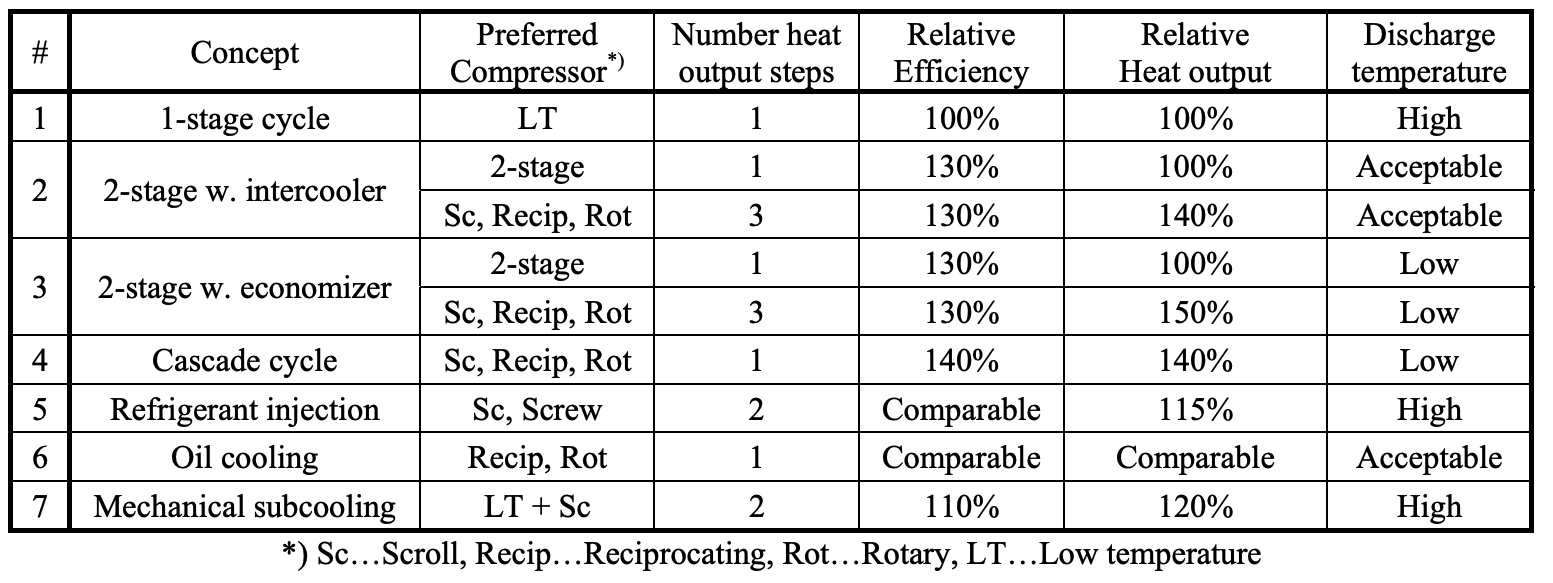
A conceptual summary of the most common architectures for CCHPs was provided by Bertsch and Groll [5] and shown in Table 1. Experimental investigations of a CCHP for the US residential market were carried out by Oak Ridge National Laboratory [6]. Two single-stage compressors in tandem were utilized to minimize cost and simplify control. Experimental investigations achieved 76% of the heating load delivered at 8.3 °C and a heating COP of 1.94 at -25 °C. When vapor injection was applied using two tandem compressors, 88% of the heating load was delivered at 8.3 °C, and a heating COP of 2.0 at -25 °C were achieved. There are a range of current investigations of CCHPs with both synthetic and natural refrigerants at many research institutions in the US, including Oak Ridge National Labs as well as the Ray W. Herrick Labs.
Table 1: Comparison of different heat pump cycles in CCHP applications [5].
Legislation surrounding allowable GWP and flammability in the residential sector has currently limited the scope of the most recent CCHP efforts to A2L refrigerants based on blends of Hydrofluorocarbons (HFCs) and Hydrofluoroolefins (HFOs). However, continued GWP phase downs due to the US EPA AIM Act from 2021, along with concerns regarding the classification of Trifluoroacetic Acid (TFA) as Per- and Fluoroalkyl Substances (PFAS) in some parts of the world, have motivated many manufacturers for heat pumps being sold in the US to keep one eye on R290 (propane) as a possible “future proof” alternative. While the US EPA SNAP regulations have recognized R290 as a viable fluid for window air conditioners, the process to broader acceptance of its use will likely follow a similar path taken for R600a in domestic refrigerators in the US. Dynamic legislation surrounding UL standards 60335-2-40 (residential) and 60335-2-89 (commercial), as well as safety standards (i.e., ASHRAE Standard 15), will have strong influences on the acceptance of hydrocarbon refrigeration and heat pump systems in the US market in the coming years. However, building codes, general EPA regulations, and decentralization of many such decisions to individual US states suggest that the US is still years away from the widespread acceptance of R290 as a working fluid in residential heat pumps.
Cold Climate Heat Pumps and Electrical Infrastructure
In addition to improving thermal comfort and reducing energy bills, CCHPs can reduce strain on electrical infrastructure at the building, distribution, and transmission scales. At the building scale, an inefficient residential air-source heat pump with resistance backup can require currents of 80 Amperes or more in very cold weather. Especially in older homes, currents this high can risk overheating the wires that connect the heating equipment to the main circuit breaker panel, the panel itself, or the wires that connect the panel to the utility’s distribution grid. Replacing this building-scale infrastructure can be expensive and slow, as it can require a skilled electrician and approvals from building inspectors or electric utilities. CCHPs, with their higher cold-weather COPs and much lower dependence on resistance backup, can bring required currents down to 30 Amperes or less. In this way, CCHPs can reduce or eliminate the need for electrical work that often accompanies heat pump installation in older homes, lowering a barrier to residential electrification.
At the scale of a medium-voltage distribution network, widespread adoption of inefficient air-source heat pumps with resistance backup could increase electricity demand in cold weather beyond the safe limits of power lines, the distribution transformers that typically serve five to ten homes or the substation transformers that serve whole neighborhoods. Due to supply chain issues and rising demand for transformers, it is not unusual today for US utilities to take two years or longer to upgrade this infrastructure, compared to just a few months in 2020 [7]. Utilities who cannot upgrade infrastructure sufficiently quickly might lobby governments to slow down or halt approvals for electrification projects. On the other hand, utilities who do upgrade infrastructure pass the costs on to ratepayers by raising electricity prices. As transformer costs have risen 60 to 80% since 2020 [7], these infrastructure upgrades could significantly increase electricity prices, weakening economic incentives for adopting heat pumps over fossil-fueled furnaces and boilers. CCHPs’ higher cold-weather COPs and reduced dependence on resistance backup could reduce strain on power lines and transformers, mitigating these distribution-scale issues.
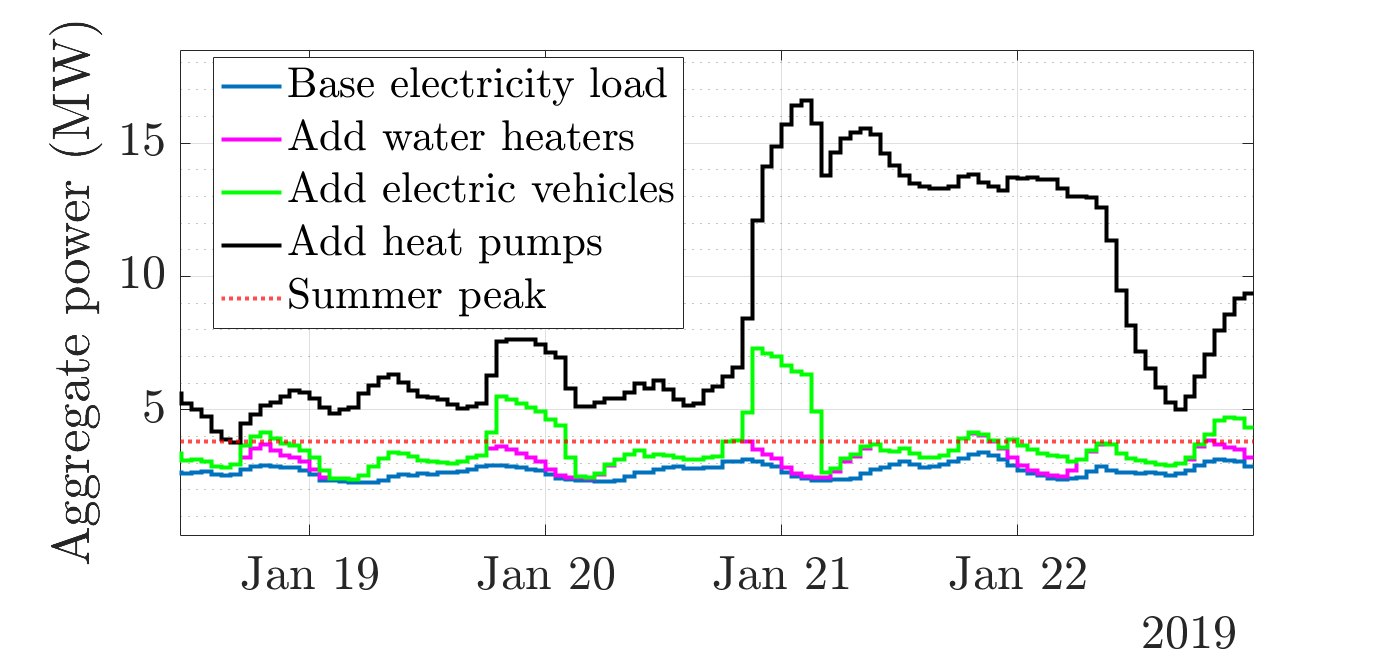
Figure 2: In simulations of 1,000 electrified houses with inefficient air-source heat pumps and resistance backup heat during the coldest week of 2019 in New York, electricity demand peaks at about four times today’s summer peak [9].
At the scale of a high-voltage transmission grid, peaks in system-wide electricity demand determine the need to expand transmission and generation capacity. Today, demand in most US power systems peaks during the hottest hours of the year, driven by residential air conditioning. As illustrated in Figure 2, however, widespread adoption of inefficient air-source heat pumps and resistance backup would switch some US power systems from summer- to winter-peaking [8], posing operational challenges. Future winter peaks could greatly exceed today’s summer peaks, triggering costly build-out of transmission lines and power plants. The associated costs would ultimately be passed on to ratepayers, weakening economic incentives for further electrification. As at the building and distribution scales, CCHPs could mitigate these transmission-scale issues.
How much money could CCHPs save society by avoiding electrical infrastructure upgrades that inefficient air-source heat pumps with resistance backup might require? The costs are hard to estimate precisely, but joint expansion of distribution, transmission, and generation capacity typically costs at least 1,000 $/kW. At a rough estimate, then, a residential CCHP that reduces peak winter electricity demand by ~10 kW (for example, by saving ~1 kW of compressor power and avoiding ~9 kW of resistance backup) could save on the order of $10,000. Although inexact, this back-of-the-envelope estimate illustrates one justification for CCHP research and development.
Conclusions
The US is a promising market for CCHPs that could improve comfort, save energy, reduce strain on electrical infrastructure, and accelerate decarbonization efforts. CCHP technology to achieve heating COPs of 2.0 at an ambient temperature of -25 °C has been proven, but there are significant legislative, market, and infrastructure-based hurdles to overcome before broad implementation of CCHPs becomes a reality. Initial investments and grid upgrades present significant economic challenges, so economies of scale, government support, and efficient CCHPs are among the next steps necessary to decarbonize residential heating in the US.
References
[1] Caskey, S.L., Kultgen, D., Groll, E.A., Hutzel, W. & Menzi, T., 2012. “Simulation of an Air-Source Heat Pump with Two-Stage Compression and Economizing for Cold Climates.” Proceedings of the 14th International Refrigeration and Air Conditioning Conference at Purdue.
[2] Khowailed G., K. G. Sikes, and O. A. Abdelaziz. 2011. “Preliminary Market Assessment for Cold Climate Heat Pumps,” Oak Ridge National Laboratory report ORNL/TM-2011/422, August.
[3] U.S. Energy Information Administration, Monthly Energy Review, Table 1.10, ”Heating Degree Days by Census Division in 2022,” July, 2023
[4] https://www.energy.gov/eere/buildings/residential-cold-climate-heat-pump-challenge
[5] Bertsch, S.S., & Groll, E.A., 2006. “Air Source Heat Pump for Northern Climates Part I: Simulation of Different Heat Pump Cycles.” Proceedings of the 11th International Refrigeration and Air Conditioning Conference at Purdue.
[6] Shen, B., Abdelaziz, O., Baxter, V., & Rice, K., 2015. “High Performance Cold Climate Heat Pump (CCHP)”. Final Report No. ORNL/RM-2015/784. Oak Ridge National Lab (ORNL). Oak Ridge, TN, USA.
[7] Chopra, S., Marks, A., Jacobs, K., & Boucher, B., 2024. “Power Transformers: Supply Shortage and High Lead Times.” Wood Mackenzie report.
[8] Zhou, E. & Mai, T, 2021. “Electrification Futures Study: Operational Analysis of U.S. Power Systems with Increased Electrification and Demand-Side Flexibility.” Final Report No. NREL/TP-6A20-79094. National Renewable Energy Laboratory (NREL). Golden, CO, USA.
[9] Priyadarshan, P., Pergantis, E., Crozier, C., Baker, K. & Kircher, K., 2024. “EDGIE: A simulation test-bed for investigating the impacts of building and vehicle electrification on distribution grids.” Proceedings of the 58th Hawaii International Conference on System Sciences.
DOI: 10.23697/24xe-fg79
Contact the author:
Name: Riley Barta; Kevin Kircher
Title: Assistant Professor of Mechanical Engineering;
Affiliation: Purdue University
Postal address: 177 S. Russell St., West Lafayette, IN 47907
E-mail address: bartar@purdue.edu; kkirche@purdue.edu
