

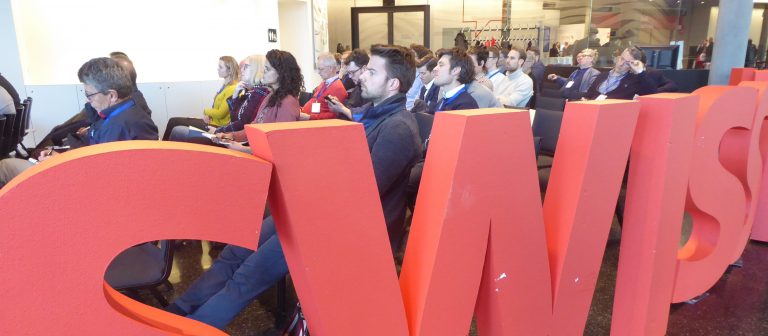
Swiss contributions to the IEA HPT Annex 49 have been presented in the frame of the technical workshop programme integrated in the largest Building Fair in Switzerland, the Swissbau in Basel on January 15, 2020. The Swissbau Focus summarises presentations of new developments in the building field in a 5 day series of workshop events. The topic of the workshop was concept of nZEB neighbourhoods. The workshop was attended by more than 30 experts from the larger archiecture and planning companies, building and facility management companies as well as public authorities.
The focus of the workshop was the presentation of a feasibility study of Zero Energy Neighbourhood in Rapperswil-Jona, which was performed at the HSR Rapperswil in collaboration with the local energy suppliers and the building developer.
As introduction C. Wemhöner presented an outline of the Annex 49 framework and different international project contributions dealing with groups of buildings and neighbourhoods.
S. Buesser and F. Ruesch followed with the presentation of the feasibility study to prove options to reach a Net Zero Energy consumption in the perimeter of the neighbourhood. The perimeter consists of three buildings projects: a home for elderly people with nursury and flats, a building complex with lab, office and hotel use, and an extension of four buildings with open plan offices. Due to the high fraction of office use, the space heating and cooling demand is in the same range. Moreover, in the neighbourhood, favourable heat source like the ground, ground water, lake water and waste heat of a waste water treatment plant are available. Under these favourable boundary conditions it was confirmed, that with a maximum PV installation on the roof and, where possible and useful, in the facades of the buildings, a Zero energy consumption on annual basis is reachable. Furthermore, due to high local feed-in tariffs and a simulated self-consumption of 50% the system can also be operated economically. Already under the current market conditions, an nZE balance can thus be economic under current market conditions in case of favourable boundary conditions. However, the balance is also quite sensitive to the boundary conditions. Furthermore, it was found, that for the first building project, ground water is a favourable heat source, but for larger perimeters, the waste heat use of the waste water treatment plant and the lake water become competitive.
B. Sommavilla of the energy supplier Energie Zürichsee Linth AG, the operator of the waste water heat recovery, presented details on the plant installation and on the business model for the connected clients. The heat is extracted from the effuent, i.e. the cleaned water of the waste water treatment plant and distributed to the clients by a low temperature grid. The heat is lifted to the use temperature level for space heating and domestic hot water with locally installed heat pumps, which get very high source temperature by the thermal grid.
The workshop was concluded by a question and answer sessions and single discussions after the official end of the workshop.
Publications of the workshop can be downloaded under publications.