

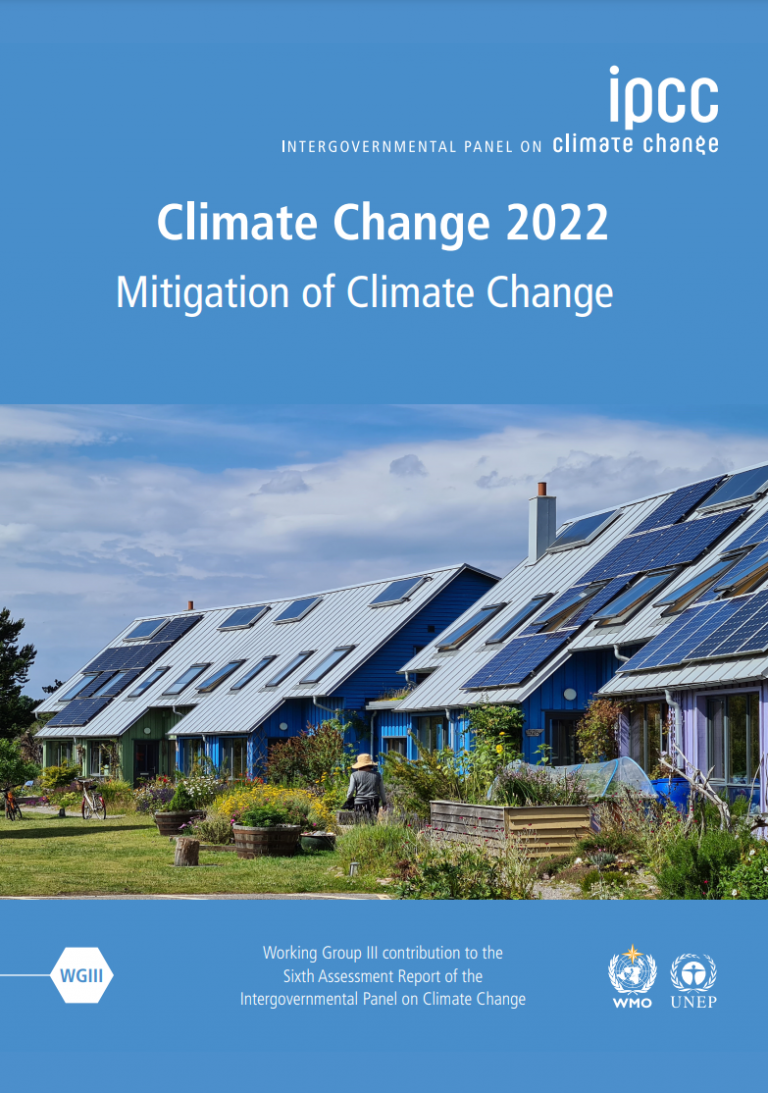
According to the report, the evidence is clear: the time for action is now. We can halve emissions by 2030, but actions are needed to accelerate the transition. The authors state that from 2010 to 2019, the average annual global greenhouse gas emissions were at their highest levels in human history, but the rate of growth has slowed. They conclude that without immediate and deep emissions reductions across all sectors, limiting global warming to 1.5°C would be beyond reach. However, on the positive side, the scientists said in the report that there is increasing evidence of climate action. Since 2010, there have been sustained decreases of up to 85% in the costs of solar and wind energy and batteries. An increasing range of policies and laws have enhanced energy efficiency, reduced rates of deforestation and accelerated the deployment of renewable energy.
In the press release published in conjunction with the launch of the report, the IPCC Chair Hoesung Lee was quoted: “We are at a crossroads. The decisions we make now can secure a liveable future. We have the tools and know-how required to limit warming. I am encouraged by climate action being taken in many countries. There are policies, regulations and market instruments that are proving effective. If these are scaled up and applied more widely and equitably, they can support deep emissions reductions and stimulate innovation.”
We have options in all sectors to at least halve emissions by 2030, and the next few years are critical, according to the communications from IPCC. In the scenarios they assessed, limiting warming to around 1.5°C (2.7°F) requires global greenhouse gas emissions to peak before 2025 at the latest and be reduced by 43% by 2030.
In the report, past and future emissions trends are compared. Future emissions were assessed using four global scenarios/pathways and their respective baselines, the IEA Net Zero Emission (NZE), the IEA Sustainable Development Scenario (SDS), the IMAGE-Lifestyle-Renewable (LiRE) and the Resource Efficiency and Climate Change-Low Energy Demand (RECC-LED) scenarios. The IEA scenarios are normative, working backwards from climate, clean air, and energy access goals.
According to all these scenarios, electrification is expected to be the dominant strategy in buildings as electricity is increasingly used for heating and cooking. Electricity will help to integrate renewable energy into buildings and will also lead to a more flexible demand for heating, cooling, and electricity. District heating and cooling offers potential for demand flexibility through energy storage and supply flexibility through cogeneration. Moreover, the report states that heat pumps are increasingly used in buildings and industries for heating and cooling. According to the scenarios, the ease of switching to electricity means that hydrogen is not expected to be a dominant pathway for buildings. Using electricity directly for heating, cooling, and other building energy demand is more efficient than using hydrogen as a fuel, for example, in boilers or fuel cells. In addition, electricity distribution is already well developed in many regions compared to essentially non-existent hydrogen infrastructure.
Both light and heavy industries are potentially large and flexible users of electricity for both final energy use (e.g., directly and using heat pumps in the light industry) and for feedstocks (e.g., hydrogen for steel making and chemicals).
An important emerging trend in electricity demand for buildings is the use of electricity for thermal energy services (cooking, water, and space heating). The increased penetration of heat pumps is the main driver of the use of electricity for heating. Heat pumps used either individually or in conjunction with heat networks can provide heating on cold days and cooling on hot ones. Quoted papers suggest electricity is expected to become an important energy vector to decarbonise heating. However, the use of heat pumps will increase halocarbon emissions, according to several quoted reports. Quoted scientists argue for electrification of heat as a cost-effective decarbonisation measure if electricity is supplied by renewable energy sources. The electrification of the heat supplied to buildings is likely to lead to an additional electricity demand and, consequently, additional investment in new power plants. Flexibility is a key enabler of larger heat electrification shares. Importantly, heat pumps work at their highest efficiency level in highly efficient buildings, and their market uptake is likely to require incentives due to their high up-front cost, according to some referenced publications.
According to many reports quoted in the report, the energy efficiency of air conditioning systems is of paramount importance to ensure that the increased demand for cooling will be satisfied without contributing to global warming through halocarbon emissions. The installation of highly efficient technological solutions with low Global Warming Potential (GWP), as part of the implementation of the Kigali amendment to the Montreal Protocol, is the second step toward reducing GHG emissions from cooling. Developing renewable energy solutions integrated into buildings is another track to follow to reduce GHG emissions from cooling.
The IPCC has three working groups: Working Group I, dealing with the physical science basis of climate change; Working Group II, dealing with impacts, adaptation and vulnerability; and Working Group III, dealing with the mitigation of climate change. It also has a Task Force on National Greenhouse Gas Inventories that develops methodologies for measuring emissions and removals.
The Working Group I contribution to the Sixth Assessment Report Climate Change 2021: the Physical Science Basis was released on 9 August 2021. The Working Group II contribution, Climate Change 2022: Impacts, Adaptation and Vulnerability, was released on 28 February 2022 and the Working Group III contributed with the report mentioned above, Climate Change 2022: Mitigation of Climate Change, on April 4 2021.
The concluding Synthesis Report is due in autumn 2022.