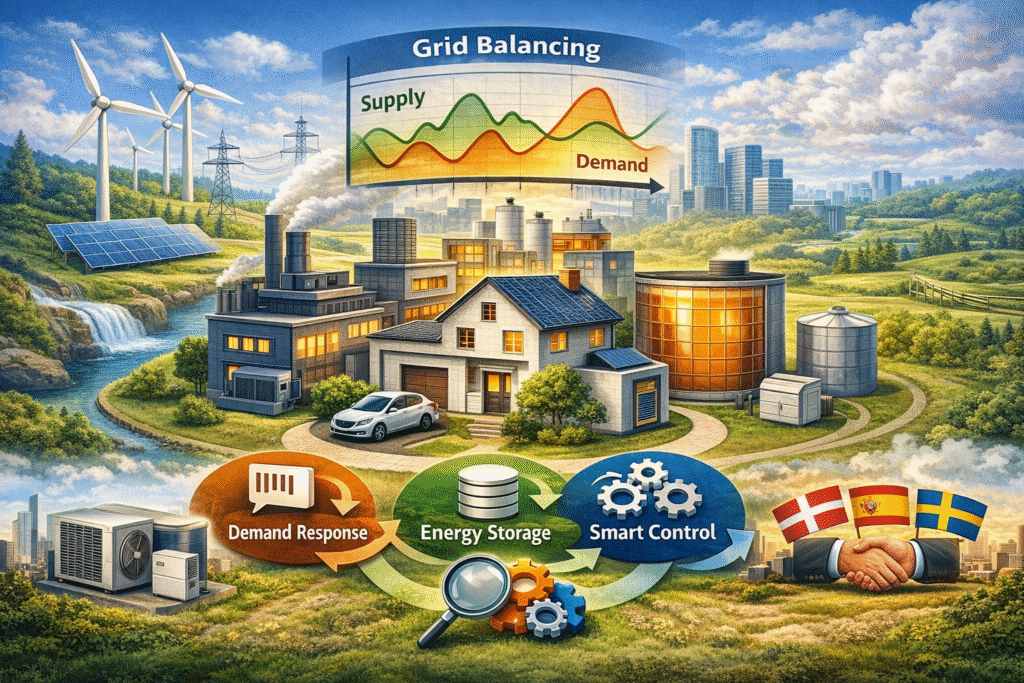
Project 70, Flexibility from Large-Scale and Aggregated Heat Pump Systems, has now officially begun. As electrification accelerates and more renewable electricity is fed into our energy systems, the need for smarter ways to balance grid loads is growing. IEA HPT Project 70 addresses this challenge by exploring how heat pump systems can provide valuable flexibility.
The ongoing electrification of society, combined with a growing share of electricity from intermittent renewable sources, is placing increasing pressure on the power grid. This development highlights the need for flexibility to balance fluctuations in electricity production and consumption. Flexibility can also help reduce challenges caused by bottlenecks and capacity constraints in the grid.
According to scenarios presented in the IEA World Energy Outlook, global demand for shortterm flexibility is expected to rise significantly in the coming years. Here, heat pumps can play a valuable role in strengthening the power system by acting as flexible demand response units. With advanced control strategies, they can adjust their operation based on, for example, the availability of renewable electricity, acting as a demand response resource. This capability not only supports grid stability but also helps optimize the use of clean, renewable energy for heating and cooling.
Project 70 builds on insights from the earlier IEA HPT Annex 57, which highlighted significant potential for flexibility but also identified several barriers, including technical limitations, regulatory uncertainty, insufficient economic incentives, and low awareness or acceptance among both operators and end users. The new project aims to tackle these challenges while also broadening its scope to include storage integration, industrial high-temperature heat pump systems, and coordinated operation of large fleets of decentralized heat pumps.
The overall goal of Project 70 is to build an independent, reliable knowledge base filled with highquality insights about the flexibility potential of heat pumps. By strengthening our understanding of how heat pumps can interact with both the wider energy system and the thermal systems they serve, the project aims to accelerate the deployment of flexible heat pump solutions and enhance their role in supporting future energy needs.
The project will:
- Identify the latest technological solutions that enhance flexibility.
- Clarify regulatory and market conditions that affect participation in flexibility services.
- Develop business models that demonstrate the economic value of flexible heat pump operation.
- Strengthening awareness and competence among operators, installers, and end users.
- Promote international collaboration and knowledge sharing.
The kickoff meeting for Project 70 took place at the Danish Technological Institute (DTI) in Copenhagen at the end of February. The project is coordinated by Denmark, and three countries have formally joined so far: Denmark, Spain, and Sweden. Several additional countries have also expressed interest and participated in the kickoff meeting.
The meeting focused on two main areas. First, participants were introduced to one another and shared insights into the current state of heat pump technology and market conditions in their respective countries, as well as their key project interests. The second focus area was to plan and discuss the project’s tasks and outline how the work will be carried out moving forward.
One of the countries that has already joined Project 70 is Sweden. Through our participation, we aim to learn from the experiences of other countries and how they work with flexibility in heat pump systems. At the same time, we see valuable opportunities to contribute with insights based on Swedish conditions and ongoing developments.
Project 70 covers several aspects of heat pump flexibility, but the Swedish national activities will primarily focus on how the introduction of powerbased tariffs affects the electricity costs of singlefamily homes with heat pumps. The project will explore how heat pumps can operate in coordination with EV charging and different forms of energy storage, such as the building’s thermal inertia or battery systems, to reduce household power peaks while taking advantage of periods with lower electricity prices to lower total electricity costs for homeowners.
Markus Lindahl, RISE Research Institutes of Sweden, coordinator of the Swedish contribution to Project 70