


In the beginning of June 2024, HPT TCP Annex 62 “Heat Pumps for Multi-Family Residential Buildings in Cities” organized a digital webinar workshop on the theme “General Classification of Heat Pumps in Residential Buildings”. The goal of the event, that involved about 70 participants, was to attain information about questions regarding a Solution Finder for heat pumps (HP) in multi-family buildings (MFB). The Solution Finder is a project to find a possible HP solution for individual homes. For that, an online tool is planned, where keen individuals can put in parameters about a domestic building, to get output on most suitable ways to include HP solutions. This tool will be be a guide and first direction into planning the optimal HP solution for individual homes.
The aim for the workshop was to attain information from the participants about their attitudes towards different solutions for different parameters in homes. After asking the attendees about their professional backgrounds and affiliation with HPs and Annex 50/62, a short introduction into the “families” of HP solutions was presented.
Following that, the attendees were asked to give their opinion on the classifications, found here, and if they think, that all possible solutions are incorporated. It was pointed out, that in the solution called B2, found here, direct electrical heaters are especially mentioned for domestic hot water (DHW), which seems odd having in mind, that no other solution seems to incorporate it. Furthermore, it was suggested to add fossil fuels to direct electric as a heating source to prevent future confusing.
In the following, room was given for questions and discussions in which interest was shown for another webinar regarding regulations and controls regarding HP.
Next up was a demonstration of the collection of case studies, which aims to be the largest data base of HP in MFB in the world, growing by two case studies per month. The current concentration of case studies to regions of Central Europe will soon be supplemented with data from China, followed by other countries, that are willing to share their data in this matter.
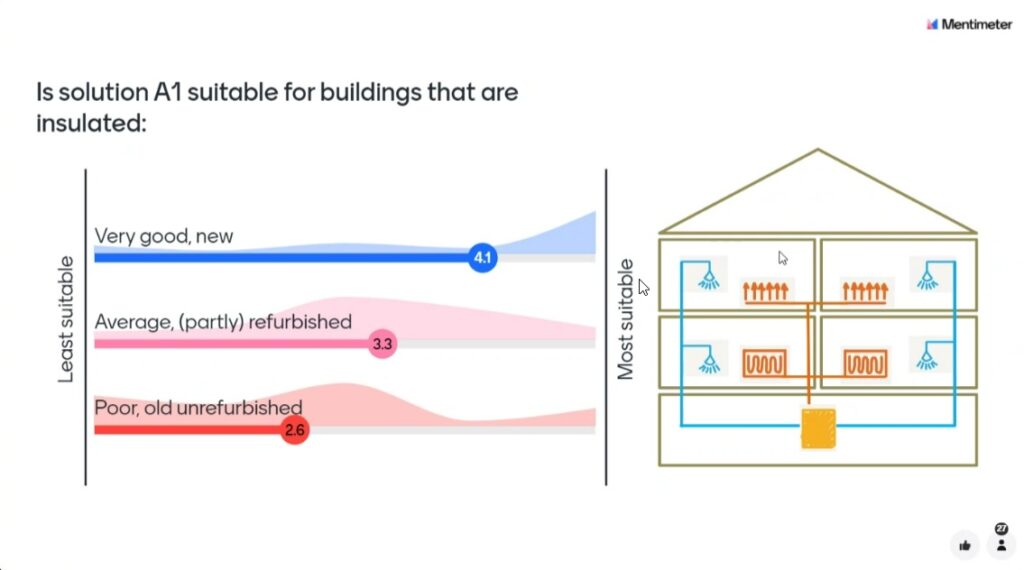
Last section of the workshop was a big block of 28 polls to gather the opinion of the attendees regarding the suitability of the different solutions for different building sizes (small <9, average 10-19, big >20 apartments) and insulation (good, average, poor).
The results from the workshop will be processed and analyzed by the research group and presented later this year.