Neither behavioural changes nor low-carbon technologies alone are sufficient for the vital energy and climate transition. Low-carbon technologies with the active involvement of consumers will be key to mitigate climate change and reach a sustainable and affordable energy sector. With this background, experts on users’ perspectives met colleagues with good insights on heat pumping technologies during a joint workshop to discuss possible collaboration in the intersection between social research and energy transition technologies to overcome barriers related to uptake of heat pumps.

The workshop was a joint effort between IEAs Technology Collaboration Programmes on User-Centred Energy Systems (USERs TCP) and Heat Pumping Technologies (HPT TCP) and the Swedish Energy Agency (SEA), who was hosting the USERs TCP ExCo meeting in Stockholm, and took place on June 17. Ainslee Emerson, Chair of the USERs TCP, opened the worked and welcomed everyone. Thereafter the two TCPs were presented by Sam Thomas (USERs TCP) and Caroline Haglund Stignor (HPT TCP).
Heat pumps, powered by low-emissions electricity, are the central technology in the global transition to secure and sustainable heating. Globally, the pace of installation is growing, but in many jurisdictions, barriers to adoption are proving hard to overcome, while the technology has become part of the culture wars affecting political narratives around transitions to low carbon heating.
Global and National Perspectives on Heat Pump Deployment
The workshop brought together participants from the different field – social scientists, technology experts and policy makers – to agree on priorities for future international collaborative research to support the transition to heat pumps across our member countries.
To set the scene, Emma Mooney from IEA presented the state of global heat pump markets. Thereafter, Carlos Lopes (SEA) shared experience from Sweden, a success story, since heat pumps has made a vital contribution to decarbonising the heating sector by phasing out almost all fossil fuel boilers, while keeping clean heating affordable for end consumers. This followed a presentation about experiences from Ireland, who is starting from a low base, Hannah Julienne, SEAI. Therafter followed a discussion on what can be generalised from the Swedish experience.
In the following section followed presentations and discussions about placement impacts from acoustic signatures of heat pumps (Christoph Reichl, AIT, Austria), insights about the social and technical potential of coordinated control of heat pumps and electric car charging in single-family homes (Hanna Björner Brauer, RISE, Sweden) and insights from a task related to Hard-to-Reach Energy Users on unintended consequences of heat pump policies (Sea Rotmann SEA, New Zealand). Finally, a new project on how to develop impactful narratives to stimulate heat pump deployment was presented and discussed. Thereafter, followed an open discussion on future collaboration between the two TCPs, which will be taken further in the soon future. There would certainly be a win-win from both sides since the social researchers would benefit from support in understanding the technology, different type of heat pumps, pros and cons, etc, while the technology experts would benefit in guidance on users’ perceptions, both when it comes to end-users of the heat pump, but also the installers. The representatives from USERs encouraged technology experts to bring in designers at a much earlier stage – both related to visual appearance but also the user interface and sales process.
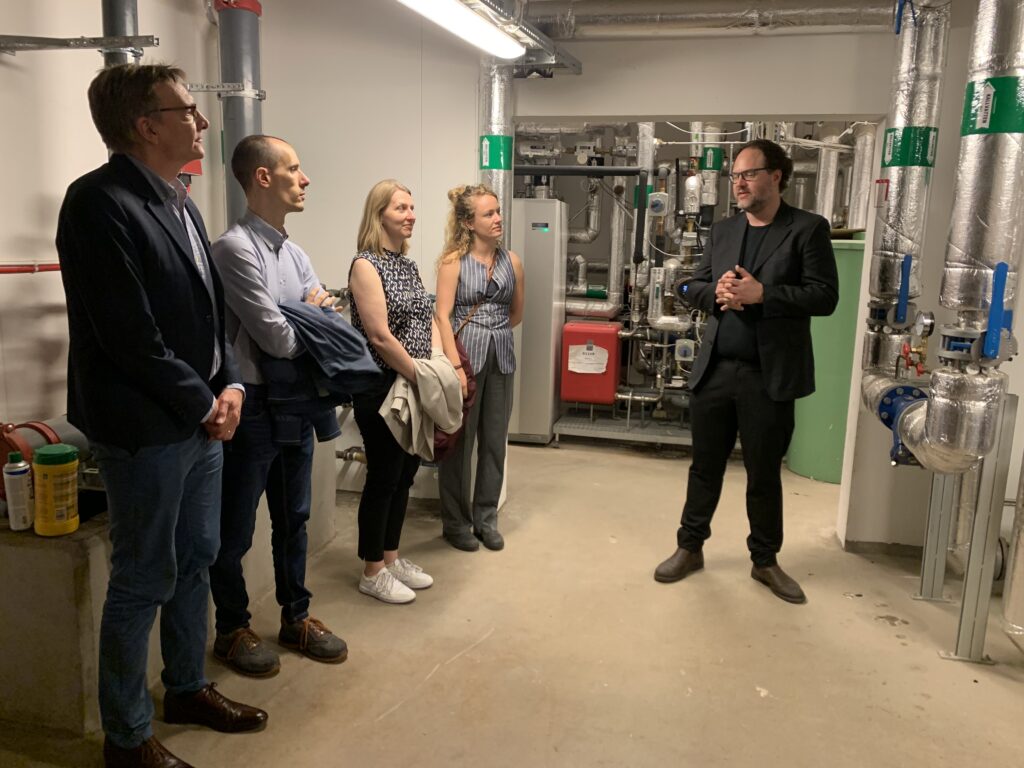
In the end of the day, the whole group made a study visit at a housing association in Hammarby Sjöstad, organised by Jörgen Lööf, ElectriCity, who showed them an installation of a large scale ground source heat pump in a multifamily building, a booster heat pump which recovered waste heat from electrical equipment in the building and a garage with a smart innovative solution for charging of electric cars.
This day was hopefully the first step in a future successful collaboration between the two collaboration programmes, which will contribute to overcome user related challenges in the roll-out of clean energy technologies.
The presentations from the event can be found here.