

The trajectory in this report is clear: as electricity decarbonises and networks shift to lower temperatures, the heat pump stops being one option among many and becomes the engine of a flexible, secure, low-carbon heat system, and the next decade of innovation will be measured less by the machine itself than by how intelligently it is integrated, priced, and digitally orchestrated within the grid it serves.
The IEA’s Renewables in District Energy sets out a sobering baseline and a large opportunity. While solar PV capacity has more than quadrupled and wind capacity has nearly doubled in recent years, the renewable share of district heating has stayed flat, and on current policies renewable district heat is projected to grow by only around 10% to 2030 (p. 8). The report frames this as a major untapped opportunity: in existing networks alone, renewable and waste heat could increase up to tenfold without major infrastructure investment, even as district heating consumers rise by roughly 8% to about 650 million people worldwide by 2030, with over 600 million people living in cities that have heating demand but no district heating access (p. 8). The energy-security case is already concrete. According to the IEA, renewables and waste heat displace over 190 million barrels of oil equivalent of imported fossil fuels each year, with import dependence in district heating at around 14% in Northern Europe and about 25% in the Baltic region (p. 9). Against this backdrop, electrified heat moves to the foreground, and heat pumps are identified as one of the commercially available, increasingly cost-competitive technologies capable of closing the gap.
Heat pumps: from supporting role to central pillar
The report is explicit that large-scale heat pumps are becoming a central pillar of modern district heating systems, driven not by novelty but by stronger policy support, pressure to cut fossil-fuel dependence, continued gains in compressor efficiency, the deployment of natural and low global-warming-potential refrigerants, and economies of scale (p. 25). Today’s utility-scale heat pumps can deliver supply temperatures in the 60 to 90°C range, making them compatible with many existing third- and fourth-generation networks, though higher output temperatures generally come with lower efficiency (p. 25). The Nordic countries remain the most established market, with long-standing deployment drawing on wastewater, seawater, industrial waste heat, geothermal resources, and increasingly data centres, while Germany accelerates project development and China scales large heat pumps in its northern provinces to integrate renewable electricity and tap wastewater and industrial waste heat (p. 25–26).
The strategic value lies in flexibility and sector coupling. When combined with thermal storage, supplementary renewables, and waste heat, large-scale heat pumps can electrify a growing share of district heat supply while absorbing low-cost electricity, converting it efficiently to heat, and shifting supply through storage (p. 26). The report pairs them with electric boilers, which are far less capital-intensive and can respond within seconds to convert surplus or even negatively priced electricity into stored heat, so that utilities combine efficient bulk production with very fast flexibility (p. 26).
What governs competitiveness: temperature lift and price ratios
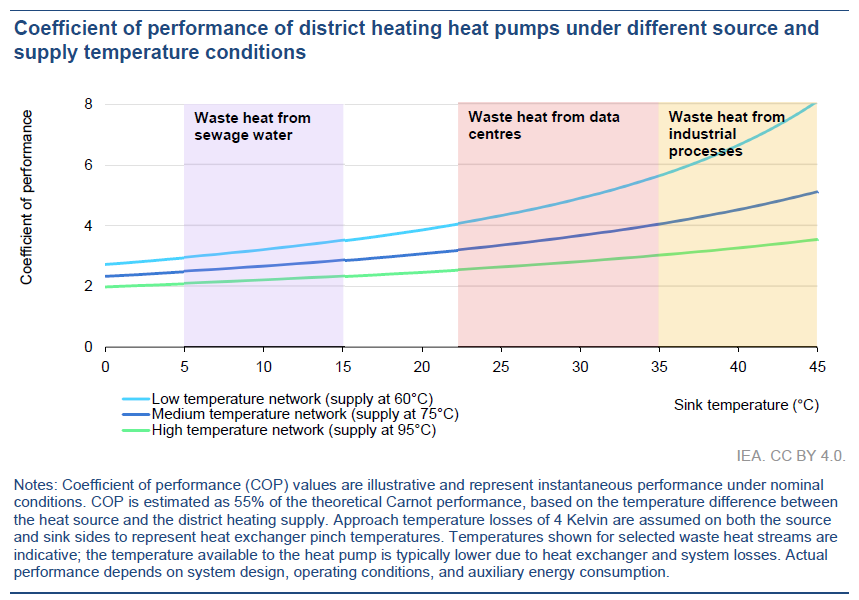
Performance hinges on the temperature lift between the heat source and the network. Higher source temperatures and lower network supply temperatures both reduce the required lift and substantially raise efficiency (p. 47). Waste heat from industrial processes, data centres, wastewater treatment plants, and commercial refrigeration provides relatively warm sources that, when upgraded through heat pumps, reduce the temperature lift, improve the coefficient of performance, and lower electricity use per unit of heat delivered (p. 47). The report quantifies the effect: a heat pump upgrading industrial waste heat at around 40°C to a low-temperature network at about 55°C may achieve performance several times higher than one extracting heat from ambient sources at around 10°C and supplying a high-temperature network at about 85°C, in some cases requiring three times less electricity per unit of heat delivered (p. 48). The accompanying Figure 1 below illustrates COP across source and supply conditions, with values estimated at 55% of theoretical Carnot performance and 4 Kelvin approach losses assumed on both sides (p. 48).
(Source: IEA (2026), Best Practices and Insights to Expand Clean Energy Access and Adoption, IEA,
Paris https://www.iea.org/reports/best-practices-and-insights-to-expand-clean-energy-access-and-adoption, Licence: CC BY 4.0)
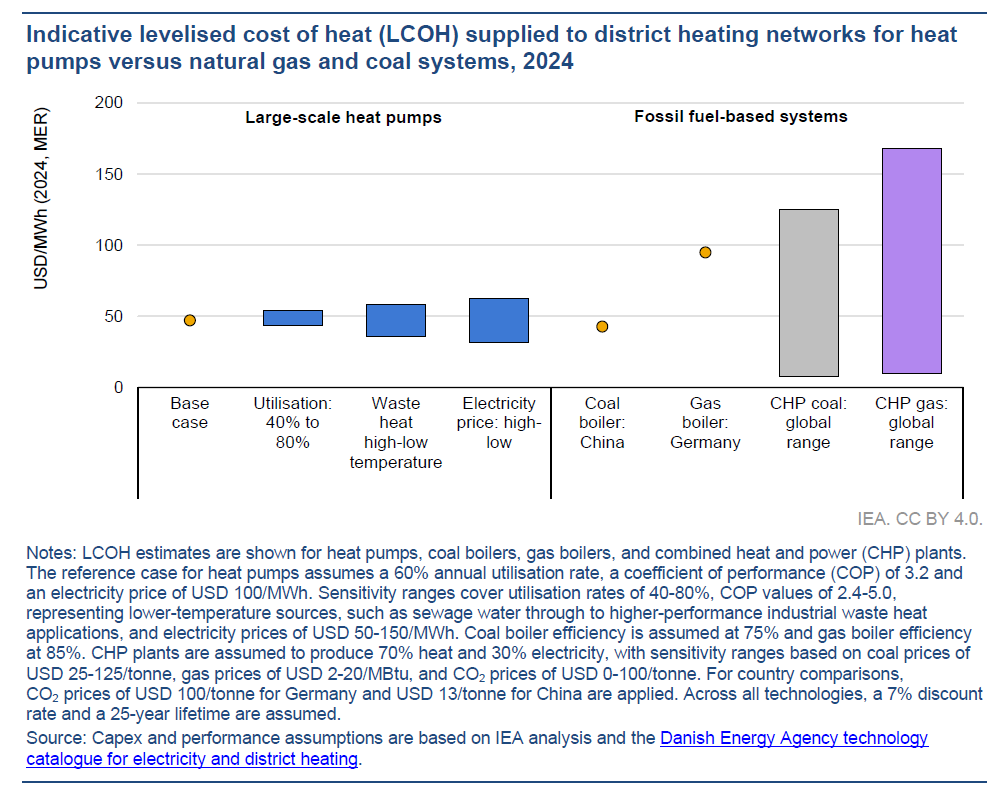
Economics, however, are decided as much by price as by physics. Electricity-to-fossil-fuel price ratios play a decisive role: where electricity remains two to four times more expensive per unit of useful heat than natural gas, heat pumps struggle to compete with existing boilers or CHP, especially in high-temperature networks (p. 49). When those ratios narrow, through lower electricity levies, reduced grid fees for flexible loads, structurally low-cost power from hydro, wind, or solar, or rising fossil prices, heat pumps rapidly become cost-competitive, particularly when tapping wastewater, industrial waste heat, or ambient sources (p. 49). The IEA’s indicative 2024 levelised cost of heat comparison models a reference heat pump at 60% utilisation, a COP of 3.2, and an electricity price of USD 100/MWh, with sensitivity ranges spanning COP values of 2.4 to 5.0 and electricity prices of USD 50 to 150/MWh (p. 49). See Figure 2 below. Well-designed electricity pricing, including time-of-use and wholesale-linked tariffs combined with thermal storage, is therefore described as a central enabler of renewable district heating (p. 49–50).
(Source: IEA (2026), Best Practices and Insights to Expand Clean Energy Access and Adoption, IEA,
Paris https://www.iea.org/reports/best-practices-and-insights-to-expand-clean-energy-access-and-adoption, Licence: CC BY 4.0)
Case studies and the project pipeline
The report grounds these principles in deployment. In Novi Sad, Serbia, where a district heating system serves 300 000 consumers with significant reliance on imported gas, an EBRD-financed project will pair roughly 870 000 m³ of seasonal pit thermal energy storage with a 17 MW large heat pump, 60 MW of power-to-heat electric boilers, and a 38 623 m² solar-thermal field, for a total investment of about EUR 108 million; the system is expected to deliver up to 120 GWh of clean heat annually, cut CO2 emissions by 17 000 tonnes per year, lower imported gas by around 20%, and yield roughly EUR 8 million in annual benefits from optimised hydro dispatch through grid balancing (p. 50). The wider project pipeline reinforces the trend: Finland’s Espoo clean-heat programme combines waste-heat recovery from data centres and heat pump plants with around 15 km of new pipeline at EUR 225 million, while Denmark’s Billund electrification project pairs 16 MW of heat pumps with a 30 MW electric boiler and 10 000 m³ of thermal storage, and Ukraine’s Lutsk Phase II combines heat pumps with bioenergy boilers and SCADA (p. 58). Heat pumps also feature prominently in district cooling, including Helsinki, where around 550 buildings are served via heat pumps and wastewater heat recovery, and Stockholm’s 250 km network connecting 600 buildings with Ropsten heat pumps linked to district heating and cooling (p. 33).
Data centre waste heat and the digital layer
Data centres reject nearly all the electricity they consume as low-temperature heat, which the report identifies as an increasingly relevant recoverable resource that can be captured through heat exchangers and, where necessary, upgraded with heat pumps before being supplied to nearby networks (p. 70). The EU’s updated Energy Efficiency Directive now requires data centres with total rated energy input above 1 MW to recover waste heat unless they can show it is not technically or economically viable, and with capacity expanding rapidly on the back of artificial intelligence and cloud computing, local authorities increasingly treat this heat as a strategic resource (p. 70). On the controls side, the report calls for digitalisation support spanning SCADA systems, predictive maintenance, real-time optimisation, and smart controls, noting that combining SCADA with smart sensors, data analytics, and forecasting can unlock predictive maintenance and real-time optimisation of network temperatures, flows, and supply sources (p. 93). Policy examples include Poland’s EU Modernisation Fund-backed Digitalisation of Heating Networks Program (p. 89).
Policy levers
The report’s central recommendation for electrified heat is to improve electricity-to-gas price ratios for large-scale heat pumps and electric boilers, since electricity is often subject to higher taxes, levies, and network charges than gas despite its falling carbon intensity, weakening the business case even where heat pumps are cost-competitive from a system perspective (p. 81). It points to enabling measures already in use, including reduced electricity taxes in Denmark and Finland, renewable-share relief in Ireland, and dynamic pricing in Denmark and the Netherlands to shift peak loads (p. 81). Alongside price reform, the IEA recommends scaling electrified heat via large-scale heat pumps powered by renewable electricity, supported by storage development and digital optimisation, with predictable levies and grid access for heat pumps (p. 85).
Ongoing international collaboration
The report was developed with input from the IEA Technology Collaboration Programme on Heat Pumping Technologies (HPT TCP), whose contributors are acknowledged by name (p. 4). That collaborative work continues through the HPT TCP’s current projects, several of which map directly onto the report’s themes, including ongoing projects on heat pumps in district heating and cooling systems (Project 70), high-temperature heat pumps (Project 68), heat pump integration in positive energy neighbourhoods and districts (Project 61), heat pump integration in dryers (Project 59), and heat pumps in a circular economy (Project 65). Together they reflect the same priorities the report emphasises: higher delivery temperatures, tighter integration with thermal networks and waste-heat sources, and the system-level flexibility that electrified heat provides.
Accessing the report
The full IEA report, Renewables in District Energy, is available on the IEA website at https://www.iea.org/reports/renewables-in-district-energy.