


IEA’s WEO-2026 presents a world entering what it calls the Age of Electricity, with global electricity demand growing at well over twice the rate of energy demand in 2025 – resulting in an increased share of electricity in final energy consumption. The report frames this shift against the 2026 energy crisis. Higher natural gas prices in the main importing regions strengthen the economic case for electrifying heating in buildings and industry, mainly by heat pumps. The report also notes that global warming will exceed 1.5 °C around 2030 in all IEA scenarios, which makes efficiency gains in end uses more urgent. Across these themes, heat pumps come up again and again as one of the technologies that serve energy security, affordability and climate goals at the same time.
The International Energy Agency’s (IEA) World Energy Outlook 2026 (WEO-2026) was released 19 November 2026 and draws on the latest energy data across all fuels and technologies, together with detailed modelling and analysis, to provide insights into potential pathways for the energy sector at a moment of extraordinary uncertainty.
The role of heat pumps: market status
According to the IEA, global heat pump sales in 2025 stayed broadly level with 2024 at around 110 GW of capacity (p. 201). The European Union was the exception. After a fall in 2024, its market rebounded by 12% in 2025 and kept growing in the first half of 2026 (p. 201). The report calls this the strongest annual growth since the 2022 energy crisis, and notes that heat pumps were the first choice of heating technology in markets such as Germany and the United States (p. 308). Global buildings heat pump sales grew by about 2.5% year on year in the first half of 2026, and by over 10% in Europe (p. 37). Global sales have risen by almost 30% since 2019, although trends have been uneven in recent years (p. 307–308).
Efficiency and cost-competitiveness
The report states that heat pumps are typically three to five times more efficient than boilers (p. 192). Because of this, the buildings sector will deliver more useful energy than the final energy it consumes by 2035, as air conditioners and heat pumps move heat to and from the surrounding environment (p. 193). IEA analysis based on regional upfront costs, fuel prices and finance costs finds that heat pumps are now competitive for half of global heating demand (p. 201–202). A wider assessment covering more than 900 country-specific variables finds cost-competitive potential to electrify around half of fossil fuel-based space heating demand and over one-third of fossil fuel-based low- and medium-temperature industrial heat demand (p. 50; Figure 1). The IEA also cautions that stable policies and financial support are needed to keep consumer confidence and allow this sales growth to happen (p. 202).
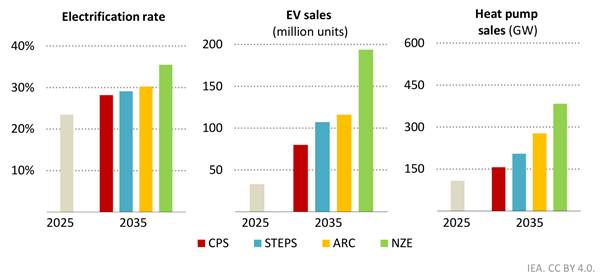
Figure 1. Global economic potential for electrification by end-use, as a share of fossil fuel-based energy consumption, 2025 Source: IEA (2026), World Energy Outlook 2026, Figure 1.14, p. 50. IEA. CC BY 4.0.
Scenario outlook to 2035 and beyond
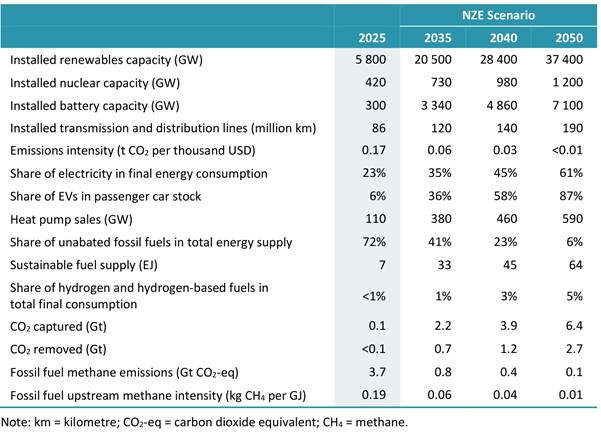
In the STEPS (Stated Policies Scenario), global heat pump sales almost double by 2035 (p. 201; Figure 2). This growth comes from clean heat requirements in parts of Europe and from the competitiveness of air-to-air units in China, Japan and the United States, where meeting both heating and cooling needs improves their economics (p. 201). Heat pumps account for more than 15% of the heating equipment stock by 2035, up from about 10% today. Because they are so efficient, they add only 200 TWh to electricity demand growth (p. 212). In the Additional Response Case (ARC), heat pump sales in oil- and gas-importing regions are 50% higher than in the STEPS by 2035 (p. 49). In gas-importing regions, which account for almost half of global space heating demand, sales nearly triple (p. 256), and space heating demand falls by nearly 10% even as floorspace grows (p. 255). The report also points to reversible air conditioners, or air-to-air heat pumps, as a way to save energy as air conditioning spreads in major heating markets (p. 257). In the Net Zero Emissions by 2050 (NZE) Scenario, heat pump sales reach 380 GW in 2035, 460 GW in 2040 and 590 GW in 2050 (p. 56; Table 1), and electricity’s share of useful space heating energy rises to 33% by 2035, up from 20% today (p. 308).
Figure 2. Electrification indicators by scenario, 2025 and 2035 Source: IEA (2026), World Energy Outlook 2026, Figure 6.15, p. 310. IEA. CC BY 4.0.
Table 1. Key indicators in the NZE Scenario for 2035, 2040 and 2050
Source: IEA (2026), World Energy Outlook 2026, Table 1.1, p. 56. IEA. CC BY 4.0.
Industrial heat, waste heat and higher temperatures
Low- and medium-temperature heat below 400 °C makes up nearly 90% of heat demand in non-energy-intensive industries and is technically well suited to electric boilers and heat pumps (p. 147). Just over 70% of demand in these industries is for heat below 200 °C (p. 207). The report lists supporting policies such as China’s Action Plan for Promoting High-Quality Development of the Heat Pump Industry, the EU Innovation Fund Heat Auction, France’s Heat Fund, Germany’s EEW programme and the US Department of Energy’s Industrial Heat Shot programme (p. 207–208). Even so, industrial heat pump uptake stays too limited in the STEPS to deliver large savings by 2035, and the efficiency of electric technologies falls closer to that of fuel-based options at higher temperatures (p. 193). For the European Union, the ARC sees heat pumps used at higher temperatures where a source of waste heat is available (p. 413). Low-temperature heat, which heat pumps can fully electrify, makes up around one-sixth of EU industrial energy demand (p. 412–413).
District heating, flexibility and digital controls
The report defines heat supply as including output from large-scale heat pumps (p. 523), and in the ARC, China leads the expansion of district heating (p. 255). WEO-2026 identifies heat pumps as a demand-side flexibility resource. Smart controls, digital technologies, artificial intelligence applications and market incentives allow heat pumps to adjust consumption to system needs (p. 326), and equipment control combined with suitable tariffs and interoperability standards can unlock this potential (p. 212). The IEA adds that an AI-enabled smart thermostat saves less energy than switching from a gas boiler to a heat pump (p. 214). In the EU ARC, households with a heat pump and an electric vehicle save 10–15% on electricity bills through demand flexibility (p. 414). The report also warns that wider use of heat pumps raises winter electricity demand, which planners must account for (p. 358).
Barriers: prices, manufacturing and equity
Electricity prices remain the main obstacle in Europe. Residential heat pumps are at least as expensive to own as gas boilers in 11 EU countries that together account for two-thirds of EU heating demand, including France, Germany and Poland, and in 13 EU countries electricity is at least three times more expensive than gas (p. 413; Figure 3). The European Commission has proposed an amendment to the Electricity Regulation that would require member states to reduce any tax disadvantage for electricity relative to natural gas (p. 413). On the supply side, existing and announced manufacturing capacity could meet only around half of NZE heat pump demand in 2030 (p. 328). Lower-income households are less able to finance the upfront cost of a heat pump, so targeted support is needed (p. 331). On policy, France has confirmed a gas boiler sales ban from 2027 together with a heat pump leasing programme (p. 111), and efforts to speed up deployment were strengthened in Europe, Japan and Korea (p. 111). Jobs linked to heat pumps more than double between 2025 and 2035 in the NZE Scenario (p. 331).
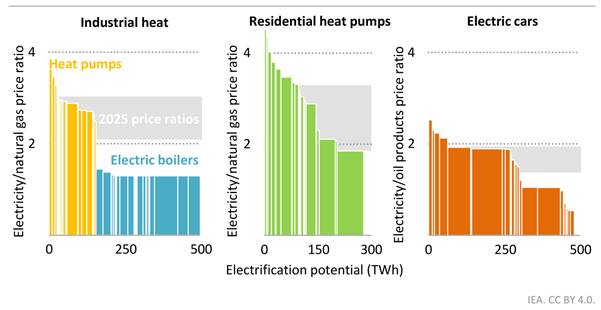
Figure 3. Potential for cost-competitive electrification at different electricity-to-fossil fuel price ratios by technology in the European Union, 2025. Source: IEA (2026), World Energy Outlook 2026, Figure 8.18, p. 414. IEA. CC BY 4.0.
Links to international collaboration
Even though the WEO-2026 does not directly refer to the IEA Heat Pumping Technologies Collaboration Programme (HPT TCP) or any of the other TCPs, it is based on findings and input over the years from its Technology Collaboration Programme, consisting of 38 TCPs. Several of the challenges it raises are already the subject of HPT TCP Projects. Ongoing work covers high-temperature heat pumps, heat pumps in district heating and cooling systems, heat pump solutions for multi-family houses in high-density cities, integration in positive energy districts, heat pumps for renovation, safe use of flammable refrigerants, low-GWP refrigerant applications, and heat pumps in a circular economy. Together, this work speaks directly to the industrial heat, urban retrofit and supply chain questions the Outlook raises.
Looking ahead
The Outlook’s message is that the case for heat pumps now rests on energy security and affordability as much as on climate goals. The next stage of innovation will depend on making heat pumps cheaper to run, smarter in operation and capable of higher temperatures.
Source: International Energy Agency (2026), World Energy Outlook 2026, IEA, Paris. The full report can be accessed at https://www.iea.org/reports/world-energy-outlook-2026