

IEA has published its primary annual analysis of global energy efficiency developments, Energy Efficiency 2026, covering energy intensity, demand, investment, employment and policy across industry, buildings, appliances, transport and power systems. This year the report is shaped by the global energy crisis triggered by the closure of the Strait of Hormuz. According to the IEA, global primary energy intensity is expected to improve as supply constraints and higher prices weigh on consumption. The energy crisis has widened the operating cost advantage of heat pumps, shortening payback periods and increasing their competitiveness in many markets. Policy is moving in the right direction and there are early signs that the crisis is accelerating adoption.
The International Energy Agency, IEA, stresses that the 2026 figure reflects both genuine efficiency progress, particularly through more efficient and electrified technologies, and forced cuts in energy use that came at a significant economic and social cost (p. 8). Global efficiency progress so far this decade sits at around 1.5% per year, far short of the 4% annual target agreed by nearly 200 governments at COP28 (p. 10). At COP31, many countries supported a collective goal to improve buildings energy intensity by at least 25% by 2035, and the COP31 Presidency built a coalition around a 35% electricity share in total final energy consumption by 2035 (p. 10–11). IEA analysis shows it is cost effective to raise electrification from around 23% to around 33% of final energy consumption with today’s technology costs (p. 11).
Efficient electrification emerges as the structural answer to the crisis
Around 120 countries introduced measures to save energy, protect consumers or strengthen energy security in response to the crisis (p. 9). However, spending was generally directed at immediate consumer relief, with around 100 governments providing price support and just over 30 governments introducing longer-term efficiency or electrification measures (p. 9, p. 34). Among those longer-term measures, a clear focus emerged: nearly 80% of governments included measures to accelerate the efficient electrification of end uses, particularly through support for electric vehicles and heat pumps (p. 9).
The role of heat pumps
Efficiency and affordability
The report highlights that heat pumps are three to five times more efficient than fossil-fuelled boilers (p. 11, p. 25), and that combining heat pumps with better-insulated buildings could reduce household heating bills by up to 90% (p. 9). Upfront costs remain a key barrier to adoption, but the energy crisis has widened the operating cost advantage of heat pumps, shortening payback periods and increasing their competitiveness in many markets (p. 25). Heating bills rose sharply where households still rely on oil: in Austria, prices rose by more than 50% year-on-year in May 2026, while in Ireland they were 44% higher in September 2026 (p. 25). In the United Kingdom, switching from an oil boiler to a heat pump could save a typical household around USD 850 per year, nearly halving its energy bill (p. 25). Figure 1 illustrates how the crisis has inflated the cost of oil heating in Austria while leaving heat pump running costs almost unchanged (p. 25).
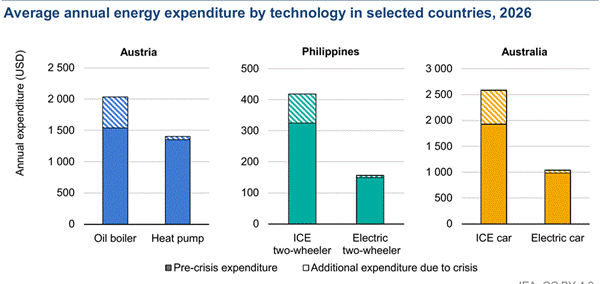
Figure 1. Average annual energy expenditure by technology in selected countries, 2026, including oil boiler versus heat pump in Austria. Source: IEA (2026), Energy Efficiency 2026 (p. 25). IEA. CC BY 4.0.
Sales and trade respond to higher fossil fuel prices
There are early signs that the crisis is accelerating adoption. According to the IEA, residential heat pump sales rose by 11% year-on-year across 12 European countries in the first half of 2026, with growth of 40% in Germany and 15% in France (p. 28). The IEA notes that this reflects prior policy support and underlying market trends, further accelerated by rising gas and oil prices (p. 28). Heat pump applications reached record levels in France, Germany and the Netherlands in the first half of 2026 (p. 39). This mirrors the 2022 energy crisis, which spurred record growth in heat pump sales and building renovations across Europe (p. 43). Figure 2 shows the year-on-year change in heat pump sales in Germany, Poland and France (p. 28).
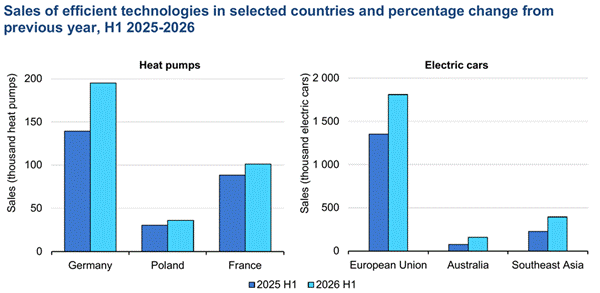
Figure 2. Sales of efficient technologies in selected countries, H1 2025 and H1 2026, heat pumps (left) and electric cars (right). Source: IEA (2026), Energy Efficiency 2026 (p. 28). IEA. CC BY 4.0.
A large share of the additional demand has been met through Chinese exports. In the first half of 2026, the value of China’s heat pump exports increased by 39% compared with the same period in 2025, with Europe representing just over 60% of total heat pump export value and driving most of the increase (p. 29). Figure 3 presents China’s export value of efficient technologies by destination (p. 29).
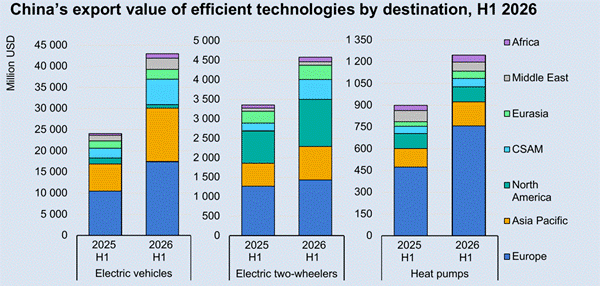
Figure 3. China’s export value of efficient technologies by destination, H1 2025 and H1 2026, including heat pumps. Source: IEA (2026), Energy Efficiency 2026 (p. 29). IEA. CC BY 4.0.
Policy support, retrofits and district heating
Announced spending on structural measures has focused on electrification, and the United Kingdom, for example, increased heat pump grants for homes heated by oil and LPG (p. 34). Demand for renovation support is rising: in Denmark, heat pump subsidy applications between March and September 2026 were nearly three times as high as in the same period of 2025, and in Germany applications for building envelope and heating system grants rose by 41% year-on-year (p. 61). In the Netherlands, applications under the ISDE scheme rose by 11%, while subsidy applications for heat network connections increased by 150% in the first half of the year (p. 61). Canada announced an investment plan of around USD 1.4 billion that includes heat pump rebates (p. 61). Figure 4 summarises renovation grant applications in four countries (p. 61).
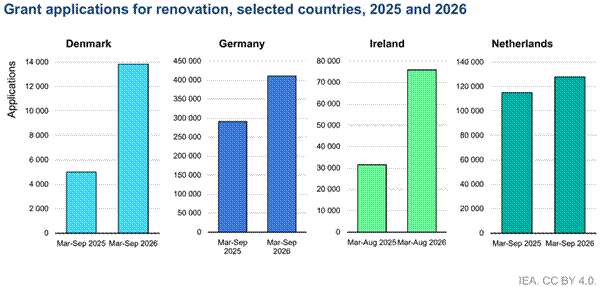
Figure 4. Grant applications for renovation in Denmark, Germany, Ireland and the Netherlands, 2025 and 2026. Source: IEA (2026), Energy Efficiency 2026 (p. 61). IEA. CC BY 4.0.
Regulation is also moving. California’s 2025 Title 24 update, effective from 2026, requires heat pumps in all new residential buildings (p. 57). The European Commission’s new Electrification Action Plan focuses on incentivising efficient electric technologies such as heat pumps to reduce exposure to fossil fuel price volatility (p. 44), and 37% of the USD 658 billion NextGenerationEU Recovery and Resilience Facility goes to climate policies including heat pump deployment (p. 98). Meeting the proposed COP31 buildings goal will require wider adoption of heat pumps, since buildings energy intensity is set to improve by only about 7% by 2035 under today’s policy settings (p. 56). The report also recalls how Sweden cut the share of oil in residential energy use from over 70% in 1970 to below 10% in 2024, a shift that gathered pace in 1974 with grants for energy conservation and the expansion of district heating networks, while Denmark’s 1979 Heat Supply Act accelerated district heating expansion (p. 42).
Industry, flexibility and skills
In industry, the IEA identifies industrial heat pumps as one of the efficient technologies with lower maintenance costs than their conventional alternative, gas boilers, and notes that for every dollar saved on energy, up to an additional 30 cents of value can be realised through wider benefits (p. 55). Heat pumps are also highlighted as demand-flexible appliances that can help balance electricity systems when they are demand-response ready and interoperable (p. 67), and as a digital end-use technology that can respond to time-varying price signals (p. 75).
Workforce remains a constraint. Employment in buildings efficiency, which includes heat pumps, remained stagnant in 2025 (p. 36), and recent boom-and-bust cycles in heat pump demand have led many installers to leave the sector (p. 39). Heat pump technicians feature among the key occupations in energy efficiency job postings, where 57% of advertisements in 2025 were for applied technical workers such as electricians and HVAC installers (p. 38). In the IEA Energy Employment Survey, 55% of respondents reported skills shortages in the energy efficiency sector (p. 39).
Links to the IEA HPT TCP
Several of the report’s themes are addressed by the ongoing collaborative projects of the IEA Heat Pumping Technologies Collaboration Programme (HPT TCP). Work on high-temperature heat pumps and on heat pumps in district heating and cooling supports the industrial and network applications discussed in the report. Project 62 on heat pumps for multi-family buildings in high-density cities, together with work on heat pumps for medium and shallow building renovation and on heat pump integration in positive energy neighbourhoods and districts, directly supports the retrofit and buildings goals highlighted by the IEA. Project 64 on the safe use of flammable refrigerants, work on low-GWP refrigerant applications, and Project 65 on heat pumps in a circular economy address the conditions for scaling deployment safely and sustainably. More information on ongoing HPT projects is available at Projects – HPT – Heat Pumping Technologies.
Looking ahead
The IEA concludes that 2026 could mark a turning point for energy efficiency if governments implement ambitious and regularly updated policies, provide sustained investment and clear policy signals, and make efficiency a whole-of-economy priority (p. 12). For heat pumps, the message is clear:
- the technology is ready, and the crisis has strengthened its economic case. Stable policy frameworks, a skilled installer workforce and continued international collaboration will determine whether today’s surge becomes a lasting transformation.
As the IEA observes, the 2022 energy crisis did not create new technologies but accelerated the adoption of existing efficient solutions, with heat pump sales in Europe reaching record growth (p. 43).
Source: IEA (2026), Energy Efficiency 2026, IEA, Paris. Licence: CC BY 4.0. The full report is available at https://www.iea.org/reports/energy-efficiency-2026