

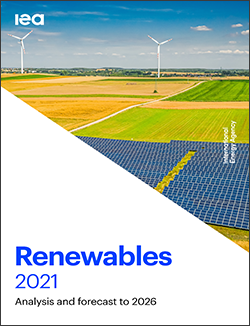
Release of IEA’s Renewable 2021 report
The report, released on December 1, shows that the world is set to add more renewable power capacity in 2021 than ever before. The record-breaking additions of 290 GW of solar, wind and other renewables are yet another sign that a New Global Energy Economy is emerging, according to their analysis.
New analysis from IEA expects renewables to account for almost 95% of the growth in global power capacity through 2026, with solar PV alone providing more than half. This is driven by stronger support from policies and more ambitious pledges made going into just before the COP26 meeting.
Moreover, the report states that “the rising share of renewables in the power sector and heat pump deployment are the main drivers of renewable heat growth in buildings”.
This year’s edition also includes a chapter on renewable energy trends to watch, including for example:
Are renewable heating options cost-competitive with fossil fuels in the residential sector?
This article summarizes the parameters affecting the cost-competitiveness of heating technologies for different renewable heating technologies such as heat pumps, bioenergy and solar heating. It is clearly seen that these parameters differ from region to region primarily due to market maturity, energy prices and the policy landscape. Along with the article, IEA also launched a Residential heat economics calculator allowing users to explore and compare the economics of different residential heating systems, including varying different parameters. The concluding remark in this article is that scaling up the use of renewable heating in buildings requires policymakers to address economic as well as non-economic challenges through comprehensive and multidimensional policy approaches. These can, according to the article, potentially include a combination of awareness-raising campaigns, regulatory measures and economic incentives, which ‒ most importantly ‒ should place social justice at the heart of the transition.
Read the press release here.