

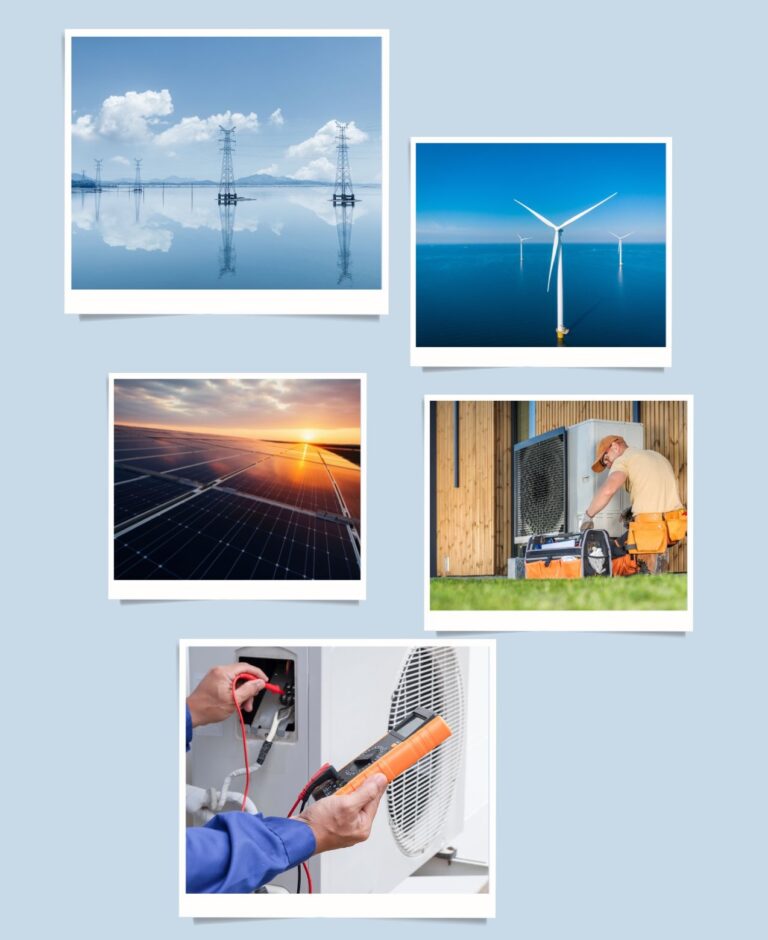
The AccelerateEU Communication sets out the European Commission’s response to renewed energy price shocks and fossil fuel dependency, combining short‑term, targeted and temporary consumer protection with accelerated action to strengthen a clean, electrified and resilient EU energy system. Heat pumps are presented as a core electrification technology to rapidly reduce fossil fuel dependence, lower energy bills, and stabilise the energy system.
The Commission presented a comprehensive plan of actions and measures on 22 April 2026 in the AccelerateEU Communication to address rising energy costs and further reduce dependency on volatile fossil fuel markets due to the escalating Middle East conflict. The objective is an energy union that delivers energy security and clean, abundant and home‑grown energy that is affordable for EU consumers and businesses.
It calls for:
- intensified EU coordination
- rapid deployment of home‑grown clean energy (renewables, nuclear, heat pumps, geothermal, biomethane)
- faster electrification across buildings, transport and industry
- major grid and storage upgrades
- large‑scale mobilisation of public and private investment
This strategy is complemented by compiling concrete, replicable national measures and good practices covering households, buildings, industry, transport and agriculture, with a strong focus on affordability, efficiency and demand reduction.
The AccelerateEU Communication emphasises that crisis relief must reinforce, not delay, the clean energy transition while reducing vulnerability to global fossil fuel markets. Overall, the Communication frames energy security, affordability and competitiveness as inseparable from faster decarbonisation and system transformation.
Overall role of heat pumps in AccelerateEU
Heat pumps are presented as a core electrification technology to rapidly reduce fossil fuel dependence, lower energy bills, and stabilise the energy system, especially during price and supply shocks. AccelerateEU positions heat pumps not only as a household solution, but also as a system-level lever that supports demand flexibility, grid efficiency and clean industrial heat when deployed at scale.
Heat pumps in buildings
Heat pumps are identified as one of the fastest ways to cut fossil fuel use in buildings, with the Communication stating that replacing gas and oil boilers with heat pumps can halve final energy consumption in buildings over time.
The Commission highlights the need to increase annual heat pump deployment from around 2.4 million units today to roughly 4 million units per year by 2030 to deliver both affordability and security benefits.
Member States are encouraged to accelerate deployment through fiscal incentives, grants, social leasing schemes and VAT reductions, especially for vulnerable households. Heat pumps are listed among priority technologies for immediate relief, especially in buildings.
From a system perspective, heat pumps in buildings are linked to:
- Electrification of heat demand, reducing exposure to fossil fuel price spikes.
- Demand-side flexibility, especially when combined with thermal storage, smart controls and dynamic pricing, helping reduce peak loads and system costs.
Heat pumps in industry
AccelerateEU highlights industrial heat pumps as a key solution for:
- Delivering process heat up to around 200°C.
- Upgrading low-temperature heat and enabling waste heat recovery in industry and district heating networks.
- They are positioned as particularly relevant for sectors where full electrification is feasible or where waste heat is currently underutilised.
The Communication calls for targeted financial incentives, innovative financing schemes and ESCO models to accelerate deployment of industrial heat pumps and other electrification solutions.
Heat pumps in district heating and energy system integration
AccelerateEU identifies large heat pumps in district heating and cooling systems as a strategic asset for:
- Replacing natural gas in heat networks.
- Providing system flexibility via thermal storage and power‑to‑heat solutions.
- Enabling large‑scale waste heat recovery from industry and other sources.
Expanded district heating combined with large heat pumps is highlighted as a way to achieve significant natural gas savings while strengthening grid integration of renewables.
Manufacturing of heat pumps, competitiveness and EU value chains
The Communication notes that more than two thirds of heat pumps installed in Europe are already produced in Europe, framing heat pumps as a strategic clean‑tech manufacturing opportunity. Predictable and rising demand resulting from AccelerateEU measures is expected to:
- Encourage manufacturers to scale EU production capacity.
- Support skills development and employment in clean energy value chains.
Summing up
In the AccelerateEU Communication heat pumps are treated as:
A short-term crisis tool (rapid deployment, boiler replacement, consumer protection), but also a medium- to long-term structural solution for electrification, efficiency and resilience.
Moreover heat pumps are highlighted as a system technology, not just an appliance, interacting with grids, flexibility markets, storage and district heating. Their deployment is consistently framed as essential to delivering affordable energy, reduced fossil fuel imports, and a more robust EU energy system.
The Communication elevates heat pumps from a sector‑specific efficiency technology to a system‑critical infrastructure solution, spanning buildings, industry, district heating, grid flexibility and EU manufacturing. The Communication links fast heat‑pump deployment directly to energy security, price stability and industrial competitiveness, and it also shows how Member States can implement this immediately using fiscal, social and regulatory tools. In contrast to earlier frameworks, heat pumps are no longer optional or incremental. They are treated as indispensable for both crisis response and long‑term Energy Union resilience.
Activities within HPT TCP linked to the EU plan
The Technology Collaboration Programme on Heat Pumping Technologies (HPT TCP) by the IEA supports the implementation and realisation of this EU plan by working on a number of international collaboration projects in which research, development and demonstration are performed in several of the highlighted areas, for example:
During the 15th IEA Heat Pump Conference, which will take place in Vienna at the end of May, the HPT TCP will organise a workshop on the theme Breaking Barriers – Accelerating Heat Pump Deployment to discuss with different stakeholders which further measures need to be taken to accelerate deployment. Welcome to join. Register for the conference here.