

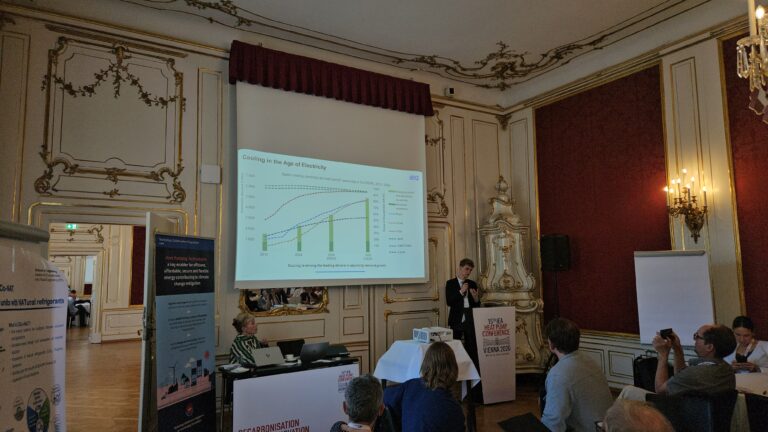
Space cooling is becoming one of the fastest-growing sources of energy demand in buildings. Rising temperatures, more frequent heatwaves, growing incomes and changing expectations for indoor comfort are all increasing the need and demand for cooling across the world. This challenge was the topic of the workshop “Comfort cooling concepts for different types of climates and regions” held during the 15th IEA Heat Pump Conference in Vienna.
Cooling-driven electricity peaks can put pressure on affordability, reliability and grid capacity if efficient technologies and smart system solutions are not deployed at scale. So the challenge is clear: efficient, affordable and climate-adapted comfort cooling needs to support resilience, decarbonisation and better energy-system integration.
This was the starting point for the workshop Comfort cooling concepts for different types of climates and regions, organised by the Heat Pump Centre in collaboration with a team from ZHAW School of Engineering, IEFE Institute of Energy Systems and Fluid-Engineering, Switzerland. The workshop took place on 26 May 2026 during the first day of the 15th IEA Heat Pump Conference in Vienna. The motto for the conference was Decarbonisation through Innovation.
Cooling demand is rising — but so is the opportunity for innovation
The introductory presentations highlighted the scale of the global cooling challenge, but also the significant untapped potential for innovation. Axel Nordin Furdos from the International Energy Agency underlined that there is room for progress both in technologies and in business models, including approaches such as cooling-as-a-service that could help users access more efficient cooling solutions.
A key point was that air conditioners and heat pumps should increasingly be understood as closely related technologies. Reversible air conditioners can provide both cooling and heating, and their widespread use may create pathways for accelerating heat pump deployment in buildings. This makes comfort cooling not only a response to higher temperatures, but also part of a broader electrification and decarbonisation agenda.
From a European perspective, Johan Carlsson from the Joint Research Centre of the European Commission presented trends showing increasing cooling demand, while also noting large differences between Member States. The discussion also pointed to differences between income groups, as lower-income households can be more exposed to heat stress and less able to invest in efficient cooling solutions. EU-level directives and policy frameworks are therefore important enablers for sustainable cooling, particularly in view of rising temperatures and the characteristics of Europe’s existing building stock.
Regional perspectives: different climates, shared challenges
The panel discussion brought together perspectives from North America, Asia and Europe to compare comfort cooling needs across regions.
Panelists:
- Yunho Wang, University of Maryland, US
- Johan Carlsson, Joint Research Centre, European Commission
- LV Han, China Heat Pump Alliance
The panel participants noted that cooling demand varies significantly depending on climate, building types, policy conditions and local energy systems.
In China, for example, demand differs widely between regions, and heat pumps are increasingly relevant for both heating and cooling. Challenges discussed included installation quality, acoustics, lack of knowledge and the need for stronger policy support to ensure high-quality implementation.
In Europe, comfort cooling demand has not reached the same levels as in warmer regions, but it is growing. Heatwaves and the legacy of the building stock are making cooling a more pressing issue, particularly in buildings that were not designed for higher summer temperatures.
In the United States, increased cooling demand is also linked to broader electricity demand growth, in addition to the growth from data centres and digitalisation, which can place additional stress on the grid. The discussion also highlighted the need to move from high global warming potential (GWP) refrigerants to lower-GWP alternatives, while continuing to improve system efficiency.
Towards a new international collaboration project
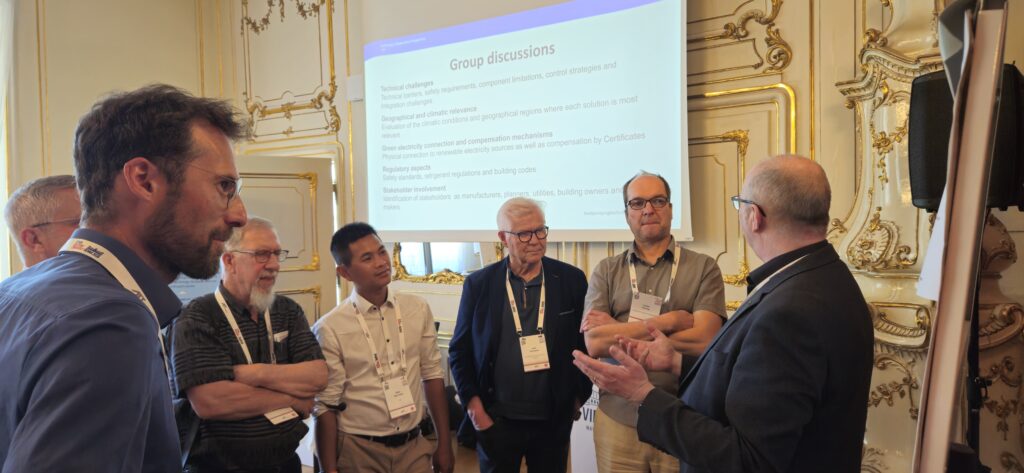
The second part of the workshop focused on the possibility of initiating a new international collaboration project within the IEA Technology Collaboration Programme on Heat Pumping Technologies and a proposal titled Comfort cooling concepts for different types of climates – CLImate-friendly COmfort units with focus on NATural refrigerants (CliCo-Nat) was presented by Frank Tillenkamp (till@zhaw.ch) from ZHAW. Participants divided into working groups to discuss potential focus areas, project tasks and barriers that need to be addressed.
Several themes emerged as priorities for future collaboration. These included making comfort cooling technologies greener through low-GWP refrigerants, improving energy efficiency, integrating cooling solutions with photovoltaics and energy storage, and using artificial intelligence for better forecasting, control and system integration. Participants also discussed the importance of developing innovative business models that can make efficient cooling more accessible and affordable, especially in contexts where high electricity prices create barriers for end-users.
Efficient cooling as part of the heat pump transition
The workshop showed that comfort cooling is not a stand-alone issue. It is closely linked to building resilience, electricity-system flexibility, refrigerant choices, affordability and the wider deployment of heat pumping technologies. While regions face different conditions and priorities, they also share many common challenges: how to provide thermal comfort in a warming climate while limiting pressure on energy systems and reducing environmental impact.
By bringing together international perspectives from research, policy and practice, the workshop contributed to defining possible next steps for collaboration within HPT TCP. The discussions confirmed the need for efficient, affordable and climate-responsive cooling concepts that can support both comfort and decarbonisation across different regions of the world.