

On 16 July 2026, the IEA HPT Project 62 team held its final webinar, drawing a line under three years of work on heat pumps for multi-family residential buildings in dense cities. Over roughly two hours, partners from across Europe presented what the project set out to answer, what the evidence now shows, and where the work goes next.
One idea ran through the whole session. For heat pumps in multi-family buildings, the problem is no longer finding a solution. The problem is choosing the right one. Or, as the closing put it: the question is no longer “can it work?” but “how can it scale?”
The audience reflected the project’s international reach: around 60 people from 20 countries across five continents. The participating countries were well represented, with Germany, France and Belgium among the largest groups, but interest stretched far beyond them, with sign-ups from Canada, the United States, Italy, Switzerland, the Netherlands, Sweden, Austria, Spain, Norway, the United Kingdom, Finland and Ukraine, and from as far afield as Japan, India, Indonesia, New Zealand and Brazil.
What Project 62 set out to do
Project 62 sits in a line of IEA HPT work on the heating transition in apartment buildings. Where the earlier Annex 50 asked which solutions are theoretically possible, Project 62 asked which of them actually fit real urban buildings, with all their constraints: limited space, noise restrictions, domestic hot water demand, split ownership, and a long list of stakeholders who each have to agree.
The team worked in a deliberately holistic way, letting a theoretical classification and real-world case studies refine each other. The classification framed practice, and evidence from the field reshaped the theory.
A shared language: the five solution families
A central output is a general classification that gives the sector a common vocabulary. Solutions are grouped into five families along a spectrum from whole-building to individual-room systems:
- A: one centralised heat pump system for the whole building
- B: a combination of central and decentral components
- C: a heat pump serving several apartments
- D: a heat pump for an individual apartment
- E: a heat pump for an individual room
Each family has several “members”, the real configuration variants seen in practice. One clear lesson emerged: reality kept reshaping the framework. Categories merged, new ones were added, and some were dropped entirely as case studies came in.
The country picture
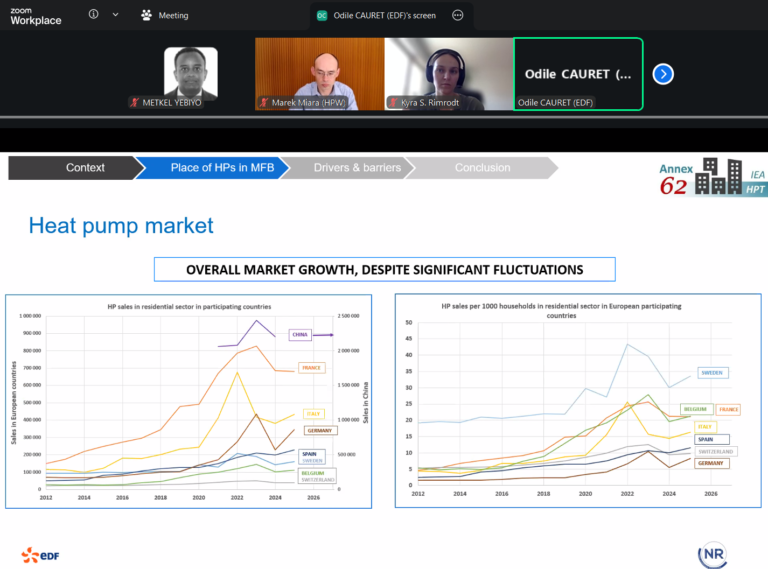
Odile Cauret (EDF) set out the context across the participating countries (Belgium, France, Germany, Italy, Spain, Sweden and Switzerland, alongside China). Multi-family buildings make up around half of the housing stock in the European participating countries and about 70 percent in China. Much of that stock is old: 55 to 65 percent of European multi-family buildings were built before the end of the 1970s and the first building codes. Energy performance is correspondingly modest, with final energy use generally between 150 and 200 kWh/m², and about 80 percent of it going to space and water heating (Spain being the exception on both counts).
Against that backdrop, gas and oil still dominate heating in most countries, with Sweden the standout thanks to district heating built on renewables. Heat pump markets have grown overall, though with sharp year-to-year swings. The barriers are familiar and stubborn: higher capital costs than gas boilers, unfavourable electricity-to-gas price ratios, a shortage of skilled installers, missing products for some configurations, and decision chains that can stall a project. The overall message: heat pumps are still not common in multi-family buildings, the market leans heavily on public policy, but the trend is positive and can be strengthened by raising the skills and awareness of everyone in the chain.
Evidence from the field: the case study database
Tom Schulz (HPW) and Nejma Hagen (ISE) presented the expanded case study database. Annex 50 left eight fully documented cases. Project 62 revised and added many more, and the database now holds 72 analysed cases drawn from around 100 case studies across 14 countries. The map has stretched well beyond western and central Europe to Nordic, eastern and Mediterranean countries, and into North America.
The cases confirm that heat pumps work in both new build and retrofit, with the split close to even (roughly 53 percent new, 47 percent existing). Centralised solutions dominate the sample (around three quarters), larger buildings of 21 or more apartments are well represented, and many of the buildings were already well insulated. Each case is captured in a standardised fact sheet. One worked example, an 85-year-old building in Cuxhaven, Germany, fully renovated with apartment transfer stations, shows the level of detail collected.
From matrix to tool: the Solution Finder
Simone Piovesan and Sara Bordignon (Clivet) presented the step from classification matrix to a practical Solution Finder. It is a high-level pre-planning tool that points a user toward a pool of suitable technical solutions based on the building’s characteristics, aimed at system designers, building owners, tenants and prospective heat pump adopters alike.
The tool scores solution families using a spider chart, chosen because it is flexible (new parameters are simply new axes), visual (differences are easy to read at a glance), and measurable (the area inside the chart gives a comparable score). Parameters include building size, insulation quality, system complexity, space requirements, fossil energy dependence and heat source flexibility. Testing through internal exercises and expert workshops, including a July 2025 exchange with Project 61, confirmed that the parameters separate the classes well, while also flagging honest limitations around participant familiarity and sample size.
Taking the work public
Marek Miara (HPW) rounded off with the project’s outreach: a dedicated website, close to 100 presentations in three years, and some less conventional formats, including “The Heating Transition” infographic colouring book. A workshop at the 15th IEA Heat Pump Conference brought around 60 participants into five stakeholder groups around a reference building, a 1968 block of 32 apartments with end-of-life oil heating in a noise-restricted, condominium setting. Each group weighted the project’s parameters differently, which sparked plenty of debate, but their recommendations converged on solution families A and B, matching the actual distribution in the database.
Real projects made the point concrete. An existing Geneva building of 53 apartments (4000 m² heated area) reached its target with two central heat pumps and no envelope renovation, moving it from class A.5 to A.1. In Flers, France, 112 compact exhaust-air heat pumps, one per flat with no outdoor units, illustrated the fully decentral D.1 end of the spectrum.
What comes next: Heat Pumps in Action
The work continues in a follow-up project, “Heat Pumps in Action”, starting this autumn. Its focus shifts from feasibility to scale, taking in cooling, costs, monitoring, new refrigerants and safety, collaboration with other IEA TCPs, more China case studies, and a further expansion of the database with clearer minimum-information rules for case providers.
The closing slide summed up the spirit of the whole project in three words: believe in facts.
For more information visit the project 62 website: https://heatpumpingtechnologies.org/project62/
The project materials, case study database and deliverables are available at www.heatpumpswatch.org. Contact: marek.miara@heatpumpswatch.org