

Soubeyran, Geneva
Heat pumps on exhaust air for Space Heating (SH) and Domesic Hot Water (DHW) in a very high performance multifamily building.
Lessons learned
- Heat recovery in new multifamily buildings, especially from ventilation, has the potential to cover a large part of their heat demand.
- While the use of heat pumps on exhaust air for the preheating of DHW is widespread, their use for combined DHW and SH production is much less known, results in a more complex system, for which standard solutions and hydraulic schemes need to be developed.
Key facts
| Building | Heat Pump and Source | ||
| Location | Geneva, Switzerland | Number of HP | 2 |
| Construction | 2017 | Installed power | 44 kWth |
| Heat distribution | underfloor heating | Operation mode | bivalent |
| Heated area | 4,607 m² (one block) | Heat source | exhaust air |
| No. of apartments | – | ||
| Level of insulation | high performance | ||
| Heating sytem | Domestic Hot Water | ||
| Heat demand | 35 kWh / (m²a) | DHW demand | 18 kWh / (m²a) |
| Heating temperature | 35 °C | Max. temperature | 60 °C |
| SH share | 38 % | DHW share | 34% |
| back-up heat production | gas boiler (125 kW) | Type of system | central |
| Circulation system | yes | ||
| Other information | |||
| HP share | 38% | COP | – |
| Gas boiler share | 62% | SPF | 3.28 |
| PV installation | 30 kWp | ||
| Ventilation | single-flow with heat recovery |
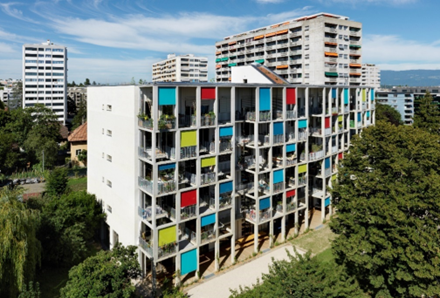
Located in Geneva and built in 2017 by two housing cooperatives, the building under consideration has a 4607 m2 heating reference area, which includes business premises on the ground floor and collective housing on the 5 upper floors. Its planned SH demand (18.6 kWh/m2/year) meets the cantonal “very high energy performance” standard.
Despite of the relative difference between planned and effective SH demand, which is a common situation, the SH demand of this building is close to the median of Geneva’s multifamily buildings constructed between 2011 and 2020.
In contrast, the DHW production turns out to be at the lower end of a benchmark on existing MFBs in Geneva.
Description of the technical concept
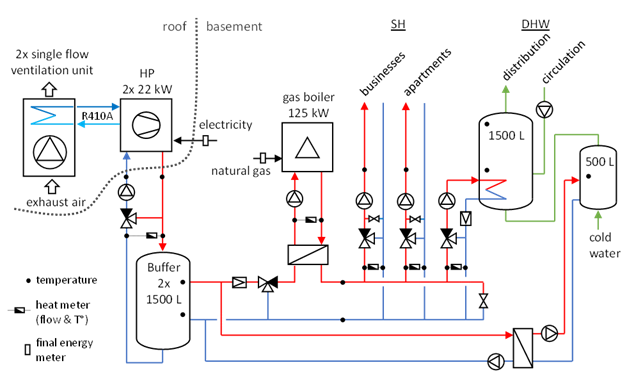
The heat production system consists of two exhaust-air HPs (2 x 22 kWth), which supply the underfloor SH system as well as DHW preheating, via common buffers. A condensing gas boiler (125 kW) ensures the complementary SH and DHW production. A 3-way valve allows to send the return flow from SH and DHW production directly to the gas boiler heat exchanger if its temperature is higher than that available in the accumulators, which happens when the gas boiler is in operation.
Heat recovery in new MFB buildings, especially from ventilation, has the potential to cover a large part of their heat demand. While the use of HPs on exhaust air for the preheating of DHW is widespread, their use for combined DHW and SH production is much less known.
In this case study, a HP system on exhaust air covers 38% of the heat production for SH and DHW of a new MFB, against a 61% projected value. Such discrepancy seems to be due to: i) a miss evaluation of the actual HP production / performance, as well as of the intrinsic HP temperature limitations in regard to DHW production; ii) a non-optimized hydraulic system, inducing unnecessary HP temperature degradation along the distribution chain.
While such solutions seem of interest for high energy performance buildings, and a fortiori when the DHW demand is lower than the potential heat recovery on exhaust air, it results in a more complex heat production and distribution system, for which standard solutions and hydraulic schemes need to be developed, and further monitoring in real condition of use needs to be done.
Final report: CALLEGARI, Simon Augustin, HOLLMULLER, Pierre (2023). Soubeyran 7 : pompes à chaleur sur air vicié avec valorisation pour le chauffage et l’eau chaude sanitaire, dans un immeuble d’habitat collectif de très haute performance énergétique à Genève.
Url: https://archive-ouverte.unige.ch/unige:169454

CH014 Soubeyran