

For the future-oriented heating / cooling concept, the soil conditions proved to be ideal for using the heat source “groundwater”. In any case, the area in the old branches of the Lower Rhine is, in this regard, extremely productive.
Two wells, each 18 meters deep, were drilled. The sump well was placed downstream of the sampling well, at a distance of 70 meters, in order to avoid mixing. 365 days a year – even on very cold winter days – constant groundwater temperatures between 8 and 12 ° C prevail at this depth. The delivery rate of the extraction well is a maximum of 60 cubic meters per hour. 18 hours a day, the groundwater may be deprived of energy.
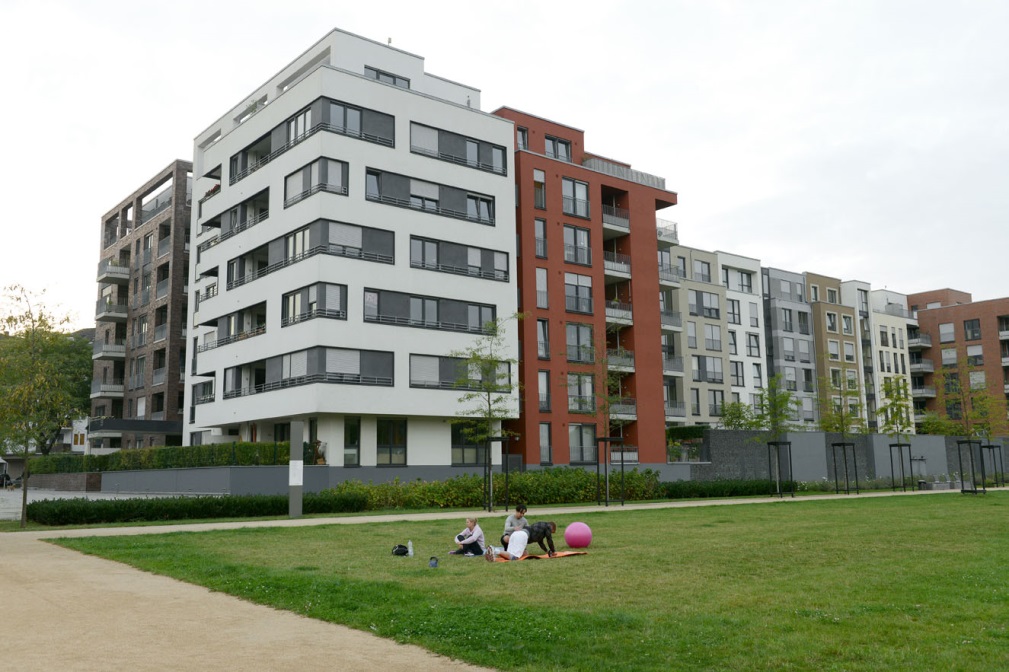
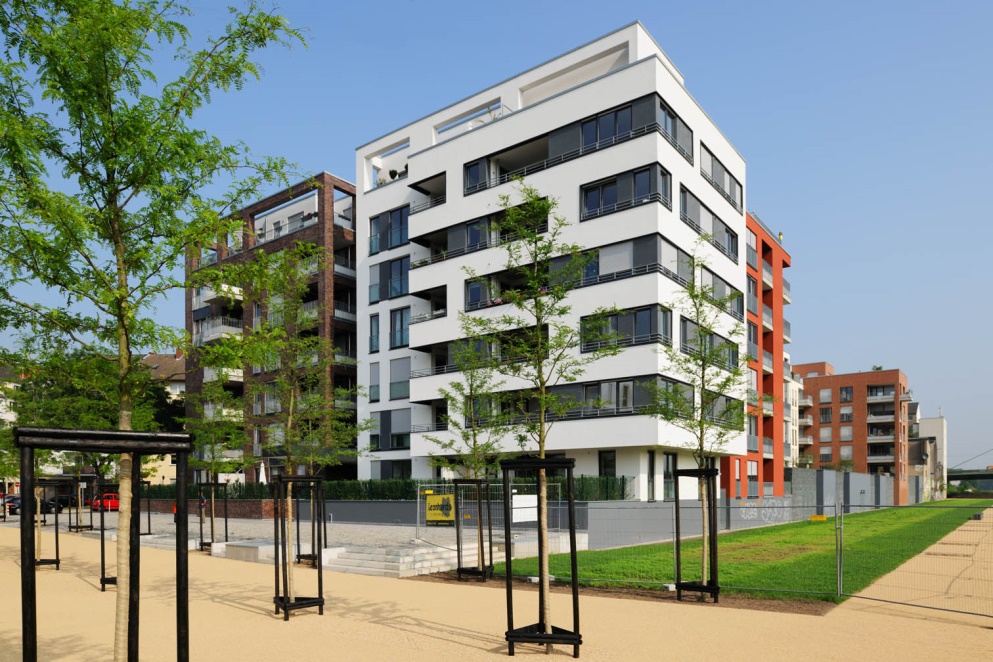
Key facts
| Building | Heat pump and source | |||
| Location | Düsseldorf, Germany | Number of HP | 4 | |
| Construction | 2009 | Installed power | 352W | |
| Heat distribution | panel heating | Operation mode | cascade | |
| Heated area | 10.200 m² living | Heat source | groundwater | |
| Heating system | Domestic hot water | |||
| Heat demand | 345 kW | Type of system | unknown | |
| Heating temperature | unknown | Max. temperature | unknown | |
| Circulation system | unknown | |||
| Other information | ||||
| Efficiency of the heat pump (SPF) | 4,5 | |||
| Investments costs | unknown | |||
| PV installation | no | |||
Description of the technical concept
The water is fed into the house via large, well-insulated pipelines and passes through four heat. Two brine-water heat pumps each are placed in a space-saving manner in the technical room of the basement, the entire system is cascaded. A control unit ensures that the operating hours of all four large appliances are almost identical. This is important to ensure a long service life of the system. The heat source is groundwater, which is made available to the four heat pumps via a large-scale DC link heat exchanger. Two storage tanks, each with a capacity of 1,000 liters, separate the heat generator from the heat distribution system and ensure efficient and trouble-free operation of the system.