

The project is part of a struggle against fuel poverty for reduced carbon footprints of over 700 homes. Up to date,
this program is the largest of its kind in the UK. Kensa Contracting and Together Housing Group installed heat
pump sources for 183 flats across three high-rise tower blocks, Daisyfield Towers, in Blackburn.
The Daisyfield Towers were heated by old and obsolete gas boilers, which Together Housing was keen to decommission and replace
with efficient and environmentally friendly Kensa heat pumps. The aim was to maintain the residents’ comfort and safety, save money
on heating bills, and move away from fossil fuel reliance.
The project is estimated to produce lifetime CO2 savings of 6,556 tonnes (based on SAP10 carbon factors). This equates to removing
1,416 cars from the road for a whole year, or 278,955 bags of waste being recycled instead of landfilled.
Lessons learned
- The £4.6 million (€5.2 mn) housing upgrade scheme proved the space saving potential of medium-depth boreholes
- Medium-depth boreholes of between 300 and 400m allow more pipe to be installed in the ground for the same amount of ground-level surface area, increasing the amount of energy absorption possible and creating a system that can sustain a higher heat load.
Key Facts
| Building | Heat pump and source | ||
| Location | Blackburn, UK | Number of HP | unkown |
| Construction | unkown | Installed power | 6kW (per hp) |
| Heat distribution | unkown | Operation mode | unkown |
| Heated area | unkown | Heat source | ground |
| Apartments heated | 183 | Technology | Shoebox GSHPs & SGLA |
| Level of insulation | unkown | ||
| Heating system | Other information | ||
| Heat demand | unknown | Refrigerant | R134a |
| Heating temperature | Up to 65°C | Subsidies | RHI |
| Water temperature | Up to 65°C | Previous heat source | Gas boilers |
| Project type | Retrofit, replacing gas | ||
| Boreholes | 84 deep boreholes | ||
| Coefficient of performance | 3.84 (for an individual Shoebox heat pump) |
Description of the technical details
The installation of Shoebox heat pumps & Shared Ground Loop Arrays
Individual Kensa Shoebox ground source heat pumps were installed inside each property, linked to a radiator system, which was upgraded where necessary. The Shoebox model is compact, quiet, and highly efficient; perfect for flats where space is at a premium, as it can be fitted inside airing cupboards or kitchen cabinets. Generating heat at the point of use, the system produces hot water temperatures up to 65°C for domestic hot water and is as quiet as an average fridge freezer.
The Shoebox heat pumps are linked to an array of shared ground loop boreholes drilled underneath the green spaces and car parks adjacent to the tower blocks. The system collects the energy from the underlying rock and distributes it at ambient temperature to the heat pumps, which is upgraded for use in the flats. It also heats communal areas within the tower blocks, and a ground-floor café.
Testing the potential for medium-depth boreholes
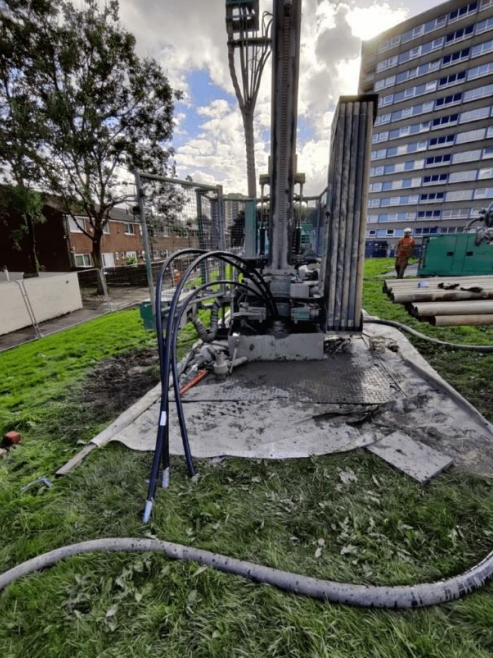
In total, 84 boreholes were drilled across the Daisyfield site, totaling 16,146m of boreholes. A combination of favorable ground conditions and
borehole configuration offered the opportunity to trial increasing drilling depths to 300m, as part of Kensa’s ongoing investigations into the viability of medium depth boreholes.
Projects are often ruled unsuitable if there is insufficient space to install the required number of standard depth boreholes (between 100 and 200m). Medium-depth boreholes of between 300 and 400m allow more pipe to be installed in the ground for the same amount of ground-level surface area, increasing the amount of energy absorption possible and creating a system that can sustain a higher heat load.
Kensa’s successful trials in this area could increase the percentage of both new-build and retrofit developments that are viable for ground source.

Case study delivered by: Team UK