

Positive Energy Building in Mediterranean Social Housing
New construction of 38 social housing units powered by centralized air-to-water heat pumps and renewable energy systems, within the EU-funded syn.ikia project.
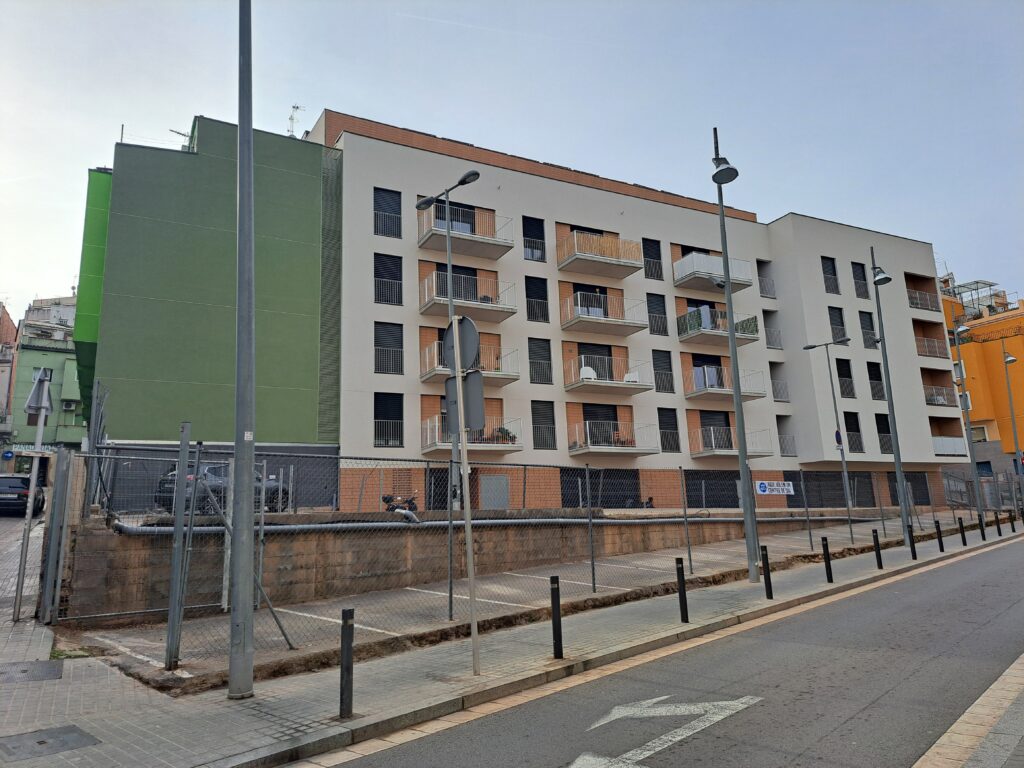
The building in Santa Coloma de Gramenet consists of 38 social housing units and has been designed to achieve a positive annual energy balance. It features a centralized air-to-water heat pump system that supplies heating and domestic hot water. Heat is distributed through vertical risers to individual hydraulic substations (LEAKO) located close to each apartment, which independently regulate domestic hot water and space heating via low-temperature radiators. These substations also provide hydraulic separation between the primary and secondary circuits, contributing to stable operation and individual control. This layout ensures thermal comfort, user autonomy and high system efficiency.
A photovoltaic installation with a total capacity of 19.8 kWp, integrated into the building’s rooftop, contributes significantly to covering the building’s common electricity demand and partially offsets the energy required for thermal generation. Alongside a high-performance building envelope with enhanced insulation and airtightness, the system minimizes energy losses and maximizes renewable self-consumption. Smart control and monitoring technologies support optimal regulation, fault detection and energy tracking over time, enabling a proactive management of the building’s energy performance.
The Santa Coloma project demonstrates that the application of Positive Energy Building standards is feasible in the context of affordable housing, under Mediterranean climate conditions. Its technical configuration offers a scalable and replicable model for future residential developments aiming to combine energy efficiency, renewable integration and social sustainability.
Lessons learned
- Centralized HPs with individual substations ensure comfort and efficiency.
- Positive energy design is feasible for social housing in warm climates.
- Problems and delays in initially setting up and commissioning all the centralized installation
| Buildings | Heat pump and source | ||
| Location | Santa Coloma de Gramenet, Spain | Number of HPs | 3 |
| Construction | 2023 | Operation mode | Monoenergetic |
| Project type | Newly built | Heat source | Air |
| Heat distribution | Low-temperature radiators | HP only/Hybrid | HP only |
| Heated space | 3420 m² | ||
| No. of apartments | 38 | ||
| Level of insulation | Very high (Positive Energy Building standard) | ||
| Heating system | Domestic hot water | ||
| Heat demand | 50 kWh/(m²a) | DHW demand | 25-30 kWh / (m²a) |
| Installed power | 150 kWth | Type of system | Centralized, with LG Hydrokit and individual substations |
| Heating temperature | 40-45°C | Max. Temperature | 65°C |
Description of the technical concept
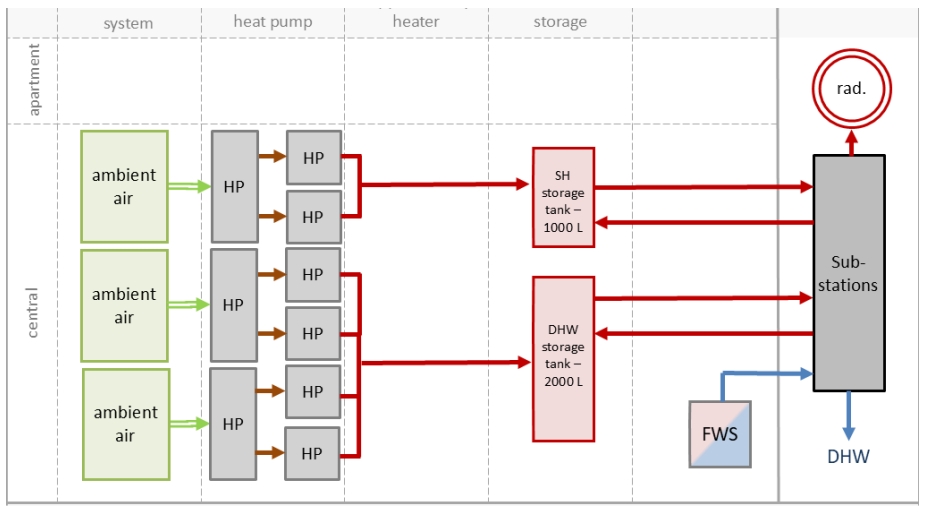
The heating system is based on three air-to-water heat pumps (LG Multi V, model ARUM180LTE5) operating with R410A refrigerant, each connected to 2 hydronic modules. Among those 6 modules, 2 are dedicated to space heating, feeding a 1000 liters tank, and the other 4 are dedicated to DHW, feeding a 2000 liters tank.
The two tanks centralize the heat storage in the machine room, and the hot water is then distributed through a 4 tubes system of vertical risers to the flats. Each dwelling is equipped with a LEAKO hydraulic substation, which enables independent supply of space heating and DHW. Space heating is delivered through low-temperature radiators, and DHW is delivered instantly through the heat exchanger of the substation.
The system includes individual energy metering for each dwelling, enabling consumption-based billing for both heating and DHW services. This configuration ensures transparency and promotes energy-saving behaviors among residents.
The installation is operational from the first half of 2025 and delivers heating and domestic hot water with high seasonal efficiency. Initial monitoring data indicate that the system performs in line with design expectations and contributes positively to the building’s overall energy balance. The approach implemented in Santa Coloma represents a good example of high energy standards for social housing in Mediterranean climate zones.

Case study delivered by: IREC – Catalonia Institute for Energy Research