

Riedberg, Germany
In August of 2015 the five-storey multi-family residential building (17 apartments) was commissioned. The all electric building is equipped with a 50 kWth electric brine-water heat pump that uses a total of 85 m2 of solar absorber in addition to an ice storage as heat source. The nZEB multi-family houses are located in the quarter of Riedberg in Frankfurt.
Key Facts
| Building | Heat pump and source | ||
| Location | Frankfurt a. M., Germany | Heating capacity/COP | 50 kW/4.5 |
| Building use | multi-family house | SPF heat pump (boundary COP) | 2.2 (4.5) |
| Energy ref. area | 1,600 m2 | ||
| Heating demand | 8.24 kWh/(m2a) | ||
| DHW demand | 10.63 kWh/(m2a) |
Technical Concept
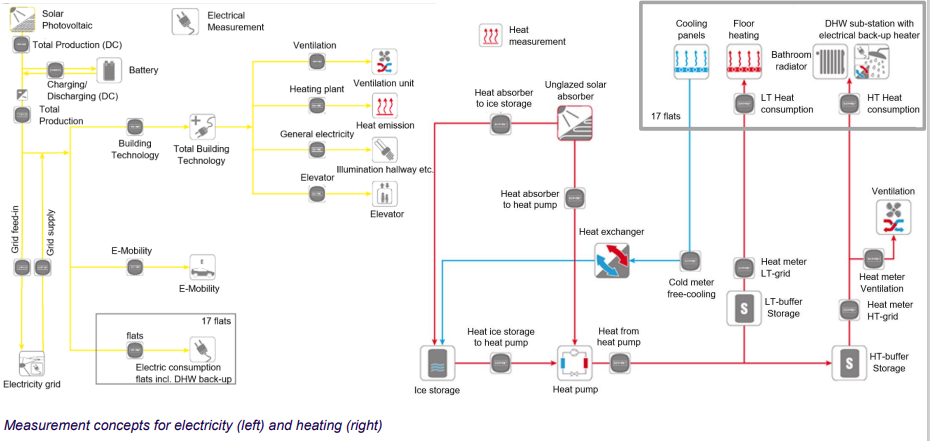
A photovoltaic system with an installed capacity of 99 kWp (84 + 15 kWp) was installed on the roof and the south façade. The PV surplus can be used to charge a lithium-iron phosphate battery with a nominal capacity of 60 kWh. The coverage of the additional electricity demand for household and technical equipment is guaranteed by a connection to the public grid. The use of solar energy is supplemented by a solar thermal system in form of solar air absorbers with an area of 85 m², which is installed under the PV modules. The provision of heat for the low-temperature floor heating system and hot water preparation (apartment transfer stations per apartment) is carried out by a brine-to-water heat pump. An ice storage of 98 m³ and the solar air absorber on the roof serve as the heat source. Depending on the temperature level and availability, the heat source is the solar thermal absorber on the roof or alternatively the ice storage tank. The regeneration of the ice storage takes place by the absorber and free cooling in the summer. There are two networks for the heat distribution in the building, a low-temperature net for the floor heating and a high-temperature net with a storage tank of 1,000 l. The high temperature net supplies the domestic hot water preheaters in the apartment transfer stations, the bathroom radiators and the heating register of the ventilation system.
Occurring ventilation heat losses in winter are reduced by a central mechanical ventilation system with heat recovery and the living comfort is to be increased by the system. The possibility of natural ventilation is always available.
More elaborate information can be found on the factsheet of the Annex 49:
