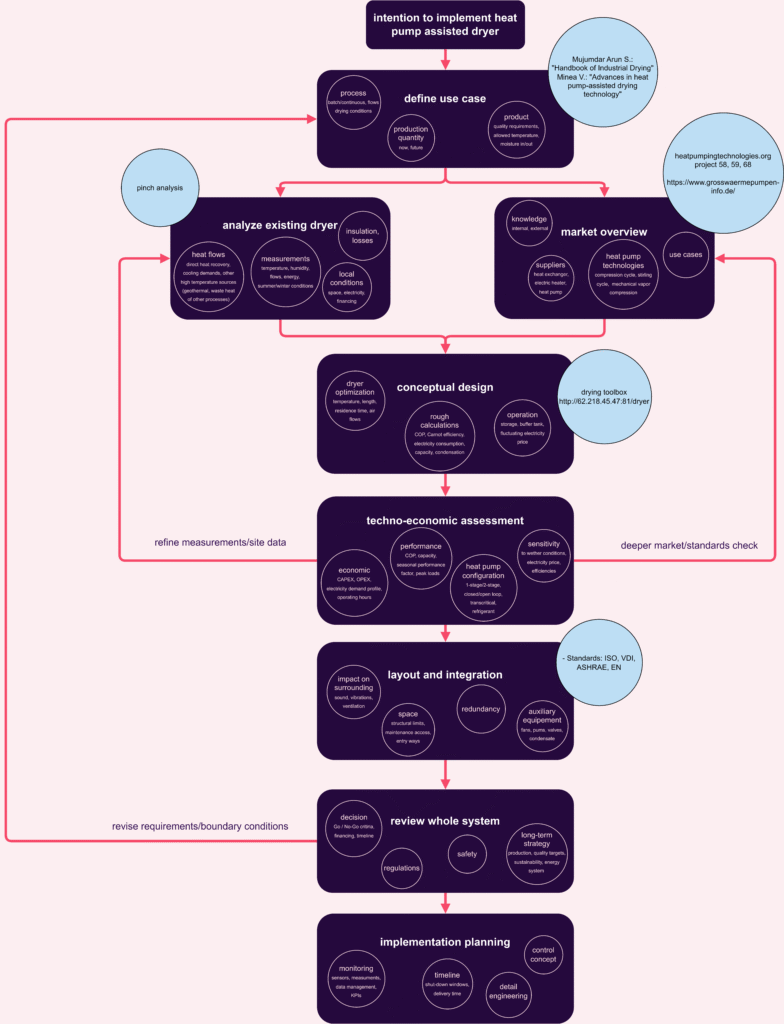
Heat pump-assisted drying systems are highly energy-efficient alternatives to conventional thermal dryers. They are therefore increasingly attractive for industrial applications. Several companies are already demonstrating its effective use. See the case studies compiled by the Annex 59 project team for the food, feed, ceramics and biomass sectors.
By recovering and reusing latent and sensible heat from the drying exhaust air, such systems can significantly reduce energy consumption and CO₂ emissions and, under favorable financial and regulatory framework conditions, also lower operating costs.
However, integrating a heat pump dryer into an existing industrial drying process is a complex task. It requires a structured assessment of technical and non-technical factors such as e.g., temperature requirements, air and moisture balances, available waste heat streams, space and interfaces, control strategy, operating profile, or electricity tariffs.
To support the decision-making process, the Annex 59 team has developed a brief procedural guideline. It is designed specifically for industrial end-users and provides step-by-step orientation from the initial use case definition to implementation planning.