

TRANSPAC is the first industrial-scale transcritical high-temperature heat pump (HTHP) using a hydrofluoroolefin (HFO) refrigerant for drying applications. The 580 kWth HTHP demonstrator was installed at WEPA Greenfield in Château-Thierry, France, a paper-pulp production facility, as part of an innovation project led by EDF R&D and Dalkia Groupe EDF and co-financed by ADEME.
Heat pump demonstrator
The HTHP demonstrator was developed between 2017 and 2023 and has been in operation since April 2023, recovering waste heat for industrial process heating.
The system operates with the HFO refrigerant R1234ze(E), which has a critical temperature of 109.4 °C (see the T–s diagram in the figure). Initial operating data confirms the expected performance at industrial scale. With a waste-heat source temperature of 70–80 °C, the unit heats the pulp dryer inlet air from 97 °C to 138 °C. Under these conditions, the measured COP ranges from 3.6 to 4.2, with an average COP of 4.0.
The figure below shows the integration concept for waste-heat recovery and drying-air heating using the transcritical HTHP. The accompanying photos illustrate the containerized equipment arrangement and the piston compressor applied in the system.
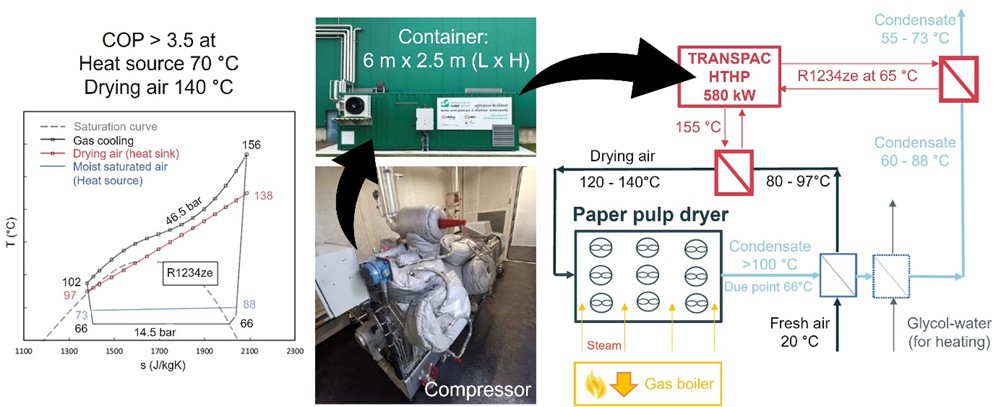
Figure: Concept for integrating the transcritical HTHP (Sources: Dalkia Groupe EDF (2024), EDF R&D (2024))
The underlying TRANSPAC technology originated from a 30-kW prototype developed at EDF R&D and MINES ParisTech (France), with financial support from ADEME. EDF patented the concept (EP 2880 379 B1, WO 2014/020255). The first-generation prototype used R32; a second-generation unit was subsequently developed using R1234ze(E) to preheat air up to approximately 150 °C (e.g., tunnel-drying applications) using waste heat at around 82 °C. Experimental testing confirmed technical feasibility.
In the prototype stage, commercially available CO2 components were adapted, including a semi-hermetic reciprocating compressor (Bock HGX2/90), an electronic expansion valve (Danfoss CCM10), stainless steel/aluminum finned heat exchangers as the gas cooler and evaporator, and synthetic POE lubricant. Efficiency enhancements were analyzed using an internal heat exchanger (+6% COP), parallel compression (+9% COP), and a combination of both (+12% COP).
Benefits
By replacing heat previously supplied by a gas boiler, the transcritical high-temperature heat pump offsets approximately 5 GWh/year of fossil heat. This corresponds to an annual reduction of roughly 1,000 t CO₂, based on an average COP of 4. Overall, the installation achieves an estimated ~75% reduction in energy use and CO₂ emissions for this heat demand. In addition, the specific CO₂ emissions are reported to be 16–20 times lower than those associated with natural-gas steam generation.
Applications
With supply temperatures in the range of 105–140 °C, the transcritical high temperature heat pump is applicable to many industrial sites with waste-heat sources between 60 °C and 90 °C. Typical target sectors include paper, food, chemicals, metallurgy, and textiles.
Drying applications include spray drying, evaporation, and distillation. Additional potential exists in starch production, wood pellets, tiles and bricks, technical nonwovens, pulp, and pet food.
Key facts
| Dryer type | Paper dryer |
| Drying product(s) | Pulp |
| Drying medium | Air |
| Operation | Continuous |
| Product conveying | Rolls |
| Heating medium temperature | 120 to 140 °C (drying air) |
| Heat sources | Humid exhaust air (condensate) from paper pulp dryer |
| Heat pump capacity | 580 kW |
| Flow temperature heat pump | 155 °C |
| Refrigerant | R1234ze |
| Drying time | n.a. |
| Start of operation | April 2023 |
| Capacity | n.a. |
| Dimensions | 6.0 x 2.5 (L x H) (container installed outdoor) |
| Outlet condition drying medium | 55 to 73 °C (condensate) |
| Direct heat recovery | Yes, fresh air preheating |
| Heat source for heat pump | Humid exhaust air (condensate), 60 to 88 °C |
| Challenges | Transcritical heat pump cycle, high temperatures, retrofit |
| Tracked parameters | Temperatures, COPs, specific energy consumption, specific air consumption, relative humidity |
More information
This information was provided by Cordin Arpagaus.
It was extracted from:
- C. Arpagaus, F. Bless, L. P. M. Brendel, D. Gstöhl, and S. S. Bertsch, “Wärmepumpen für industrielle Trocknungsprozesse,” 31. Tagung des BFE-Forschungsprogramms Wärmepumpen und Kältetechnik, 12. Juni 2025, Eventfabrik Bern, 2025. https://www.fws.ch/wp-content/uploads/2025/08/Tagungsband-31-Waermepumpen-Tagung_2025-06-12.pdf
- C. Arpagaus, F. Bless, L. Brendel, D. Gstöhl, and S. Bertsch, “Heat Pumps for Industrial Drying Processes – An Overview of Realized Case Studies,” in 15th IEA Heat Pump Conference, May 26-29, 2026, Vienna, Austria, 2026, pp. 1–11. [Online]. Available: https://hpc2026.org/
A video presentation by Dalkia (in French) provides additional detail on the project scope, integration concept, and operating experience.