

Bündnerfleisch is a traditional Swiss air-dried beef produced in the Canton of Grisons. It is made by several companies that are members of the Association of Grisons Meat Producers. The beef is dried at elevations above 800 m above sea level. Production requires high-quality raw material: approximately 5,000 tons of fresh beef are needed to produce about 2,500 tons of air-dried beef per year.
Production process
The meat is rubbed with a seasoning mixture of salt, pepper, juniper, bay leaf, allspice, garlic, ginger, and, in some cases, wine. It is then stored in brine for approximately 1 to 5 weeks, during which moisture is lost and seasoning aromas are absorbed. After curing, the meat is placed in a cotton bandage to prevent fraying and is pressed repeatedly—initially after curing and subsequently at regular intervals during drying—to remove liquid and obtain a uniform shape.
Drying takes place in several stages in air-conditioned rooms at 12–18 °C and 70–80% relative humidity, with controlled air circulation to ensure uniform dehydration. After drying, the meat undergoes a sweating phase at approximately 21–26 °C to allow the seasoning to develop. The overall process takes 3 to 6 months, during which the meat typically loses 45–55% of its original weight.
Heat Pump Technology & Heat Pump assisted drying
Brasser Kälte AG, based in Rhäzüns (Switzerland), is a proven specialist in industrial meat drying and has installed drying systems for numerous renowned meat producers.
The figure below shows the CO2 booster system with heat recovery and CO2 air/water heat pump as installed at Micarna SA in Tinizong (Grisons, Switzerland).The drying and refrigeration system is configured as transcritical CO₂ booster system. It supplies the entire facility with cooling and heating for the deep-freeze area, as well as for chilled storage, cold rooms, and drying rooms. Key specifications are as follows:
- Total cooling capacity: 200 kW
- Deep-freeze refrigeration: Direct CO₂ evaporation
- Chilled storage: Indirect cooling via a 34 % glycol-water system (-10 °C supply / -4 °C return)
Waste heat generated during CO₂ compression (330 kW usable) is recovered and used for:
- Process drying: +43 °C supply / +25 °C return
- Heating domestic hot water (DHW) and process hot water
If recovered heat is insufficient, an integrated CO₂ air/water heat pump (80 kW heating capacity) supplements heat generation. It uses ambient air via an external evaporator and supplies heat to the existing heating circuits.
The system is equipped with reciprocating compressors from Dorin: two units for the heat pump, one unit for deep-freeze operation, and four units for medium-temperature refrigeration. One compressor per stage is frequency-controlled (VFD), enabling flexible and energy-efficient capacity modulation. Demand-based gas cooler defrosting provides additional energy savings.
Typical performance values are an EER of 1.5–2 in cooling mode and a COP of 3–5 in heating mode.
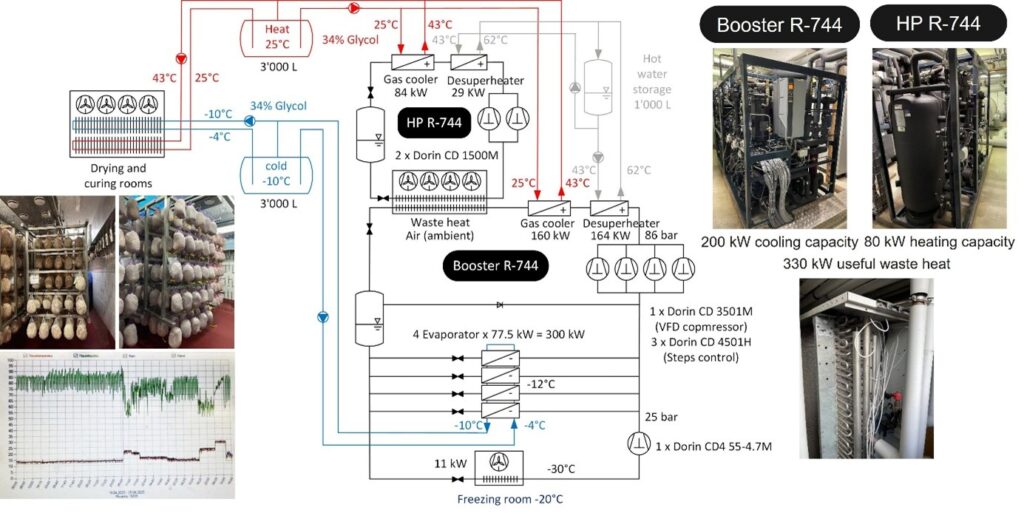
Figure: Sketch of the heat pump system installed at Micarna in Tinizong (CH). Manufacturer: Kältering AG / Enex srl (IT), plant engineer: Brasser Kälte AG (Photos: C. Arpagaus, 25 April 2025).
Key figures
| Dryer type | Meet dryer |
| Drying product | Air-dried beef (Bündnerfleisch) |
| Drying medium | Air |
| Operation | Continuous over several months |
| Product conveying | Air-conditioning rooms |
| Heating medium temperature | 43 to 25 °C (water-glycol mixture) |
| Heat sources | Waste heat from the gas cooler |
| Heat pump capacity | 80 kW (CO2 heat pump) |
| Flow temperature heat pump | 62 °C and 43 °C |
| Refrigerant | CO2 |
| Drying time | 3 to 6 months |
| Start of operation | 2020 |
| Capacity | 3500 kg/h water evaporation |
| Dimensions | 3.0 x 1.5 x 2.0 m (L x W x H) (CO2 booster & heat pump) |
| Outlet condition drying medium | 12 to 18 °C, 70% to 80% relative humidity |
| Direct heat recovery | Yes |
| Heat source for heat pump | Process cooling and waste heat |
| Challenges | Stable temperature control over several months of drying |
| Tracked parameters | Temperatures, COPs, specific energy consumption, specific air consumption, relative humidity |
More Information
This information was provided by Cordin Arpagaus.
It is an extract from C. Arpagaus, F. Bless, L. P. M. Brendel, D. Gstöhl, and S. S. Bertsch, “Wärmepumpen für industrielle Trocknungsprozesse,” 31. Tagung des BFE-Forschungsprogramms Wärmepumpen und Kältetechnik, 12. Juni 2025, Eventfabrik Bern, 2025. https://www.fws.ch/wp-content/uploads/2025/08/Tagungsband-31-Waermepumpen-Tagung_2025-06-12.pdf